


This past summer wasn’t a good one for the image of the Canadian Army, coming just after commitments were made by Prime Minister Mark Carney to increase Canadian defence expenditures to five per cent of the country’s gross domestic product by 2035. In quick succession this past July, Canadian soldiers were revealed to have engaged in internet chatter that was antisemitic, anti-immigrant, and misogynistic.
Early in the month, the Ottawa Citizen detailed reports of a now-defunct hateful Facebook group, the Blue Hackle Mafia, made up of members of The Cameron Highlanders of Ottawa (Duke of Edinburgh’s). It had some 200 participants espousing opinions seemingly opposed to everything that Canadian values are supposed to represent. Some Highlanders had also posted pictures of their genitals.
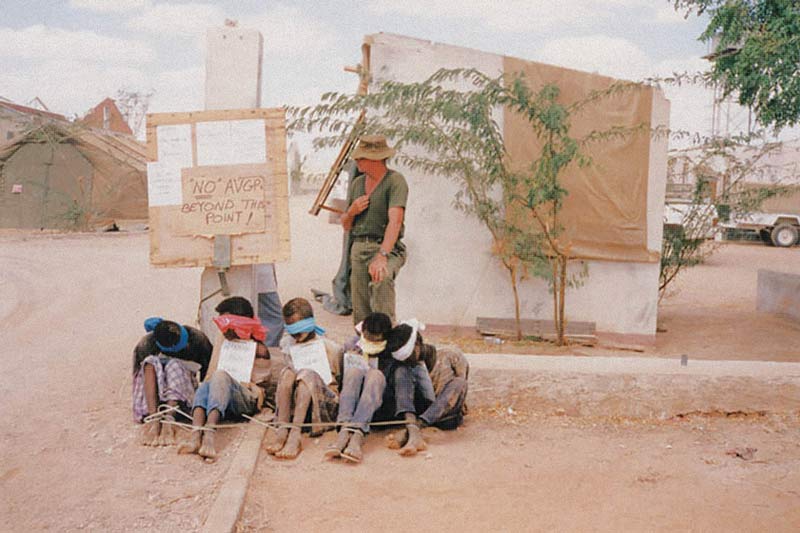
A member of the Canadian Airborne Regiment stands behind bound and blindfolded Somali civilians during a UN-backed humanitarian mission to the country in the early 1990s.[LAC/3604003]
Meanwhile, days later, the RCMP arrested four suspects—two of them active soldiers—for plotting an armed revolt aimed at taking territory in the Quebec City area and using it as a base for an anti-government militia. They had a stockpile of 16 explosive devices, 83 firearms and accessories, some 11,000 rounds of ammunition, 130 magazines and four pairs of night-vision goggles.
Once again, the media has revealed soldiers of the Canadian army who appeared racist, dangerous and armed. The stories are reminiscent of some from 30 years ago.
In the early 1990s, members of 2 Commando, Canadian Airborne Regiment (CAR) at Canadian Forces Base Petawawa in Ontario filmed themselves engaging in racist behaviour, destroying the car of an officer and using military pyrotechnics to celebrate drunken parties in the wilderness near the base.
In Canada, revelations of such abhorrent behaviour are typically followed by pledges at the highest level to crack down and take action. But it continues.
Sent to Somalia on a peace enforcement mission not long afterward, members of the unit killed several Somali civilians, including Shidane Arone, a teenager who had snuck onto the CAR base at Belet Huen, allegedly to steal helicopter parts for the black market. Two commandos beat Arone to death while he was in custody. This sparked the Somalia Affair, which embroiled the CAF in investigations into violent abuses in the military for almost a decade.
The problem with such behaviour is obvious: young men, armed by taxpayers, show racist and misogynist behaviour that demonstrates they’re a danger to other soldiers and to the Canadian public.
At least two recently completed studies—former Supreme Court justice Louise Arbour’s May 2022 report on sexual misconduct and University of Alberta political scientist Andy Knight’s February 2025 paper on white supremacy—revealed similar behaviour. These latest findings support several studies conducted after the killing of Arone that also found racist behaviour in the military before, and during, the deployment to Somalia 30 years ago.
Canada’s military isn’t the only one facing such challenges. Similar cases have arisen in Britain, Australia and the U.S. In Canada, revelations of such abhorrent behaviour are typically followed by pledges at the highest level to crack down and take action. But it continues.
Militaries have long enticed young men (and young women, too) who appreciate weapons, regimented discipline and adventure, and who sometimes behave in ways that would otherwise be unacceptable in civilized society. So, what can be done about it?
First, use testing to filter out as many of these individuals as possible, but understand that some will get through. From there, high command—all the way up to the minister—needs to treat these problems as seriously as any other the military may face. And never stop examining what goes on in the ranks.
Next, provide strong and continuing leadership in these matters—never relent. In his report, Knight suggested that the recruitment pool needs to be widened to include far more non-white Canadians.
Finally, such behaviour must be subject to harsh penalties.
The army can follow the lead of professional sports. Several decades ago, Jim Bouton, a former pitcher for the New York Yankees and the Seattle Pilots, among others, wrote a memoir that revealed all sorts of terrible behaviour in Major League Baseball, including widespread use of drugs, racist behaviour and misogyny. Baseball, and subsequently other pro sports, eventually worked to reduce such behaviour and clean up their enterprises. They largely succeeded.
Surely there’s a lesson there for Canada’s military.
Read more on the Somalia Affair in David J. Bercuson’s 1996 book Significant Incident: Canada’s Army, the Airborne, and the Murder in Somalia.
Advertisement




David Bercuson’s article, Breaking Bad, raises legitimate concerns about misconduct within the Canadian Armed Forces, and no professional organization should ignore cases of racism, misogyny, or extremism when they appear. These behaviours are unacceptable and must continue to be addressed through strong leadership, transparent investigations, and appropriate consequences.
However, the article presents these incidents as reflective of the broader culture of the CAF, and that characterization is both inaccurate and deeply unfair to the tens of thousands of service members who uphold the highest standards of professionalism every day.
The CAF is one of the most diverse, disciplined, and scrutinized institutions in Canada. The overwhelming majority of members:
* serve their country with integrity,
* work in multicultural teams,
* respect the Code of Conduct,
* and perform their duties in demanding environments where trust and cooperation are essential.
Highlighting the worst behaviour of a very small minority without acknowledging the dedication and conduct of the vast majority paints a misleading picture. Isolated incidents should not be used to define an entire institution or tarnish the reputations of thousands of men and women who serve honourably.
Constructive criticism is important, but so is balance. Addressing problems requires accuracy, context, and fairness, not generalizations that risk damaging morale, recruitment, and public trust. The CAF has real challenges, like any large organization, but reducing it to a narrative of pervasive racism and misogyny does a disservice to those who sacrifice for this country.
Accountability matters. So does recognizing the professionalism and character of the many who uphold the values Canadians expect of their armed forces.
"It is not the critic who counts, not the man who points out how the strong man stumbled, or where the doer of deeds could have done better. The credit belongs to the man who is actually in the arena; whose face is marred by dust, sweat and blood; who strives valiantly; who errs and comes short again and again; who knows the great enthusiasm, the great devotion and spends himself in a worthy cause; who at the best, knows in the end the triumph of high achievement, and who, at worst, if he fails, at least fails while daring greatly; so that his place shall never be with those cold, timid souls who know neither victory nor defeat."
THEODORE ROOSEVELT
(Paris Sorbonne,1910)