

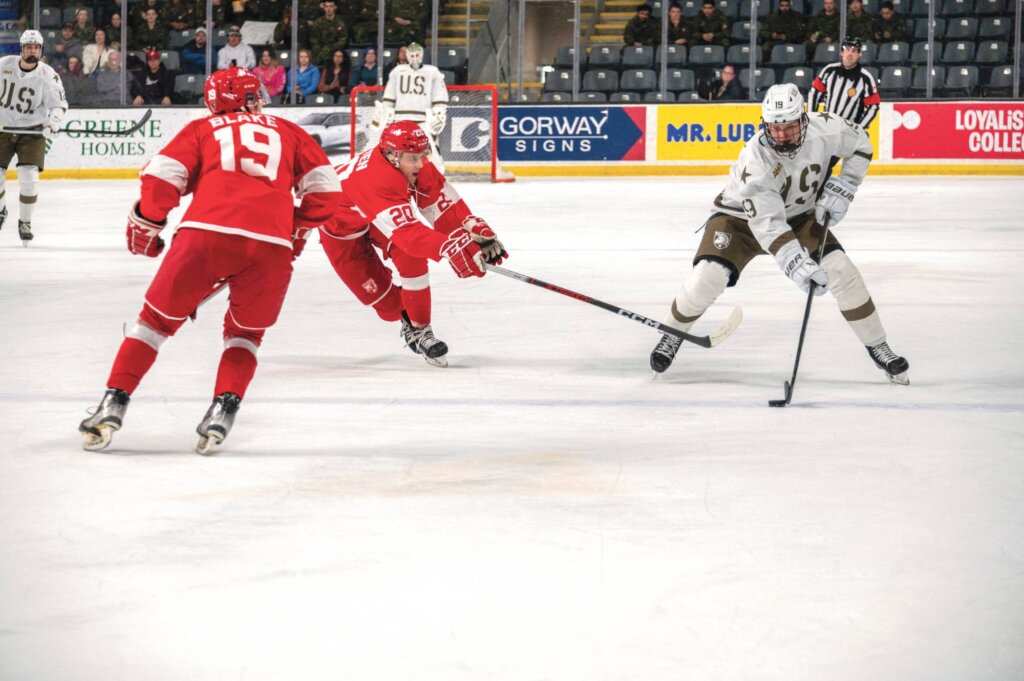
In one of hockey’s oldest rivalries, the Royal Military College of Canada plays against the United States Military Academy West Point in Kingston, Ont., on Feb. 1, 2025, for the 102nd time. [United States Military Academy West Point]
The story isn’t quite that straightforward, we should acknowledge. While hockey does indeed have roots in Indigenous games of stick-and- ball, it owes much as well to migrant imports: Scottish shinty, Irish hurling and various golf-like Dutch diversions. But isn’t that a Canadian story in itself?
However you want to frame it, hockey is (as the poet Al Purdy wrote) “a Canadian specific.” It’s our ballet and our murder (also Purdy). What else? Our Saturday night, our still-going-in-June, our common coin, not to mention the flag we fly and rally around, not least in times of tariffs and affronts from the superpower next door. Hockey is politics for us, and culture, too, and it skates into every aspect of Canadian life. The military and its heritage are no exceptions.
What is it that binds hockey so closely to soldiering? Lacrosse would seem to have, perhaps, a more direct lineage going back to the Indigenous game that was sometimes called the “Little Brother of War.” Rugby and North American football, meanwhile, have their militant focus on conquering territory. Still, if the aggressive urgency of hockey does seem more naturally warlike, the game’s weaponry may be the reason for that—its sticks, sharpened skates and body armour.
Hockey is politics for us, and culture, too, and it skates into every aspect of Canadian life, and the military and its heritage are no exceptions.
There is, of course, too, the battlefield confusion and desperate violence that hockey pantomimes, and the warrior values of bravery, perseverance and sacrifice that it honours.
When you look at the ways in which historical circumstances have aligned hockey and the military, there’s no avoiding the plain fact that both have traditionally drawn from the same demographic— young men—to fill their ranks.
Hockey’s physical demands and unrelenting vigour do seem custom-designed, in many ways, for training soldiers. There’s also no underestimating the importance of boredom as a bonding agent.
In 1825, hockey passed the time for men from John Franklin’s Royal Navy overland expedition into what today are the Northwest Territories, as they waited out the winter in Délįnę, on the shores of Great Bear Lake. Other early references to hockey spring from the long, wintry tedium of imperial garrison life in Canada.
It’s entirely possible that the men stationed at Fort Henry and the Royal Naval Dockyard at Kingston on Lake Ontario, were stickhandling there in the early 19th century, but it wasn’t until 1843 that one of the participants made a note of it. Arthur Freeling would rise to the rank of major-general and serve as surveyor-general of Australia but, as a young lieutenant with the British army’s Royal Engineers, he found himself in Kingston. “Began to skate this year,” he penned, “improved quickly and had great fun at hockey on the ice.”
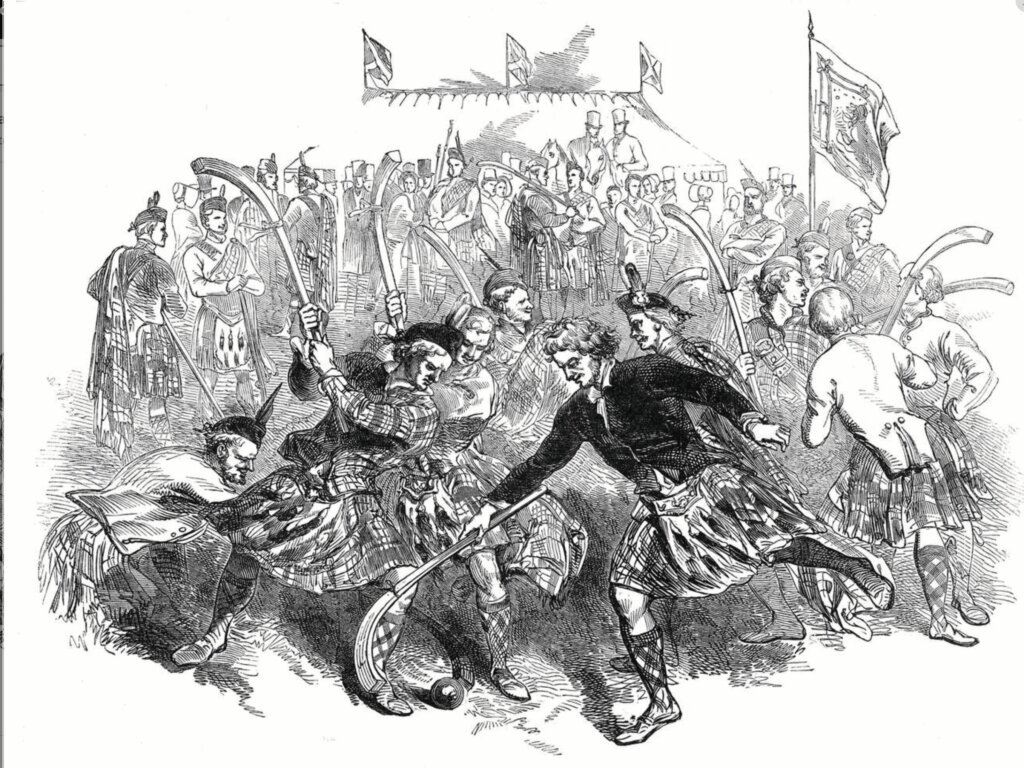
A game of Scottish shinty. [Chronicle/Alamy/2M3K8TD]
In Canada, hockey hadn’t yet taken enough of a hold in the 19th century to say that the tides at Cut Knife in 1885, during the North-West Resistance, or Paardeberg, South Africa, in 1900, during the Boer War, were turned by battalions shaped by hockey-playing devotions.
Still, the ideals of Muscular Christianity (intertwining spiritual and physical strength with civic duty), played important roles both in the evolution of hockey in these years as much in that of the country’s homegrown military establishment, particularly after the withdrawal of Imperial garrisons in 1871.
Founded in 1876, Kingston’s Royal Military College of Canada (RMC) would play a foundational role in that development. By no surprise, cadets were involved in 1886 when the city’s first recorded game was played on the harbour. Around that time, a little to the northeast, military attachés at Rideau Hall in Ottawa were taking up the game, too, helping to create the enthusiasm that would soon see their boss, Lord Stanley of Preston, donate what would become hockey’s most coveted trophy.
Major-General Archibald Macdonell was addressing a banquet audience of hockey-playing cadets in 1921 when he said: “Remember that a trained athlete and a true sportsman is practically a soldier in everything except the actual training and technical mental equipment. His sports have taught him that the worst epithet in the world that can be directly applied to him is that he is a ‘quitter,’ and not stick it. He has learned leadership of a high order, discipline, self-sacrifice, fortitude, resourcefulness under stress, i.e. the combined action of brain and muscle to the end that when an opening presents itself, he instinctively seizes it.”
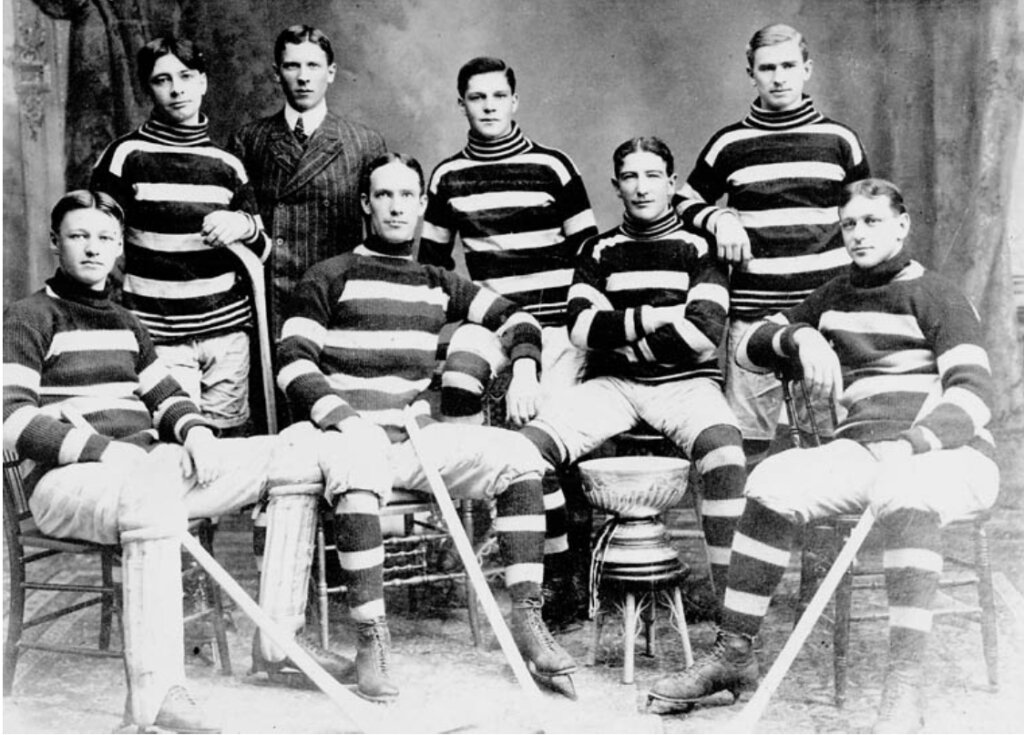
Frank McGee (standing, far right) and the 1905 Ottawa “Silver Seven” Stanley Cup winning team. Playing with one eye—the other lost in a 1900 benefit game to raise money for Boer War veterans and their families—McGee once scored 14 goals in a championship game. He was killed by artillery fire during the Battle of Courcelette in September 1916. [Thomas Patrick Gorman/LAC/PA-091046]
In the context of the social upheaval that the First World War entailed at home and the carnage it produced overseas, the synthesis of war and hockey remains an undercurrent. But at such an important time in the evolution of Canadian identity, there’s no overlooking it, either.
That the relationship was curing in real time is as clear to read as the words that adorn the walls of the Montreal Canadiens’ dressing room at the Bell Centre, still, more than a century after they were written by Lieutenant-Colonel John McCrae, the physician and poet, “In Flanders Fields”:
To you from failing hands we throw
The torch; be yours to hold it high.
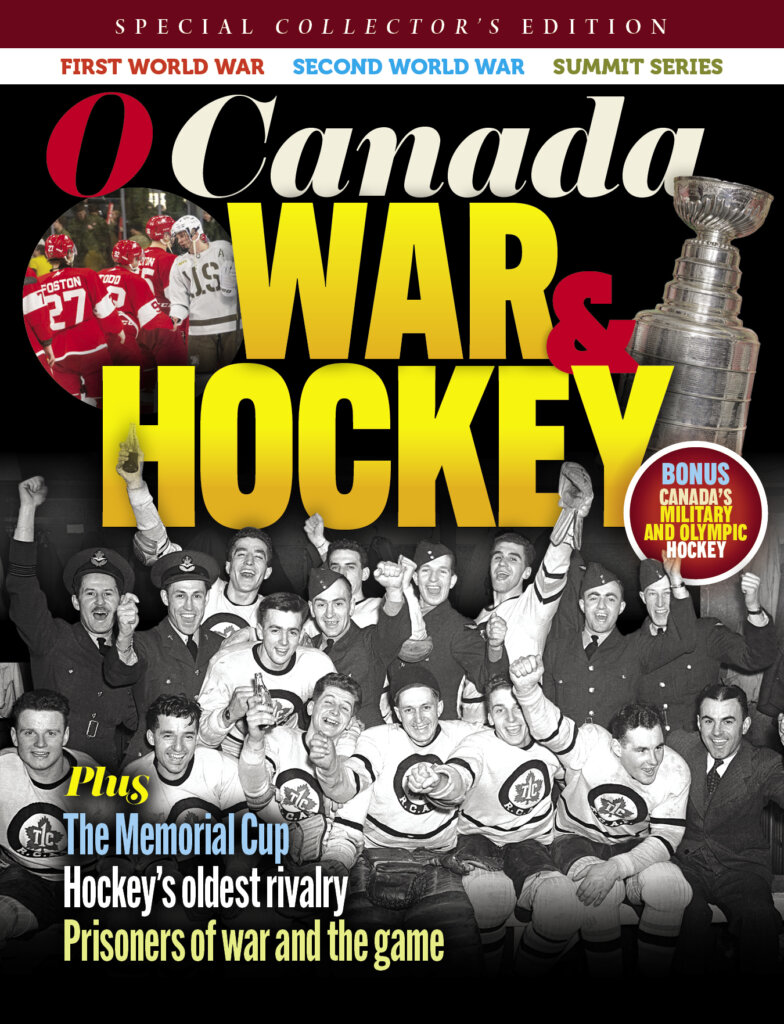
O Canada: War & Hockey is the latest issue of Canada’s Ultimate Story. [Canvet Publications Ltd.]
Advertisement