








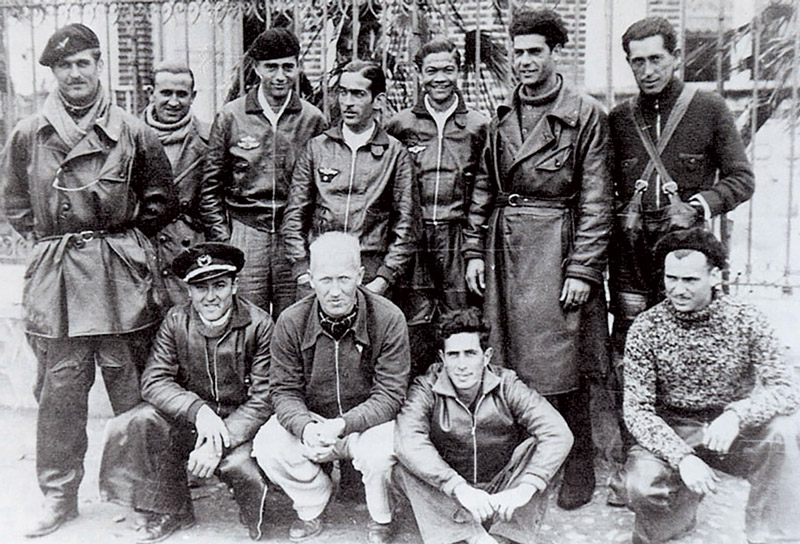
An aerial dogfight during the Spanish Civil War, circa 1937. U.S. pilot Harold (Whitey) Dahl (left, bottom centre) and the rest of the Republican squadron he served on in 1937, shortly before being shot down and captured by Franco’s Nationalists. [Wikimedia]
Things seemed to go from bad to worse for U.S. pilot Harold (Whitey) Dahl when he was captured by Spanish General Francisco Franco’s Nationalist rebels in 1937. A mercenary pilot after he was tossed out of the U.S. Army Air Corps the previous year, Dahl’s compulsive gambling habit prompted him to head overseas to join the Spanish Republic’s fight against Franco’s forces during the Spanish Civil War. There, he claimed five verified kills, and survived being shot down twice, before being captured and jailed. Shortly after, Franco sentenced Dahl to death by firing squad.
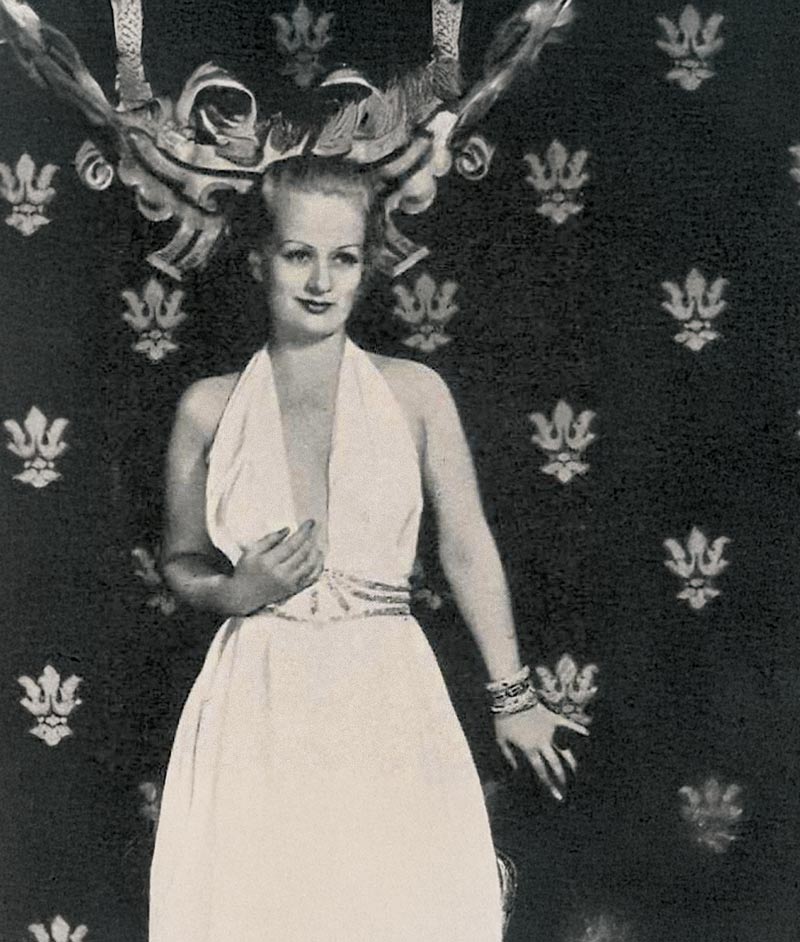
Incredibly, the ruthless dictator granted a reprieve after Dahl’s sweetheart, Swedish-American singer Edith Rogers, wrote to the generalissimo claiming to be Whitey’s wife and pleading for the release of her “husband.” Rogers, who had sung with Rudy Vallée’s band, included with her note a picture of herself in a low-cut evening dress. A letter came back from Franco, promising to spare Dahl’s life and ending with the old-fashioned Spanish salutation, “[the one] who kisses your feet.”
Fascinating, charming and resourceful, Dahl was never down for long when he was on the wrong side of the law. And he was there a lot.
After nearly three years in a Spanish prison, Dahl returned to the U.S. in 1940 and kept up the marriage hoax with Rogers for a brief period. Now celebrities, their improbable story was big news in U.S. newspapers. It inspired the Hollywood movie Arise, My Love, which won an Oscar for Best Writing, Original Story and earned three other nominations in 1941.

Dahl and Rogers’ story inspired a 1941 Oscar-winning film.[amazon.ca]
Fascinating, charming, and resourceful, Whitey Dahl was never down for long when he was on the wrong side of the law. And he was there a lot.
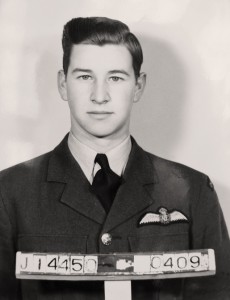
A few months after he arrived home, attracted by his hard-won 15,000 piloting hours, the Royal Canadian Air Force enlisted Dahl and 17 other experienced Americans as flight and air-to-air combat instructors. Stationed at RCAF Trenton in 1941, he met and married Eleanor Bone, a student at the Montreal School of Interior Design and the daughter of a former mayor of nearby Belleville, Ont.
Just days after their wedding, it was revealed that Dahl had never been married to Edith Rogers. That news drew a response from Rogers, who was booked at a vaudeville house in Salt Lake City as “The Blonde Who Spiked the Guns of General Franco’s Firing Squad.”
“I knew the lid was going to blow off this thing some day,” she said in Time magazine. “I’m the best damned woman violinist in show business, and I don’t need Dahl to sell a violin solo.”
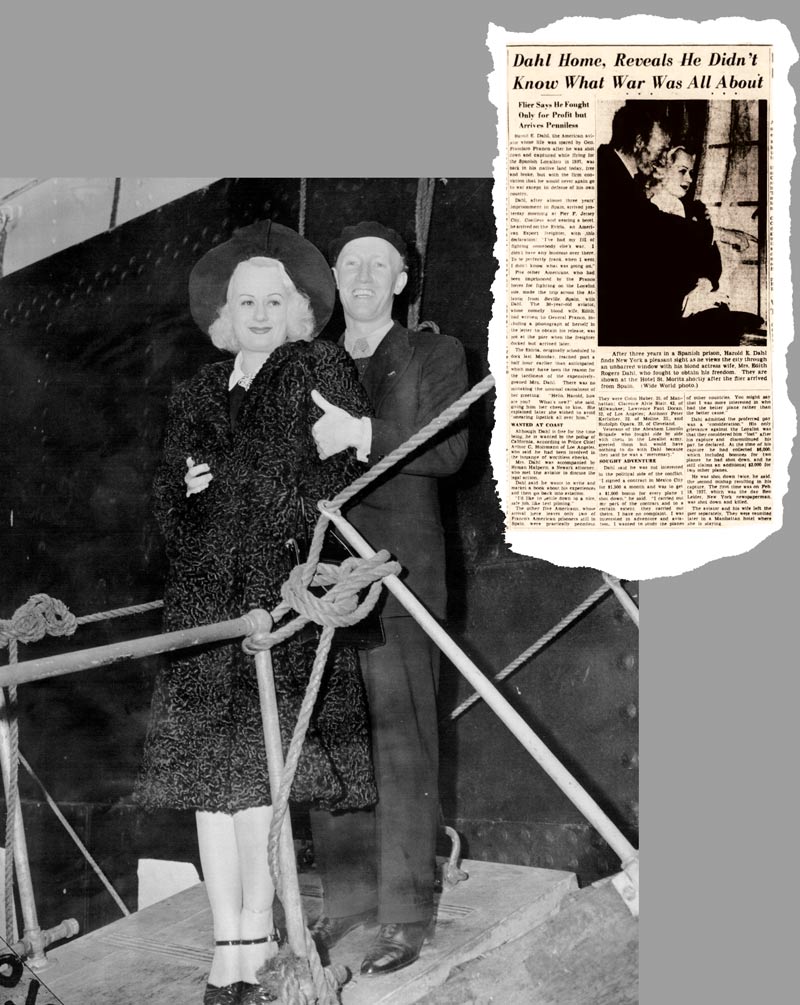
The daring photo (left) Edith Rogers sent to Franco in 1937 along with a letter pleading for the release of her “husband” Whitey Dahl caused a media storm. The pair became instant celebrities when Dahl returned to the U.S. in 1940.[SuperStock/Alamy/3CP731C; Brooklyn Eagle Archive 18 Mar 1940]
Shortly after his marriage to Eleanor, things turned sour for Whitey once again. In 1942, the RCAF posted him to Britain’s Royal Air Force Transport Command and he was stationed at Belém, Brazil. Charged and convicted on four counts of improperly disposing of aircraft equipment and other articles, and for conduct “to the prejudice of good order and air force discipline,” he was dismissed from the RCAF in April 1945.
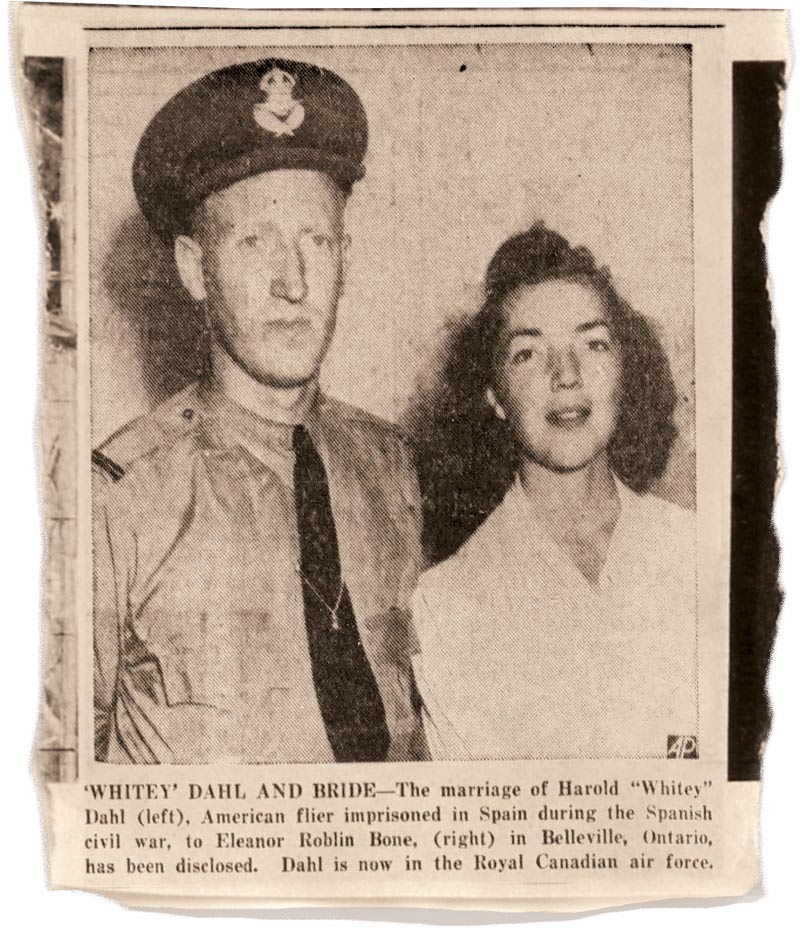
While stationed at RCAF Trenton as a flight instructor, Whitey Dahl married Eleanor Bone, revealing his first marriage had been a sham. [Toronto Telegram August 1941]
A few months after he arrived home, attracted by his hard-won 15,000 piloting hours, the RCAF enlisted Dahl and 17 other experienced Americans as flight and air-to-air combat instructors.
Yet by around 1951-52, Dahl had bounced back. With his wife and now three children in tow, he moved to Switzerland for a plum pilot’s job with Swissair. But he couldn’t keep out of trouble for long. In 1953, he was accused of stealing a gold bar worth more than $34,000 at the time that was being transported on his flight from Paris to Geneva. According to the evidence, Dahl had used the heist proceeds to finance an extended, high-end gambling spree with a new girlfriend, a Swissair stewardess. Found guilty, he was sentenced to two years and expelled from the country.
With this latest deceit, Eleanor had had enough. She divorced him, returned to Canada, took a typing and shorthand course, and raised two boys and a girl on her own. Her daughter would later be well-known to Canadians as the distinguished journalist and author Stevie Cameron. In a Toronto Globe and Mail article following her mother’s passing in 1997, Cameron wrote that after her father’s RCAF court martial, Eleanor tried hard to make the marriage work.
“A variety of mysterious flying jobs took my father to Caracas, Hollywood and Zurich,” she wrote. “In each city my mother would put her children in school and try to build a life, but she was puzzled by the odd acquaintances who turned up, men such as the CIA’s Allen Dulles and Richard Helms and nightclub owner Jack Ruby. Again and again, when Whitey would suddenly disappear, she’d dress her children in the middle of the night, leave everything she owned behind, and make a run for Canada.
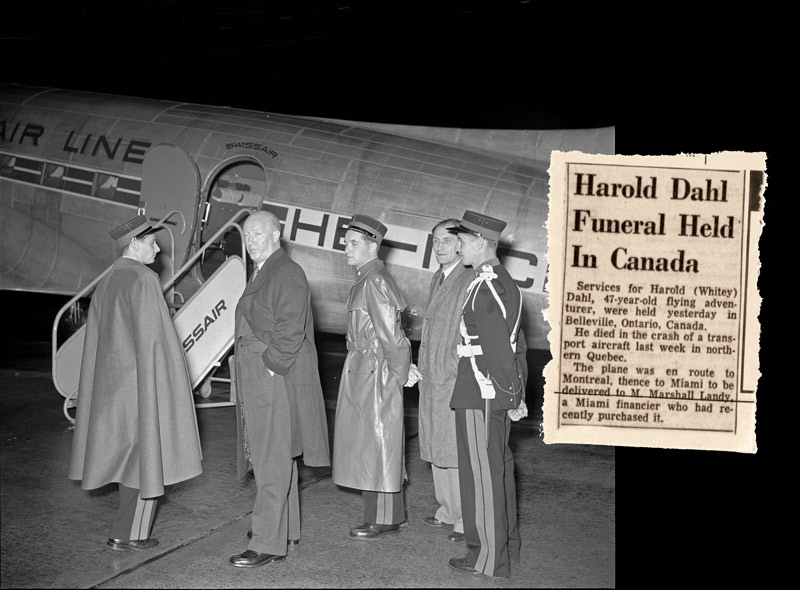
Trouble followed Dahl, convicted of stealing a gold bar on a Swissair flight he was piloting (centre). In 1956, Dahl died in a plane crash in northern Quebec.[Prisma by Dukas Presseagentur GmbH/Alamy/2SKDGAD; JLC/findagrave.com]
“The night my father and his mistress were arrested in Paris on the gold-smuggling charge, my mother pushed my two brothers and me into a taxi and moved under an assumed name from our Zurich apartment into a [boarding house]…until she could get us back to Canada.
“[She] assured us we’d be fine,” Cameron continued. “We were, although we never saw him again. Even though they’d separated (the mistress, not the smuggling charge, was the last straw), my mother spent the next forty years praising his wit and his courage.”
Out on appeal for the Swiss gold heist, Dahl returned to Canada in 1955 and became a bush pilot on the DEW Line, ferrying supplies to the series of radar stations being built in the Arctic to protect North America from Soviet bomber attacks during the Cold War. A spokesperson at Dorval Air Transport called him one of their best pilots, matching the often-dangerous Arctic flying conditions with his formidable skills.
One February day, Dahl got a moonlighting job to fly a rickety old Douglas C-47 one way from Frobisher Bay (now Iqaluit) to Fort Chimo, Que. (now Kuujjuaq), a distance of about 650 kilometres. It would be Whitey Dahl’s last flight.
The job paid $1,500 (about $17,000 today). However, the plane had no instrument panel and only a couple of functional engine gauges. Despite that, Dahl, who would have been capable of making the flight visually, took off with two passengers in good weather.
It isn’t known what happened. Thick and disorienting ice fog is common in winter in that region. The plane may have entered a thick patch and, without altitude instruments, there would have been no escape. That is the opinion, at least, of navigator Noel Funge who was aboard the RCAF plane that found the wreckage of the crash three days later.
“From the appearance of the wreckage, it is likely that in a low-altitude turn, the wingtip hit the snow-covered ice surface, and the plane crashed nose-first,” Funge, now 95, recalls.
According to Funge, Dahl and his mechanic co-pilot were killed on impact. The surviving passenger, Eric Pearson of Miami, told Funge that he had been in the rear washroom.
“When [Pearson] came to,” says Funge, “it was dark and as he had no flashlight, he felt his way forward until he realized there was nothing he could do for the pilot and mechanic, who were fatally enmeshed in the wreckage. In the morning, Pearson extricated the bodies, laid them out in the snow alongside the aircraft in a dignified fashion and set out an SOS in the snow, as well as burning oil that he extracted from the motors to make black smoke for the search aircraft.”
The bodies were loaded onto the rescue plane and flown south. Dahl is buried in Belleville, Ont., where he had married Eleanor, and just minutes away from the RCAF Trenton airfield where he had taught aspiring pilots.
Advertisement