







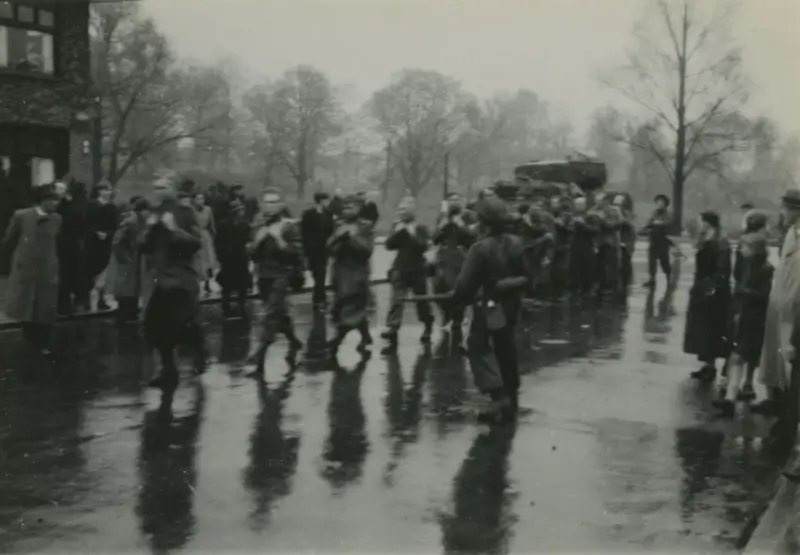
German prisoners are marched away after heavy fighting in the Noorderplantsoen, in the northwest corner of Groningen, Netherlands. [Beeldbank Groningen/Liberation Route Europe]
Street by street, house by house, canal by canal, the Canadians clawed a foothold into the Dutch city of Groningen. It was April 15, 1945, and despite the German defenders having ceded sizable swaths of urban terrain, the struggle within persisted.
Major-General Bruce Matthews, commander of the attacking 2nd Canadian Infantry Division (along with additional support elements), had finally recognized the stakes. There could be no bypassing Groningen lest its enemy garrison snatch at his heels from the rear. Nor could it be left behind when its 200,000 civilians yearned for liberation. There was only one answer: a full-scale divisional assault lunging into the city from multiple angles. And so, roughly two days into the battle, progress was being made—if not without sacrifice.
“The Germans have to defend everywhere,” explained Major Jayson Geroux, a Canadian infantry officer, urban operations instructor and urban warfare historian in a Legion Magazine exclusive. “If you have to defend everything, you defend nothing.”
In Part 1 of this interview, Geroux explored the initial phases of the fighting for Groningen. Here in Part 2, he draws it to its fiery yet largely forgotten conclusion.

Urban warfare historian Major Jayson Geroux. [CAF]
On 4th and 5th brigades on April 15
The Battle of Groningen by April 15, 1945, is really the fighting for both the old and new cities. 4th Brigade is largely left out of this battle. At this point, it has remained in the southwest corner of the old city, although The Essex Scottish regiment is tasked with watching the Germans in an electrical power plant that has been bypassed.
5th Brigade is in the west, where The Calgary Highlanders are right-forward. They clear a series of apartment buildings, the university and the naval barracks. There is German resistance, but the Canadians use good urban TTPs [tactics, techniques and procedures] to counter them with mortars. They also have these Wasp flame-throwers. The troops are on top of them with machine guns, shooting into a position so the Wasp can get closer and squirt that jet of flame into the German defensive positions, which works well. And so, the Calgarys are able to clear up to the ring canal on the west side of the old city.
The Black Watch is left-forward, toward the northern suburbs, and they advance toward the Noorderplantsoen, which is this huge park in the northwestern corner of the city. The funny thing is, as they advance, they’re just going up and ringing doorbells. Dutch civilians are opening their doors, and the Canadians are asking if there are any Germans inside. If they say yes, the Dutch are told to leave, and the Canadians go in. If there aren’t any Germans inside, these residents are normally pointing out other enemy positions. This doorbell ringing tactic is something I have never seen in urban warfare history before.
Meanwhile, The Black Watch clear the Reitdiep canal, over a viaduct, where they encounter some 20mm or machine-gun fire, so they bring up the tanks and destroy the guns. There are also Dutch civilians helping them cross the canals, which enables them to reach the Noorderplantsoen. There, they find German defensive positions, including slit trenches and bunkers within surrounding buildings. A two-hour exchange of gunfire breaks out, prompting The Black Watch to call up PIATs, mortars, six-pounder anti-tank guns, and Wasps for a large assault. The Germans are completely overwhelmed and withdraw from their positions.
Le Régiment de Maisonneuve, “the Maisies,” do a forward passage of the lines through The Black Watch and attack into the new city. They are able to make good progress, wherein they turn south and get up to the north side of the ring canal in the old city.
A Canadian Army newsreel details the Battle of Groningen.
On April 15 for 6th Brigade
At the same time, 6th Brigade is coming in from the southeast corner. Now, they cross the canals into the old city. The South Saskatchewan Regiment are left-forward, Les Fusiliers Mont-Royal right-forward and The Queen’s Own Cameron Highlanders of Canada in reserve.
The South Sasks slowly advance north. The streets are a little narrow, so tanks are a little difficult to use, but they clear up to the Vismarkt. It’s important to know that there are two markets in downtown Groningen: Vismarkt to the southwest and the Grote Markt to the northeast. The South Sasks clear the Vismarkt and get to the west side of the Grote Markt. Les Fusiliers Mont-Royal are beside them, still advancing right-forward. They take some fire from the other side of the canal as they work up the east side of the old city, but they eventually get to the Grote Markt as well. However, it’s impossible to cross it because of German defensive positions in the buildings on the other side.
They don’t want to do a frontal attack across a big open square because they will get mowed down, so they bring up the tanks from The Fort Garry Horse to fire away at the German positions.
So, by the end of the day, the western suburbs of the city have been cleared, the northern new city is occupied, the old city is cleared right up to the Grote Markt, and more than one-third of the German forces have surrendered. But there are still pockets of Germans northeast of the Grote Markt, inside the old city, which will lead to the final half-day of fighting on April 16.
On the German surrender
The German commander consolidates his positions east of the Grote Markt, but the Canadians intend to take the remainder of the city. 4th Brigade can remain in position; 5th Brigade is going to clear the new city and the suburbs to the north and east; and 6th Brigade is going to clear the remainder of the old city.
As 4th Brigade sits, its Essex Scottish regiment takes the surrender of the Germans at the electrical power plant. That’s all that 4th Brigade does on the 16th.
5th Brigade’s Maisies continue clearing the new city until they arrive at the ring canal. They are engaged by a gun, so they bring up the tanks and destroy it. Meanwhile, The Black Watch meets little resistance, clearing the entire north- and east-side suburbs and seizing canal crossings en route.
6th Brigade’s South Sasks, situated left-forward, clear the remainder of the west side of the old city. Les Fusiliers Mont-Royal, right-forward, clear the remaining positions within the Grote Markt and then east of the old city. They use tanks and mortar support to soften those positions before the infantry cross the Grote Markt square, seizing buildings off to the side. The Germans eventually withdraw to the north through the eastern portion of the old city toward the German headquarters.
An elderly woman points out to the Canadians where the German headquarters is—and where the Germans will soon surrender.
Before that happens, however, The Queen’s Own Cameron Highlanders still have a bit of a fight. They do a forward passage of the lines through Les Fusiliers Mont-Royal and cross into the eastern suburbs, where they engage some Germans at the Oosterhoogebrug bridge on the Van Starkenborgh Canal. With civilian assistance, the Canadians get across and force the German surrender, and that effectively ends the battle.
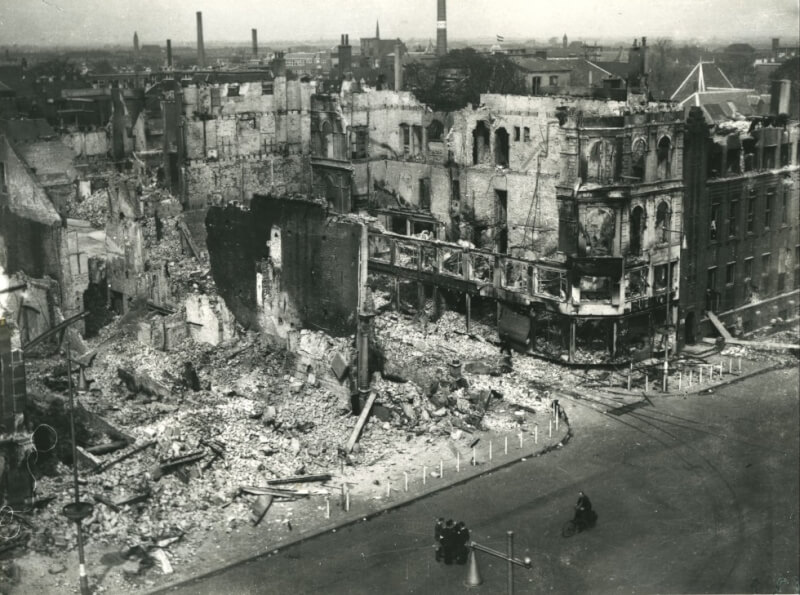
The Grote Markt in Groningen after the city’s liberation in April 1945. [battlefieldtours.nu]
On the battle’s aftermath
2nd Canadian Infantry Division lost 43 killed in action and 166 wounded. For the Germans, sources differ—it’s anywhere from 130-160 killed, with around 40 dying of wounds and another 170 wounded. There are also over 5,200 who become prisoners of war. In terms of civilians, 110 were killed.
Some 270 out of 32,000 buildings are destroyed as well. Some of these buildings are very symbolic for various historical reasons. However, because the Canadians were very selective with how they used their firepower, there wasn’t a lot of destruction—at least compared to other urban warfare battles in history. In the Battle of Ortona, the Battle of Aachen, the Battle of Huế during the Vietnam War, and the First Battle of Grozny in 1994-1995, during the First Russo-Chechen War, there was something like 95 per cent of buildings being destroyed. That’s not the case here, and essential services remained intact.
On the legacy of Groningen
I think that Groningen is sometimes overshadowed by Ortona for several reasons: how well the Canadians did in Ortona; the amount of violence and destruction that occurred in eight days of fighting; the resilience of the German paratroopers; and the demonstration of Canadian grit and determination in that particular battle.
All of that is a fair assessment, but I still think that many students of Canadian military history and urban warfare history don’t give Groningen the attention it deserves. The battle, after all, does teach us some of the tried-and-true TTPs that remain current. It also teaches us that a certain level of restraint can be applied in urban warfare; that even when close air support and artillery support are minimized, providing that mitigations are in place with more direct fire support assets, an urban battle doesn’t have to be as destructive as most people tend to believe. Groningen certainly shows that you can still fight an urban battle without laying waste to an entire city and killing a large amount of the civilian population.
I believe that Groningen deserves a more prominent place not only in Canadian military history in particular, but in urban warfare history in general.
This interview has been edited for brevity and clarity.
Advertisement