


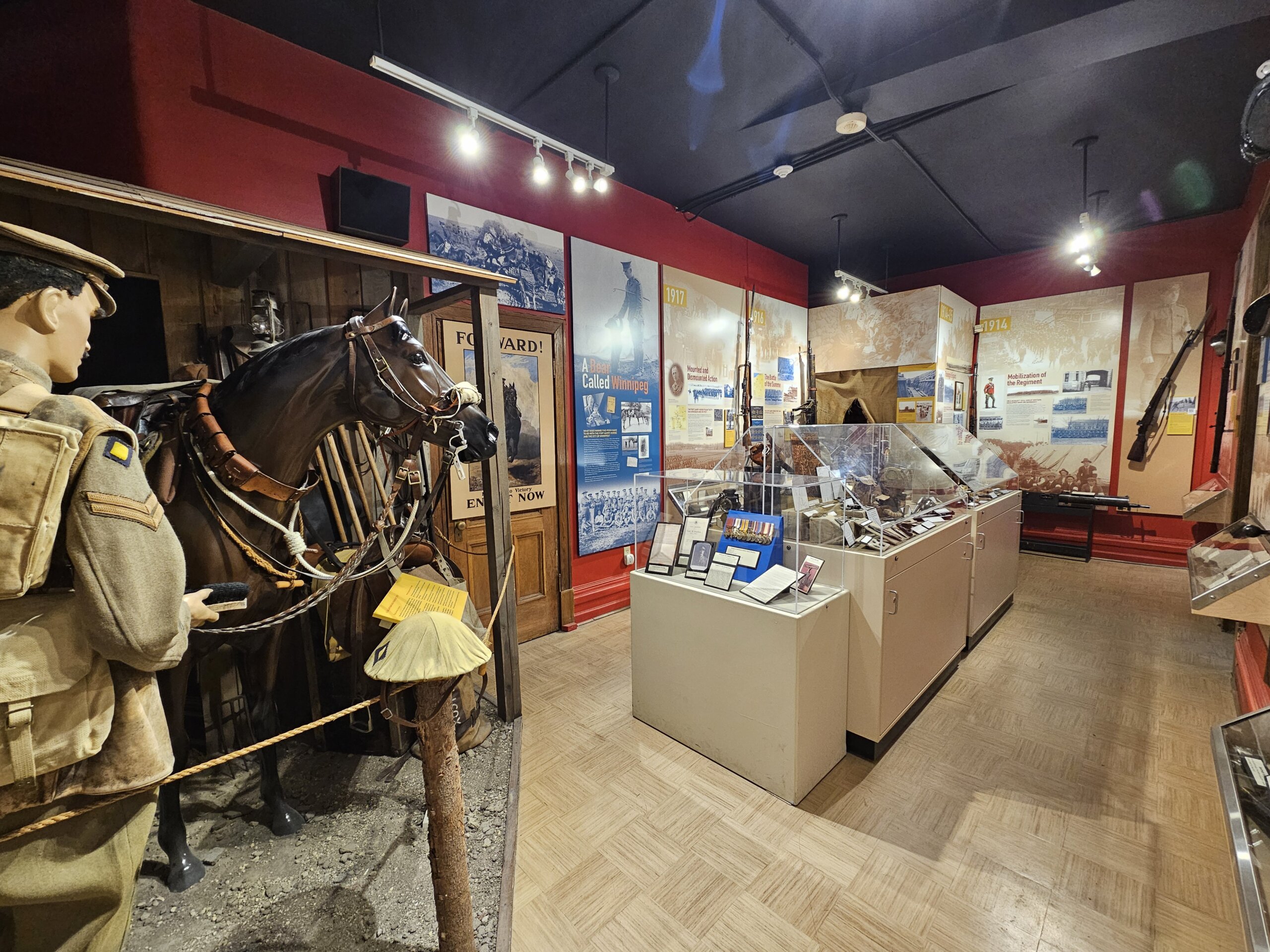
Displays at The Fort Garry Horse Museum and Archives. [Fort Garry Horse Museum and Archives]
“We have a rich history,” said Gord Crossley, director of the Winnipeg-based Fort Garry Horse Museum and Archives, of its namesake regiment. “We like to say that we have more battle honours than any other armoured formation in Canada.”
The 43-year unit veteran knows such realities better than most. Since the earliest days of its inception in 1912—and arguably before—The Fort Garry Horse has distinguished itself at home and overseas, from its service in the Great War’s trenches—yes, trenches—to its sword-drawn cavalry charges to its mechanized role in D-Day and beyond. In everything it has accomplished during the ensuing years and decades—be it in Germany, Latvia or Petawawa, Ont.—Crossley’s former regiment has lived up to its motto, Facta non verba or Deeds not words.
Words, however, have their place. Having been involved with the museum for some 34 years, Crossey continues to tell the unit’s story, one battle honour at a time. Here, in an armchair tour of the site, he highlights it anew.
On the history of the museum
The museum itself is interestingly located in the Lieutenant-Colonel Harcus Strachan, VC, MC Armoury, formerly known as the McGregor Armoury, which was built in Winnipeg in 1913. The armoury, which is where the unit continues to be based, is still very much as it was in 1913.
Its in what was a former caretaker’s apartment. When the space became available in 1976, we started moving our regimental collection up there. Over the years, there have been various groups that have established, maintained and upgraded the museum.
On the 19th and early 20th century displays
As you enter the [museum], you’re greeted by a picture of Lieutenant-Colonel [Robert W.] Paterson, who was our first commanding officer and founder of the regiment. As you go in, you have a small exhibit dedicated to the 1885 North-West Rebellion. Even though The Fort Garry Horse was formed in 1912, we perpetuate a unit from that rebellion called Boulton’s Mounted Infantry. We have a small display explaining what that unit did.
You then go into what was originally the [caretaker’s] living room, which is now our First World War display room.
Counterclockwise are panels that will take you through the origins of the unit: its 1912 founding, its mobilization in the First World War, its brief conversion to infantry, then back to cavalry, and its service with the Canadian Cavalry Brigade throughout the war.
We have a large trench diorama because we spent some time in the trenches, even though we were cavalry. We also have a life-size horse and rider display, as well as a display on the Victoria Cross earned by Harcus Strachan during the Battle of Cambrai [in November 1917].
In addition to other display cases and descriptive panels, we have various firearms, either used by the regiment or used against us.
On the Winnie-the-Pooh connection
One special panel tells the story of Winnie the bear, which is the inspiration for [British author A.A. Milne’s] Winnie-the-Pooh. Everyone in Winnipeg knows this story, but it might not be known everywhere: it was based on an actual bear.
A veterinary officer, Harry Colebourn, took a [Canadian black] bear to London Zoo [during the First World War], and that veterinary officer was from The Fort Garry Horse. That’s our connection to that famous tale.
On the uniform collection
We have two other main rooms, one of which has several display torsos with different uniform jackets, boots and more.
We have an original 1912 officer’s tunic in scarlet. We also have a very unusual uniform worn in Vietnam. One of our officers was part of several diplomatic exchanges there in the 1960s, wearing a custom-made white cotton uniform with a Saigon tailor tag inside—but with Fort Garry Horse insignia.
On the Second World War exhibit
We then have the Ron Morton room. He was our commanding officer during the Second World War for D-Day until he was moved on to a staff officer role.
The room covers all aspects of The Fort Garry Horse in the Second World War, including our mobilization in 1939 and conversion from cavalry to a tank regiment. We have displays about how we initially used scrap metal tanks obtained from the United States before eventually getting our own Canadian Ram tanks and American Sherman tanks.
We talk a lot about the duplex drive tank—the swimming tank—used on D-Day. We were one of the two Canadian regiments, along with the 1st Hussars, assigned those tanks. We have a small diorama showing how they worked and a lot of physical artifacts from the time.
We have a map that was literally sitting on the knee of one of our crew commanders as they came ashore with notations and marks. We also have a field message book from the Battle of Carpiquet [during the Normandy Campaign] in July 1944.
On a vision for the future
We completely renovated our First World War exhibit in 2018, and we’re currently undergoing a plan to renovate our Second World War exhibit. It was last done in 1994, and we want to bring it up to more modern standards.
What matters most to me is that visitors take away an understanding of what The Fort Garry Horse is, that it’s not just a name. I’d like them to realize that Canadian soldiers have volunteered with us since 1912—before then when you think of our prehistory dating back to 1885—and that they continue to serve.
Advertisement