






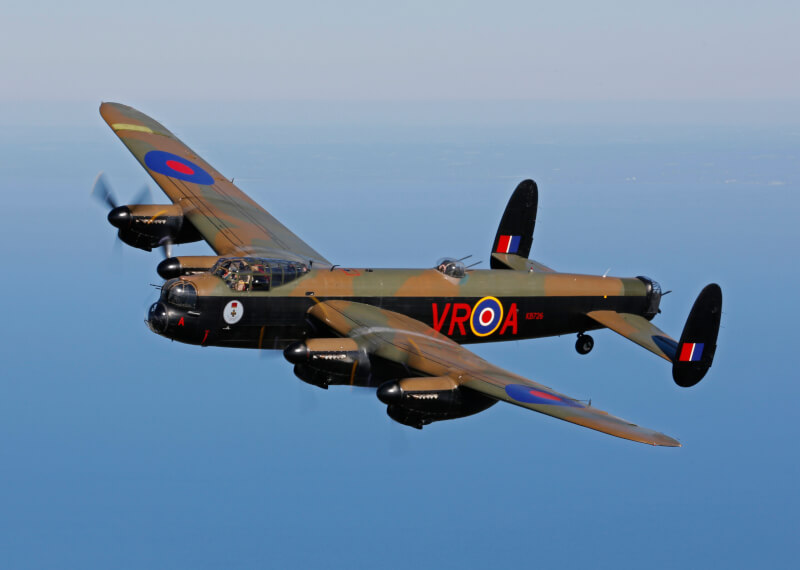
The Lancaster bomber of the Canadian Warplane Heritage Museum, one of only two airworthy Lancs in the world. [Canadian Warplane Heritage Museum]
They call her Vera—and she sings.
Her voice may not carry through the sky like bluebirds, for bluebirds cannot roar. Her stature may seldom tower above the white cliffs of Dover, for her heart lies across an ocean. An English sweetheart she is not—although the late, great Vera Lynn did surely approve.
For a few months each year—a mere 50 hours in total—a very different icon leaves its hangar at the Canadian Warplane Heritage Museum in Mount Hope near Hamilton, Ont., as the sound of its four Packard Merlin 224 engines churns the air. Capable of reaching speeds of 443 kilometres per hour, the beloved beast is a true sight to behold when it graces the heavens, its roughly 21-metre-long frame looming large amidst the clouds.
While it was constructed during the Second World War, it never served overseas—VE-Day arrived before the chance arose. Still, the Avro Lancaster Mk. X, first restored and now long maintained by the museum, has many a tale to tell. Recounting its more than eight-decade story, in the first of two parts, is Sean Kearney, the museum’s manager of education and public programs.
On the Lancaster’s service history
The Lancaster is always the aircraft that gets the spotlight. It is the largest aircraft in our collection and definitely the most famous. It is also, arguably, the most unique in the collection in that it is one of only two such Lancaster bombers left flying in the world today.
It was built in Malton, Ont. [now Mississauga], in what was Victory Aircraft Ltd. They built a number of planes there, the most famous being the Avro Lancaster. Of 7,377 of those aircraft built during that time, 430 Lancasters [Mk. Xs] were built here in Canada.
Our aircraft did not make it to the war in time. It was a very late production [in July 1945], so it stayed here in Canada and was absorbed into the postwar air force, designated as a bomber reconnaissance maritime patrol aircraft, including for anti-submarine warfare. It served until being formally retired in the 1960s, when the plan was basically for all postwar Lancasters to be scrapped.
On the museum acquiring the aircraft
Fortunately, this particular Lancaster was saved through the initiatives of a number of individuals, including those from The Royal Canadian Legion branch in Goderich, Ont., where it was placed up on pylons [outside the branch].
Special mention needs to go out to those at Goderich at the time, especially Bill Clancy, who had the foresight to ensure that when they mounted the aircraft, they did so to reduce the strain on the aircraft. It would be over 20 years before it would get back into the air again, and it spent nearly a decade on those pylons.
Our museum eventually wanted to acquire a large project for restoration. They heard of the Goderich Lancaster and it was obtained by the museum. Getting it to the museum, however, is the crazy part of the story.
The Lancaster was unable to fly as its engines were not in good enough condition. That meant the aircraft would have to be transported to Hamilton from Goderich, which is not a short trip, so they contacted the Canadian Armed Forces [for assistance]. No. 450 Squadron of the Royal Canadian Air Force provided a Chinook helicopter to airlift the Lancaster stripped down to the bare minimum weight.
The fuselage [without the wings and engines, among other components] was flown all the way to Hamilton. It took a couple of different attempts to get it airborne, and when they did, the plane started to sway underneath the helicopter. It ultimately made it after a one-hour-and-40-minute flight.
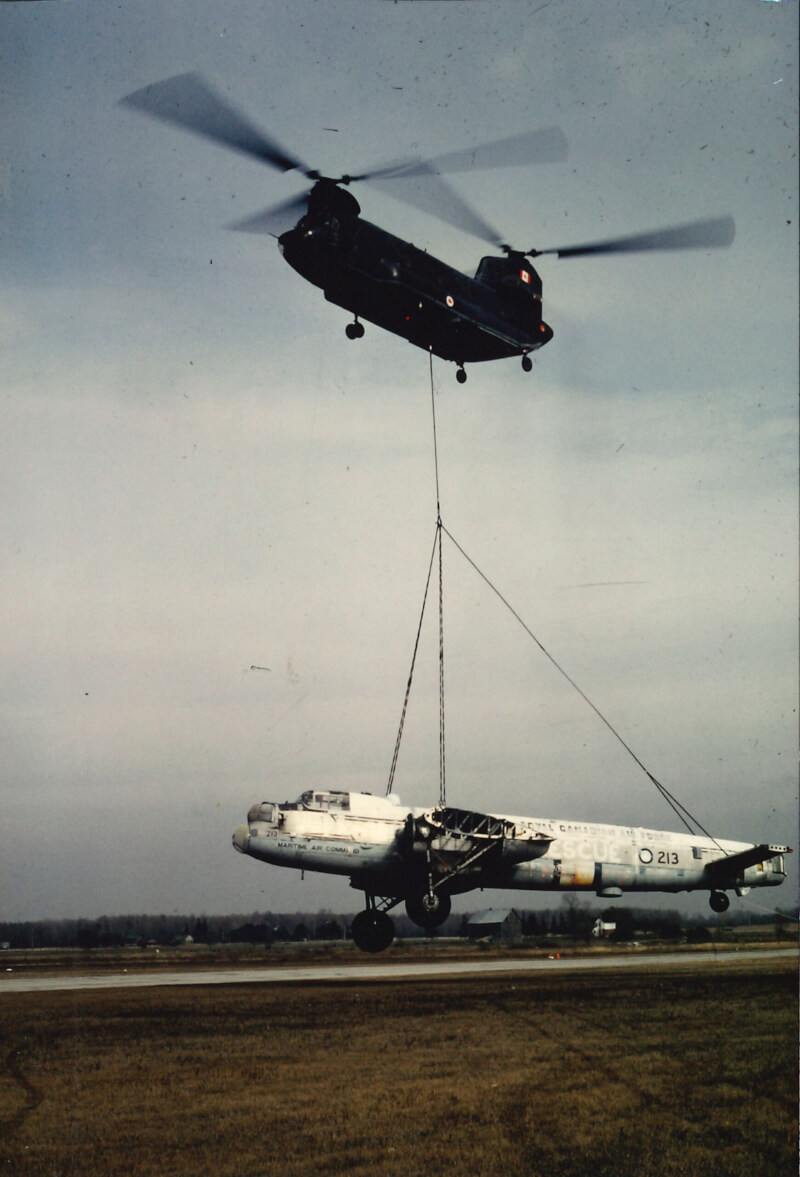
A Royal Canadian Air Force Chinook helicopter moves the Lancaster’s fuselage from Goderich, Ont., to the museum in Mount Hope. [Canadian Warplane Heritage Museum]
On getting the aircraft back into the skies
The aircraft began a prolonged period [roughly five years] sitting and waiting at what was then hangar four at the Hamilton Airport. Challenge would be the word for the entire [restoration] operation, but really, its entire story is about overcoming challenges.
The restoration was a puzzle with a scavenger hunt mixed in, because there’s no one-stop shop for all the parts. Even to this day, if parts can’t be found, they need to be made.
The first official flight in September 1988 was not necessarily the very first flight. There had been flights done previously to test and check various parts and areas of the aircraft before it could fly in front of the public.
It took over 11 years from the moment of acquiring the aircraft to its first flight. You can imagine that when the plane finally lifted off the ground, it was both a sigh of relief and a moment of elation. It was said to be quite an emotional experience where the voices and other sounds on the airfield died away as the Merlin engines roared to life. Only after it lifted off the ground did the cheers ring out.
The museum had expected 2,000-3,000 people to show up, but some 20,000 visitors came from all parts of the world. One person apparently discharged themselves from hospital to see it.
There’s still a very similar feeling here at the museum, because every year, every spring, when the aircraft flies again, it’s almost a first-flight moment all over again. It’s such a powerful moment when it comes back to life.
On the 1993 hangar fire
The devastating fire of hangar three in 1993, just after Valentine’s Day, nearly brought the entire museum mission to a fatal end. The Lancaster had been parked on the opposite side of a cinder block wall, which helped prevent the flames from spreading at the end of the hangar, but the plane couldn’t be moved because it was undergoing winter maintenance at the time, meaning that it was off its landing gear and mounted on jacks.
People just stood helplessly watching and waiting for the terrible moment where perhaps the entire building would go up in flames or come crashing down on top of the Lancaster. Flames even managed to lick one side of the aircraft’s ailerons, which were damaged, but the Lancaster was eventually able to be lowered onto its wheels, which were still attached, and rolled out—again to a cheering crowd who were happy to see almost a phoenix rising from the ashes.
On the 2014 trip to Britain
There was a lot at stake with getting the Lancaster over to the U.K. It was a dream that many here had—to reunite the two remaining [airworthy] Lancaster bombers, the other belonging to the Battle of Britain Memorial Flight in the U.K.
The plan was to follow a similar route to the ferrying flights done during the Second World War, which would allow the aircraft to hop its way across the Atlantic. It was to fly first to Goose Bay, N.L., then to Greenland, potentially making a stop, if required, in Iceland. It would then fly straight to the U.K. from there. The flight over was relatively uneventful, and they managed to get ahead of their schedule.
Both arriving for and departing from the tour, the joke was that there must have been a lot of dust bouncing around the cockpit, because there were teary eyes amongst the crew. It was very powerful for these two aircraft to represent those who came before us, who, in many cases, did not come back.
On Vera’s symbolic value
We’re passionate about telling the story of the crews that flew and operated these aircraft. Some would criticize us, saying that we tell a story that’s glorifying war or trying to promote some sort of agenda, but really, what we’re all about is continuing to preserve memories.
We say that every day here at the museum is Remembrance Day, that remembrance does not take place only on the 11th day of the 11th month of the 11th hour. Every time you come into our museum, every time you look upon the collection, whenever you talk to our tour guides or attend one of our education programs, even when you’re just wandering around by yourself and reading the signs and looking at the exhibits, you’re participating in an act of remembrance. We’re telling stories here of people, not just aircraft.
This interview has been edited for brevity and clarity. A second part will appear next week, on Feb. 18.
Advertisement