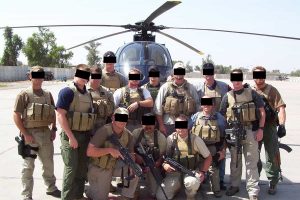




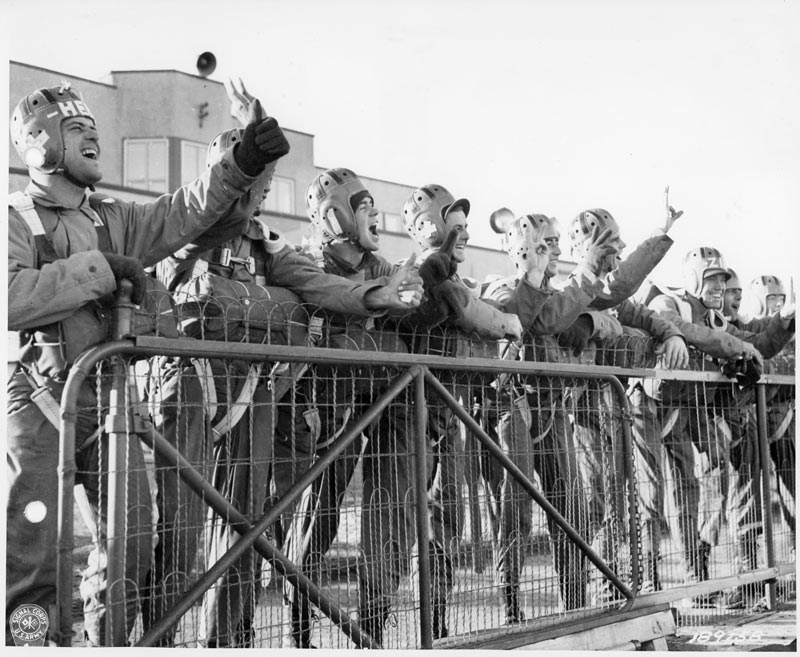
Members of the First Special Service Force, a WW II unit of Canadian and U.S. soldiers, during training in Montana in 1944.[U.S. National Archives/111-SC-189158]
One country in North America was at war, the other neutral.
U.S. President Franklin D. Roosevelt was understandably worried. In September 1939, his northern neighbour was fighting with Nazi Germany, while he had kept his country out of the conflict. Protected by the Atlantic Ocean, few Americans felt threatened by the Axis and the president needed to heed vocal isolationist sentiment at home.
While the North Americans had begun to rearm with urgency in the late 1930s, it had been too slow and too late. Yet, on Sept. 10, Canada declared war on Germany, one week after Britain and France had, and launched the country into a great struggle.
Roosevelt faced a choice. He could take advantage and beggar his weaker northern neighbour to draw it further into the U.S. orbit or he could help. The president understood the need for a strong neighbour capable of defending itself against threats. He decided to support Canada as much as possible.
The defence of Fortress North America during the Second World War was critical in allowing wartime industry to safely expand and to send expeditionary forces abroad. But it was cumbersome work, at first, since Canada and the U.S. had few direct war industry links or military relationships in place and both countries needed to overcome nationalistic trade barriers.
Prime Minister Mackenzie King and Roosevelt collaborated, along with diplomats, service personnel and civil servants, to ensure co-operation and harmony between their countries. Canada needed U.S. help and quickly. Strict American neutrality laws limiting the export of weapons to belligerents were relaxed in November 1939 to allow for cash sales so long as no U.S. ships carried the defence goods to a warring state.
France was defeated in June 1940, and although most of the British Expeditionary Force had escaped at Dunkirk, it had left behind its vehicles, artillery and heavy weapons. The British became desperate and needed virtually everything. Both Canada and the U.S. ramped up production, but not before the Americans insisted on payment, obliging the British to deplete much of their gold reserves.
Canada’s withered industrial base was revitalized by an infusion of American expertise and the critical tools that made factories boom. With Britain approaching bankruptcy, in March 1941 Roosevelt signed the famous Lend-Lease Act that allowed Britain to obtain war supplies of every kind on credit. This lifeline was sorely needed but since Britain now had almost unlimited credit in Washington, it didn’t place as many orders with Canadian industry, something that rankled King.
Roosevelt again came to the rescue. Just as the pair had established defence protocols in August 1940 to defend North America, in April 1941 both men worked out a bilateral defence-sharing deal, the Hyde Park Agreement. It basically established a continental free-trade zone for defence goods. This meant that Britain could purchase Canadian supplies using its Lend-Lease credits. Everyone benefitted.
Canada had also grown in power and was ready to help its southern ally, too. When Japan attacked Pearl Harbor in December 1941, it drew the U.S. into the global conflict. Canada took on a greater role in North Atlantic defence and rushed troops to strengthen West Coast fortifications, siphoned off warships from the Atlantic, and sent Royal Canadian Air Force squadrons to help defend Alaska. The Canadians supported their neighbour even as they denuded their own military assets.
Canada’s strategic resources were also of great importance to North American security and the Allied cause: thousands of tonnes of aluminum, steel, nickel and more went to help fuel the U.S. war machine. Canadian electricity powered northern U.S. industry. Canada was an important ally to Britain and the U.S.; it was a consequential nation.
The war fundamentally changed Canada, and its economy became entwined with the U.S. The two countries emerged from the conflict wealthy and willing to support allies in the emerging Cold War. They also renewed their military bonds in defending their continent, knowing they were stronger together.
And yet, in early 2026, there is a very different president in the White House. Donald Trump’s trade war with Canada flies in the face of this history. It mocks the service and sacrifice of Canadians and Americans who acted jointly in the defence of their countries in time of peril. In seeking to beggar-thy-neighbour, the U.S. has weakened both countries.
Trump’s trade war with Canada flies in the face of history. It mocks the service and sacrifice of Canadians and Americans who defended their countries.
Unexpectedly perhaps, Canadians owe Trump some gratitude. Firstly, his malicious talk of Canada becoming the 51st state quickly went from joke to threat, leading to a robust nationalist reaction. Canadians had slunk into apathy about their country. For too long, they focused on some negative elements of their past to the exclusion of the great things Canadians have done together, and alongside others, in critical times. That has begun to change.
Trump also pushed Canada to think more carefully about its security in an increasingly dangerous world. Even though the country isn’t likely a primary target and might only see collateral damage in a major war, Canadians have realized that they had been free-riding on U.S. defence for too long. That consequential nation from 1945 had allowed itself to become weak behind a blizzard of pious words untethered from hard power.
Canada is now undergoing a major rearmament and reorientation: of warships, airpower, over-the-horizon radar, drones, space warfare and much more. Unfortunately, U.S. tariffs are making this harder, which ultimately weakens that steadily diminishing superpower that’s shedding allies and emboldening bad actors with its current economic policies.
Still, in moving from crawl to sprint, Canada’s rearmament feels reactive and haphazard, unrelated to any obvious major national security strategy. That’s often the way in a crisis, but hopefully gone are the days of pouring hundreds of millions into the border for non-existent threats such as fentanyl to curry favour with the White House.
To return to being a consequential nation, Canada needs to pull its weight, show the U.S. that it needs Canada and that the two countries are stronger together. But reason doesn’t work with the unreasonable. Canada must rely on its strengths. Natural resources and energy are trump cards. And before Canada can reorient some of its trade away from the U.S., it might need a mixture of “elbows up,” bending the knee and going down swinging.
The Second World War showed that Canadians could be tough. Are they still? I think we are, although fostering resilience isn’t automatic. There are lessons to be drawn from those Canadians who served from 1939-1945. They, too, lived in turbulent, frightening and unpredictable times. They didn’t know how it would end. But they got through. We will too, with hard work, compromise, pride, optimism and knowing how to take the hit.
Ed note: Tim Cook died on Oct. 25, 2025 (see “Obit,” page 70), two days before this piece was due. He had written a draft and asked his friend and fellow Legion Magazine contributor Serge Durflinger to edit it and submit it.
Advertisement