







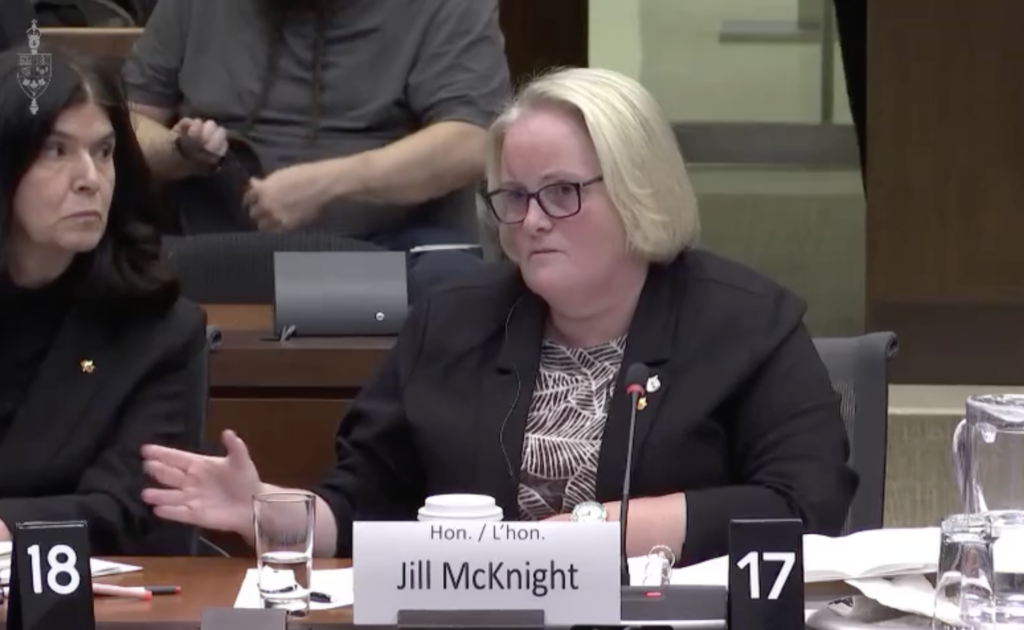
Veterans Affairs Minister Jill McKnight speaks during a House of Commons veterans affairs standing committee meeting on March 25. [CPAC]
“I have shoulder, neck and back injuries as well as PTSD [post-traumatic stress disorder],” Bennett told Legion Magazine from his home in Chamcook, N.B.
“Working on large vehicles and equipment is pretty rough on the body. I was also in a rollover tank accident where the vehicle flipped—myself and a couple of others were injured—we were training to go to Bosnia.”
Bennett’s rehabilitation was going smoothly under the guidance and funding of Veterans Affairs Canada. He was being cared for by a team of trusted therapists when he was suddenly transferred to the department’s privately contracted rehab program, run by a company called Partners in Canadian Veterans Rehabilitation Services (PCVRS).
“I got a phone call shortly after I was enrolled in that program, and a lady from PCVRS strongly encouraged me to switch over to their health care providers, their chiropractors, their physiotherapy, all that stuff,” said Bennett, who replied that he was happy with his existing care team and had no desire to alter course.
“She was pretty insistent that I changed and asked 12 times in one conversation that I switch to their providers,” he said. “It was a difficult conversation to have.”
Bennett’s experience with PCVRS, along with that of dozens of other veterans with related complaints, prompted Veterans Affairs Minister Jill McKnight to announce on March 25 an independent review of PCVRS and its rehab program.
The review follows a Toronto Star investigation revealing alleged failures in the nearly $600-million-dollar program. The investigation by reporter Frédérik Plante portrays a federally mandated but privately run service where injured veterans—some of whom have serious mental health needs, including risk of suicide—are “drowning in bureaucracy, being forced to change service providers, given inadequate care and facing threats to their benefits. Veterans said their health worsened as a result.”
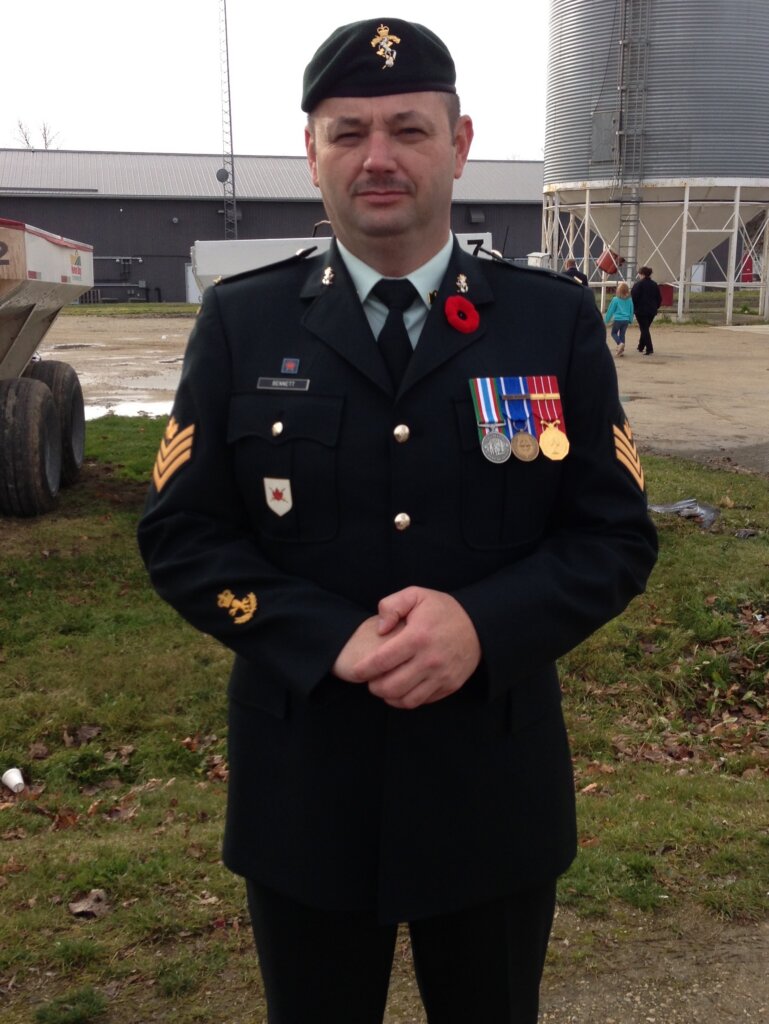
Mark Bennett in uniform in 2014. [courtesy Mark Bennett]
In 2021, VAC awarded PCVRS a five-and-a-half-year, $560-million contract, with the possibility for three two-year extensions, to deliver vocational and rehabilitation services to veterans and their families. The aim was to improve access to services for veterans. Now worth $573 million, the contract could be extended for an additional six years.
Presumably, any extension hinges on the outcome of the department’s independent evaluation—although McKnight did not say what the review’s timeline was or who would lead it, during her announcement to the House of Commons Standing Committee on Veterans Affairs.
As documented by the Star, some veterans said their health was made worse by the rehabilitation program, and that they felt demoralized and insulted by PCVRS staff.
“She was pretty insistent that I changed and asked 12 times in one conversation that I switch to their providers. It was a difficult conversation to have.”
One Afghanistan veteran struggling with PTSD, anxiety and depression, said he faced endless delays over many months in simply being assigned a PCVRS case worker, known as a “rehabilitation services specialist.”
Others have complained of the company requiring veterans to undergo reassessments—by PCVRS-affiliated clinicians—of already diagnosed conditions, even though such information is available in veterans’ files. Reassessments run the risk of resurfacing trauma for some veterans.
Perhaps most concerning are complaints like Mark Bennett’s—that PCVRS staff badgered veterans to cut ties with their existing therapists who are not affiliated with the PCVRS network. Although this would disrupt ongoing treatment, some veterans felt pressured to submit out of fear that they would lose the Income Replacement Benefit they receive upon discharge from the military.
The Veterans Ombud Office said it has received 100 formal complaints about the program since 2022, and has heard other, informal stories from veterans and health care workers about service delays and communications issues with PCVRS. However, the ombud has found no evidence of systemic problems with the program.
Such complaints are probably a sign that “thousands of other veterans” are dealing with similar concerns, said Conservative MP Blake Richards, vice-chair of the Veterans Affairs committee, amid its hearings into the program in March.
Marc-André Bernard, a Quebec psychologist, informed the committee that, in his opinion, the PCVRS program amounts to “bureaucracy to the point of absurdity.” He said the program “seems to exist for its own sake by piling on administrative requirements that make the process extremely cumbersome and painful for the veteran [and] irritating and suffocating for the professional [clinician].”
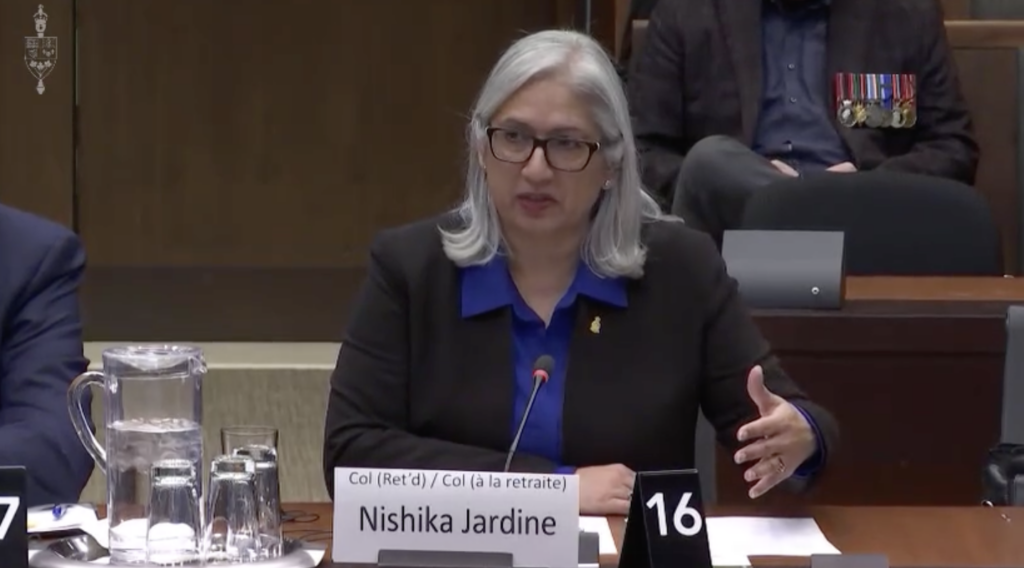
Veterans Ombud Nishika Jardine speaks on the complaints her office has received about PCVRS in March 2026. [CPAC]
Sonya Lockyer, the CEO of Lifemark, highlighted the results of an internal program survey that showed 74 per cent of veterans who received health and vocational rehabilitation from PCVRS (among 732 surveyed) reported improved outcomes after completing the program.
Scott Maxwell, the CEO of Wounded Warriors Canada, an independent organization that specializes in delivering mental health care to veterans, told CityNews’ Rob Snow in a recent radio interview that concerns were first raised within the mental health provider community in 2021 about VAC’s decision to award its rehab contract to a private, for-profit enterprise.
Maxwell said it is irresponsible for PCVRS to pressure veterans into breaking relationships with existing therapists in favour of new ones affiliated with the company.
“We talk about the ‘therapeutic relationship’ all the time in the clinical counselling world,” he said. “That relationship is invaluable to the quality and outcomes of care. You just don’t switch mental health practitioners.”
When Mark Bennett refused to switch to PCVRS providers, he was released from the company’s program and placed back under the stewardship of a VAC case manager, allowing him to continue therapy with his existing care team. He considers himself fortunate, knowing that not all veterans—particularly those receiving the Income Replacement Benefit—are given that option under the benefit rules.
“We talk about the ‘therapeutic relationship’ all the time in the clinical counselling world. That relationship is invaluable to the quality and outcomes of care. You just don’t switch mental health practitioners.”
Despite the departmental resourcing shortages and other administrative problems that prompted VAC to outsource the bulk of its rehabilitation services in 2021, Bennett has nothing but praise for the care he has received since 2024 under VAC’s direct guidance.
“I’m so thankful for VAC and all the health care providers I currently have,” he said. “I’ve seen tremendous gains both physically and mentally.
“I’d really like to see the whole rehabilitation program just come back in-house under VAC administration,” he said. “The people there all seem to really care and have all helped me through difficult situations.
“It’s hard to beat people who care about your well-being, rather than the bottom-line dollar.”
Advertisement







PCVRS, Lifemark and Pro Physio is all owned by Lablaws. How they were able to get the tax payers to foot the bill for third party organizations to do what Veterans Affairs are supposed to be able to do. Put money into Veterans Affairs not subcontractors.
My benefits were taken away, lost income and cause more damages. All because of PCVRS reported to Blue Cross that is was not participating in their program.I thought we had a choice?
I was being treated during the time when PCVRS sent the non participant report to Blue Cross and my physiotherapist was denied further extensions why? All because PCVRS reported I not longer needed further treatments.
Thanks 👍
I’m a veteran who had to deal with PCVRS. I had already completed both the mental and physical assessment through VAC, and was just waiting for a decision. PCVRS took over and I was forced to start the program from the beginning again. They refused to use what was on file, as well their ignorance regarding the available clinic locations to me had me investigate to find out they are not even a Canadian headquartered company. I had to work with Lifemark after appointments were scheduled to change from the “closest” location to me (45 min as per PCVRS) to the location I was going to under VAC that is 6 min from my house.
It is nice to see there could be something done about this change for the worse. Canadian veterans deserve so much better.