





Author Allan Levine profiles Canada’s dollar-a-year-men in his latest book. [Courtesy Allan Levine]
“We’re always looking back on the Second World War and seeing it as an important time in Canadian history,” said historian Allan Levine, “but this is one story that’s never really been told.”
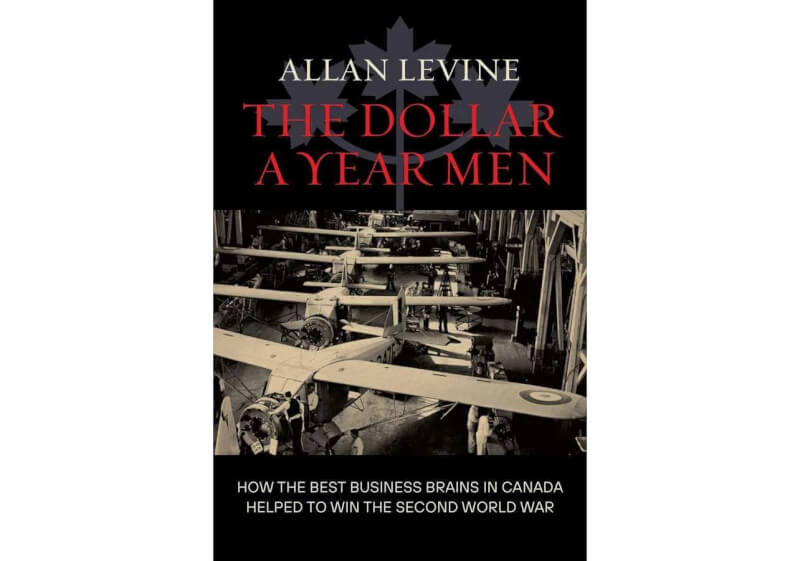
It has now, however, in the award-winning author’s most recent book The Dollar a Year Men, published by Barlow Books.
Rather than any battle blow-by-blow or front-line testimony, Levine’s narrative largely remains within the confines of Canada at a time when the country needed to mobilize its industry to support the Allied cause. Civil engineer-turned-politician C.D. Howe, then serving as minister of munitions and supply—and nicknamed the Minister of Everything for his far-reaching influence—took on that challenge, enlisting dozens of business leaders from across the country, their task to bring about the “greatest economic metamorphosis” ever experienced in Canada.
It was, argues Levine, an endeavour that helped win WW II.
Praised by former prime minister Jean Chrétien, The Dollar a Year Men takes its name from a sobriquet endowed upon recruited businessmen who “served their country without drawing a government salary,” even if the moniker almost always fell short, literally.
Numerous industry experts nevertheless “donated time, energy and experience out of a sense of duty,” asking for little in return.
“They were prepared to do whatever was necessary,” added Levine, who spoke to Legion Magazine about his new book and the business leaders he has since chronicled.
[Barlow Books]
On the men behind the nickname
I never realized how many people were involved [until writing the book]. Initially, I thought we were talking about 50 people, but ultimately, I looked into about 260 businessmen who worked for [the department of] munitions and supply.
There were probably several hundred others co-opted by other departments. Actually, during my research, I came across a reference to a January 1949 report outlining how many [dollar-a-year men] there were, and it had the number at about 800 in all.
When you think of the dollar-a-year men, however, it’s mostly the people who worked directly with C.D. Howe. For a period, Howe had this executive committee of businessmen whom he had appointed. They are among some of the main people I cover in the book.
There was Henry Borden, for example, who was one of the key dollar-a-year men. He was a corporate lawyer in Toronto and the nephew of Sir Robert Borden, the prime minister during World War One. He had a stellar career.
Ralph Bell was a Nova Scotian personality and another interesting character. He was recruited early [in the Second World War] by C.D. Howe, in charge of aircraft production.
There was also a guy named R.A.C. Henry from Montreal. He had been a deputy minister in the government, but during the 1930s, he’d also been involved in a massive hydroelectric power project that ended up being somewhat of a scandal for financial reasons. Even though he’d been called into question regarding his role [in the scandal], Howe still decided that he would make a good executive.
E.P. Taylor was another example, a Toronto tycoon who later built the Argus Corporation. He was a brewer initially, having made his money in the beer industry, but during the war, he played a very important role in munitions.
On a dollar-a-year man fatality
The story of one dollar-a-year man, Gordon Scott, is a particularly sad one. He was a Montreal accountant who had worked for the government in Quebec as the provincial treasurer. However, in December 1940, Howe and a couple of other dollar-a-year men, including Scott and E.P. Taylor, travelled to Britain [for meetings]. They took what turned out to be an extremely dangerous trip across the Atlantic from New York to Liverpool, and halfway there, past Greenland, they were hit by a German U-boat.
Several people died, but Howe and his men made it to the lifeboats, and they were ultimately rescued by a merchant ship that wasn’t supposed to help them because the Germans could still have been lurking. During those rescue efforts, Scott was crushed and died. He was the only dollar-a-year man killed in the war.
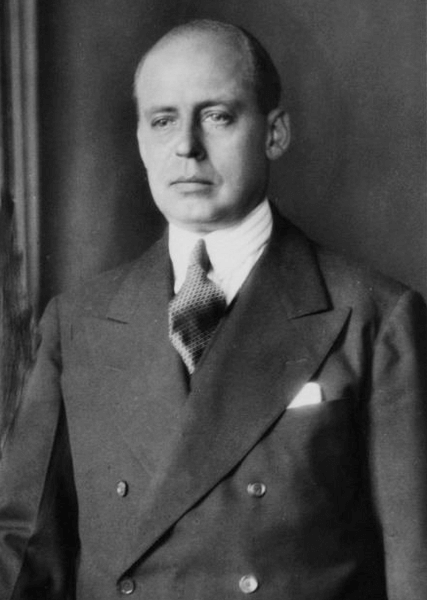
Dollar-a-year man Gordon Scott died on Dec. 14, 1940, after the ship he was travelling on to Britain was sunk by a U-boat. [Bibliothèque et Archives nationales du Québec/Wikimedia]
On the power they wielded
This whole idea of enlisting private businessmen to run much of the economy—guns, steel, rubber, aircraft, ships and more—could only have happened in wartime. The government was operating by orders-in-council. In other words, they didn’t have to go to Parliament to ask about various things, which worked out pretty well for the dollar-a-year men.
These guys, like Henry Borden, R.A.C. Henry and Gordon Scott—before he died—lived at the Château Laurier hotel in Ottawa and drew up these orders-in-council for basically whatever they wanted. They were then signed and became law. Perhaps it’s unsurprising that there were complaints from Howe’s own colleagues that he was running a private government through these men.
Howe largely trusted them enough to do their own thing, although there were a few ego clashes.
Certainly, I don’t think you’d ever get to a point today, unless circumstances were extremely drastic, where you would have businessmen running the government without any bureaucratic regulations. The whole idea sounds kind of crazy, but for a while, it worked.
On their motivations
I think some people today just don’t get how supportive the population was, at least in English Canada, of Britain. The dollar-a-year men were no different. These guys were motivated by a love for Britain that just doesn’t exist anymore. And they were also very modest about [their work]. Most of them didn’t really talk about their wartime experience.
Today, businessmen are often portrayed as greedy capitalists, but the dollar-a-year men didn’t care about money or profit at that time. Some of them had served during World War One, so they knew about conflict. They felt like they were saving the world, which you could argue they did. They left a lasting mark on Canada in terms of the country’s industrial activity, which was completely transformed. They’re certainly worth remembering.
This interview has been edited for brevity and clarity.
Advertisement