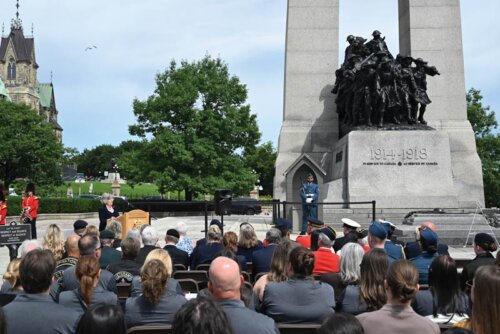


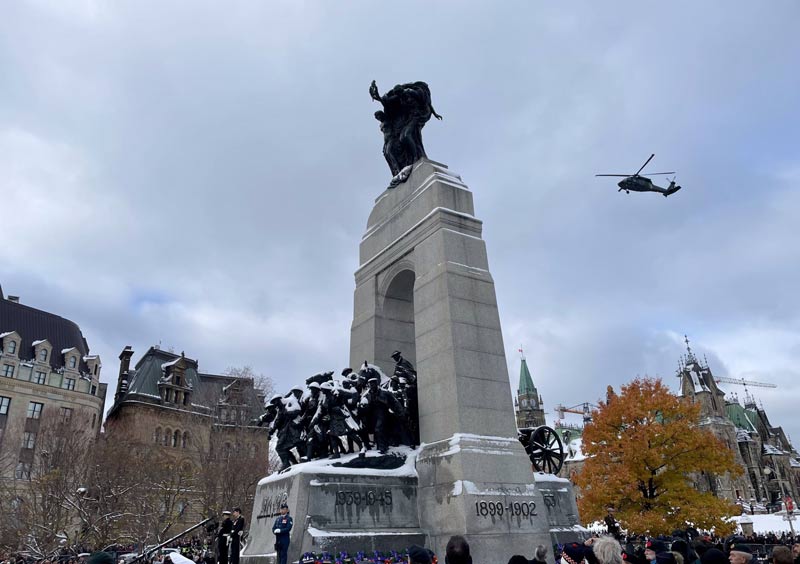
Beyond the grounds of Parliament Hill, there may be no other location as synonymous with Canadians gathering en masse as the National War Memorial. Since 1940, thousands have flocked annually to the country’s cenotaph, known as “The Response,” to pay their respects to those who have served, and continue to serve, Canada in uniform.
Coincidentally, design proposals for the monument, with a budget set at $100,000, were first sought 100 years ago in February 1925. The tribute was to evoke “the spirit of heroism, the spirit of self-sacrifice, the spirit of all that is noble and great that was exemplified in the lives of those sacrificed in the Great War, and the services rendered by the men and women who went overseas.”
The memorial was rededicated in 1982 to formally recognize those who fought in the Second World War and the Korean War, at the request of The Royal Canadian Legion. And a quarter century ago, the Tomb of the Unknown Soldier was added to the monument, again following a push from the RCL.
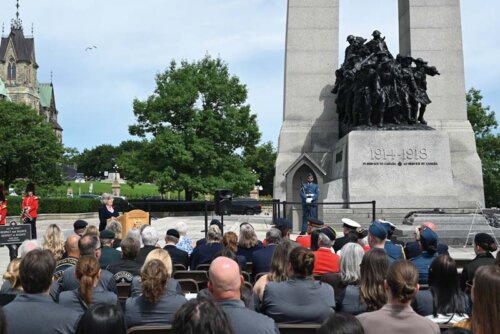
Fittingly, the national veterans’ organization now runs Ottawa’s Remembrance Day service. And once again, thousands gathered for the 2025 event around the National War Memorial—this year dusted with snow amid overcast skies and temperatures just below zero—as they have now for 85 years, on the eleventh day, of the eleventh month, as the eleventh hour neared.
The tribute was to evoke “the spirit of heroism, the spirit of self-sacrifice, the spirit of all that is noble and great.”
The proceedings commenced shortly after 10 a.m., when six sentries took positions around the War Memorial. They included Sergent Kevin Deng of Princess Patricia’s Canadian Light Infantry, Sailor First Class Christian Campbell of the Royal Canadian Navy, Master Corporal Benton Wong of the Royal Canadian Air Force, Warrant Officer Jason James of Canadian Special Operations Forces Command, RCMP Staff Sergeant Roch Lizotte, and Captain Mariel Justice of 1 Canadian Field Hospital. They were joined by Master Corporal Lindy Georgekish of the Canadian Rangers, who stood by the Tomb of the Unknown Soldier with the Canadian Armed Forces Eagle Staff.
Moments later, veterans and Canadian Armed Forces and RCMP members paraded to the site. Around 10:30 a.m., special guests arrived, including Prime Minister Mark Carney, Senate speaker Raymonde Gagné, Veterans Affairs Minister Jill McKnight, General Jennie Carignan, the defence chief, and four teenagers, all winners of the Legion National Foundation’s poster and literary contests there to represent the country’s youth. Richard Wagner, deputy of the governor general and chief justice of Canada, was on hand representing Gov. Gen. Mary Simon who was unable to attend due to an illness. All were greeted by RCL Dominion President Berkley Lawrence and the organization’s executive director Randy Hayley.
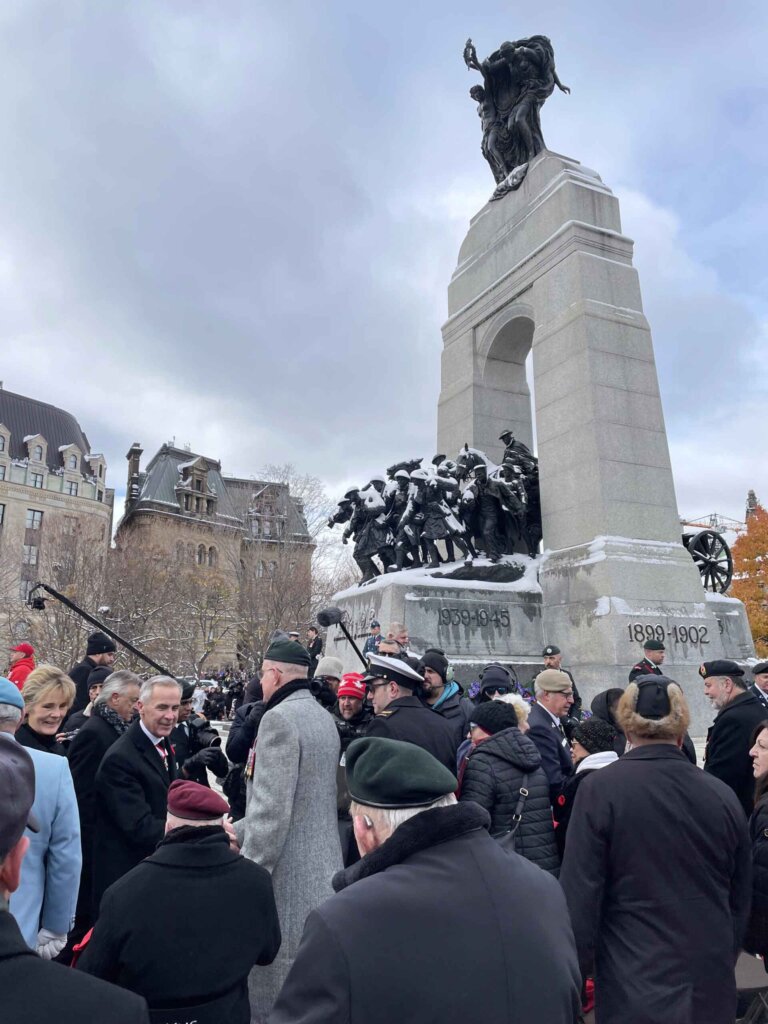
The 2025 National Memorial (Silver) Cross Mother, Nancy Payne of Lansdowne, Ont., also arrived among the VIPs. Payne’s son, Corporal Randy Joseph Payne, served with the Canadian Army as part of 1 Garrison Military Police Company, based in Wainwright, Alta. He was killed in Afghanistan on April 22, 2006, when his military vehicle struck a roadside bomb while serving as a member of a close protection team.
This year’s event commemorated the 80th anniversary of the liberation of the Netherlands and the end of the Second World War, and the 25th anniversary of the Tomb of the Unknown Soldier.
“O Canada,” performed by the Ottawa Children’s Choir and members of the Central Band of the Canadian Armed Forces, kicked off the start of formalities, followed by “Last Post” by bugler Sergeant Christoper Gerdei. The following two minutes of silence were shattered by the first salvo of a 21-gun salute, carried out by 30th Field Regiment, Royal Canadian Artillery, before piper Corporal Nathan Plante played “Lament.” Bugler Gerdei performed “Rouse” before three versions of the Act of Remembrance were recited: the first in English by Lawrence, the second in French by RCL Grand President Larry Murray and the third in Inuktitut by Ranger Sergeant Titus Allooloo.
Colonel Lisa Pacarynuk, the Canadian Forces chaplain general, shared prayers. “Today reminds us that life and peace are fragile,” she said. “While we take time to recall our past, let us also recognize the progress and potential that those past sacrifices won for us. And let us look ahead with hope to the promise of a more just society.
“On this 25th anniversary of the Tomb of the Unknown Soldier, we ponder here the mystery of life and death,” continued Pacarynuk, “and pause to thank those who never came home.”
Dignitaries, led by Chief Justice Wagner and Memorial (Silver) Cross Mother Payne, then placed wreaths while the children’s choir performed “In Flanders Fields,” a musical setting of John McCrae’s renowned poem. The performance was a haunting combination of young voices and powerful words, particularly when accompanied by the echoing blasts of a gun salute. Members of the diplomatic corps and veterans’ groups then placed wreaths around the entire memorial.
Rabbi Idan Scher delivered the benediction. “Today, we gather at this sacred space,” he began, “to honour those who served and those who never came home.
“As Prime Minister John Diefenbaker once said, ‘I am Canadian. Free to speak without fear, free to worship God in my own way, free to stand for what I think right. Freedom: the right to be one’s self.’ It’s a simple idea,” continued Scher, “but it’s what our soldiers gave everything to protect. They fought so we could live free. That is the legacy of the Canadian Armed Forces.”
“Peace needs protectors,” Scher concluded. “So does freedom and human dignity. Our soldiers have always been those protectors. They have always known that freedom is not only won in battle, it must be lived back at home in how we treat one another and how we honour those who served. Today, and every day, we honour the legacy of our troops, not only with immense undying gratitude but by becoming protectors ourselves, safeguarding the freedom, the dignity and the belonging that are the right of every single Canadian.”
The Ottawa Children’s Choir led a rendition of “God save the King” as an RCMP Black Hawk helicopter swooped out from the north in a flypast as the formal event concluded.
“Today reminds us that life and peace are fragile. While we take time to recall our past, let us also recognize the progress and potential that those past sacrifices won.”
After the ceremony, many attendees slowly approached the Tomb of the Unknown Soldier and placed their poppies on it in one of the annual event’s most powerful moments. In the end, the sarcophagus enshrouded in red poppies became a reflection of the sentiment set out in the design brief for the National War Memorial a century ago: “While the spirit of victory is essential it should be expressed so as not to immortalize Canada’s defenders but convey a feeling of gratitude that out of this great conflict a new hope has sprung for future prosperity under peaceful conditions.”
Advertisement