
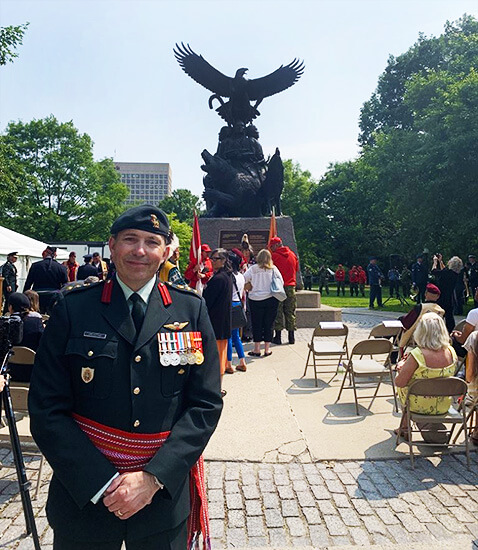
Colonel David Grebstad is deputy commander of the Canadian Armed Forces Transition Group. [DND]
“We had to do better,” remarked Colonel David Grebstad regarding the services available to military personnel transitioning out of the Canadian Armed Forces, particularly ill and wounded members, after the War in Afghanistan. “We had to.”
The process took several years and “several efforts,” he said in a Legion Magazine exclusive, to hone strategies that could help uniformed men and women preparing for “Civvy Street.” It was a process that culminated in establishing the Canadian Armed Forces Transition Group (CAF TG) in 2018, an organization that’s part of a broader effort to enhance care for veterans. The group became fully operational in April 2024, and now hosts nine units and 26 centres across Canada.
Recognizing that transitioning back to civilian life is a major life change and can be a stressful experience, the group commits itself to professional, standardized and personalized support. Further, in recognizing that “transition does not automatically mean leaving the CAF,” its expert teams also facilitate career path changes within the military when applicable.
A sizeable array of other services, from seminars to military family assistance, are likewise available. Grebstad, the group’s deputy commander, spoke about what’s on offer.
On the transition group’s general approach
The seven domains of well-being are something we’ve adopted in conjunction with our colleagues at Veterans Affairs Canada. These seven domains are the following: purpose, finances, health, life skills, social interaction, housing and physical environment, and cultural and social environment. We focus on these because they’re key parts of any individual’s life. Whether in terms of comfort or success, it’s these aspects that enable an individual to thrive.
In the context of the CAF, whether it’s an older person who has done their time and wants to put their feet up, or someone who has served for 10 years and is looking for a new career, or, sadly, a person who is ill or injured, we use the seven domains to gauge whether someone is well and truly set for success post transition. Of course, that’s a very individual experience depending on the person.
That’s where our teams at the transition units and transition centres have to get personal with the individual to ensure they have everything they require. We can offer a range of different services, including coaching, mentoring, guidance and more, and we do all that work in partnership with Veterans Affairs Canada.
On other services the group offers
Obviously, we’re not trying to encourage people to leave the Canadian Forces, not least because that’s a personal decision made by these members and their families, but we do encourage them to consider life after service throughout their career in the military by attending what we call “my transition” seminars. They can speak with people and seek advice while also doing a bit of horizon scanning early on.
In some cases, releasing members are eligible for vocational rehabilitation training. This is particularly important for a lot of people who may have learned skills over the course of their [military] career that aren’t necessarily translatable back in the civilian sector. So, for those who’ve decided they’re young enough and intend to do something else with their lives, our program is a chance at a career 2.0.
We have partnered with numerous organizations that support transitioning women veterans. Meanwhile, for other equity-seeking groups, we’re always looking at ways to improve.
On what can be done for those feeling left behind
What we’re trying to do is increase our co-ordination with Veterans Affairs to ensure transitions for former service members are as seamless as possible. The other element is that we’re a learning organization. Certainly, when someone has criticism or complaints, or really had a bad experience transitioning for some reason or another, we’re here to support them and, where necessarily, seek better ways to provide that support if mistakes were made, even if not by the CAF TG.
On the group’s future
We’ve got a great team spread out across Canada. We’re doing excellent work. However, we’re always striving to improve. I think what we need to do better is getting the word out there. Even though we’ve been around for over 10 years in various forms, there are still people who don’t know what we do as a transition group, and I’m not just talking about young soldiers, but senior leaders as well. Beyond any religious connotations, we must spread the good news.
This abridged interview has been edited for brevity and clarity.
Advertisement