


Desiderates Meliorem Patriam. “They desire a better country.” It’s the Latin motto of the Order of Canada, and what appointees are said to exemplify. Diane Pitre, a veteran of the Canadian Armed Forces, 2SLGBTQI+ purge survivor, and now member of the Order, embodies that sentiment.
It was 2018, and Diane Pitre was a special guest for a film screening in her home province of New Brunswick. Family members were in attendance, aware, if only to a certain degree, that she featured in the documentary called The Fruit Machine.
Directed by Sarah Fodey, the film details the events and impacts of the 2SLGBTQI+ purge that robbed many thousands of Canadian Armed Forces personnel of their dignity, identity and livelihoods from the 1950s to the 1990s.
The documentary’s title, aside from being a derogatory reference toward people of the 2SLGBTQI+ community, refers to a genuine, government-sanctioned device that could purportedly reveal the sexuality of test subjects who, after being shown pornographic pictures, were determined to be “homosexual” if their pupils dilated.
Canadian veteran Pitre was never hooked up to the machine, its use having been phased out in 1967 for its scientific infeasibility, but she still had her own story to tell.
“I went on stage afterward,” she recalled, “and everyone was shocked. I spoke to my family as if we had forgotten the audience. My aunt asked, ‘Why didn’t you tell us?’ I replied, “because I didn’t want to lose you like I’d lost so much else.”

Pitre had wanted to serve her country since she was a child. In light of her father’s absence—he died when she was just three months old—Pitre always admired her uncles, one a Second World war veteran of The North Shore (New Brunswick) Regiment and the other having fought in Korea before becoming a peacekeeper.
Pitre wished to follow in their footsteps, enlisting at age 18 on Nov. 9, 1977, whereupon she commenced her training to become an air frame technician.
“It was everything I ever dreamed of,” she recalled—until it wasn’t.
Believing at the time she conformed to stringent societal norms surrounding sexuality, Pitre knew “nothing at all” about the CAF’s discriminatory policies toward 2SLGBTQI+ personnel. Seemingly, she had little reason to.
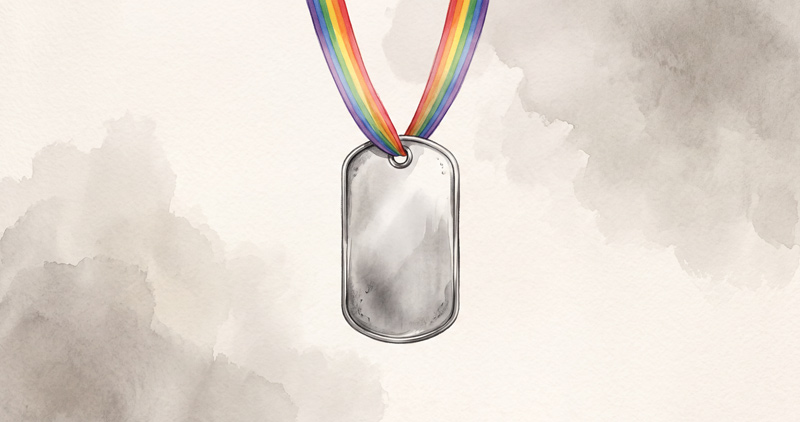
For several decades, however, the Canadian government believed certain individuals were more vulnerable to being targeted by Soviet blackmail. Armed with flawed logic that the so-called “character weakness” of 2SLGBTQI+ members could lead to the release of state secrets, supposed suspects within the military, RCMP and federal public service endured investigations, persecution and ostracization.
The human rights-suppressing campaign became known as the Purge, and it employed many of the same tactics against fellow Canadians that authorities feared the Soviets were using. Pitre was just the latest of an untold number to undergo interrogation.
“I was instructed to go to Halifax without knowing why, and two guys picked me up at the airport. They were completely silent as they drove me to an undisclosed wooded area in an industrial park. I wondered if I was in with the wrong people.
“They got out the car at a warehouse and started questioning me: ‘Who’s the man in the relationship?’ ‘Do you masturbate in front of a mirror?’ Questions like that.”
Pitre was released after three days. Though temporarily permitted to remain in the military, she lost her security clearance on “suspicion of being a homosexual” and was thus forced to retrain as a supply technician. Nevertheless, on Sept. 24, 1980, having been subjected to incessant surveillance, Pitre was discharged.
“I had done a good job and was going to be promoted to corporal before my time, but a captain told me that wasn’t happening and threw my papers in the garbage.
“I left the base totally devastated. I was disconnected. It was surreal. How could I be a threat to my country for just wanting to serve? Why would Canada do that?”
Change arrived in 1992 following the precedent-setting court case of veteran and Purge survivor Michelle Douglas, who sued the Defence Department for infringing on her rights. The historic lawsuit led to Douglas receiving a settlement of $100,000 and, ultimately, the revoking of Canadian Forces Administrative Order 19-20, the policy that helped enable the harmful practices.
But for too many, the damage had already been done. Lives had been ruined during successive decades; others lost to suicide. What’s more, discrimination wouldn’t just end overnight. Pitre, who had dedicated years to advocating for an official apology, was joined by a growing number of voices demanding greater justice.
Nov. 28, 2017, proved to be the turning point. That day, a class action filed against the government on behalf of Purge survivors reached a settlement, which was ratified in June the following year, of $145 million. The compensation package, which awarded between $5,000 and $50,000 to most claimants while committing to reconciliation and memorialization measures, accompanied the assurance that service records would include disclaimers regarding the nature of discharges.
That same day, Prime Minister Justin Trudeau stood in the House of Commons and delivered the words Pitre had long waited—and fought—for.
“To the victims of the Purge…we betrayed you. And we are so sorry,” he announced. “You were not bad soldiers, sailors, airmen and women. You were not predators. And you were not criminals. You served your country with integrity, and veterans you are.”
For Pitre, who embraced the apology even if its lateness “made me a bit angry,” the fight continues. In 2019, she founded the Rainbow Veterans of Canada to “provide a supportive and safe space for CAF veterans impacted by the LGBT Purge along with other CAF veterans who identify as 2SLGBTQI+, while educating and advocating for the rights, benefits and recognition our members deserve.”
As the Rainbow Veterans’ co-chair, Pitre considers placing a wreath at the National War Memorial as one of her “proudest accomplishments.” In the same capacity in 2024, she joined representatives in symbolically breaking the ground for the 2SLGBTQI+ National Monument due to be completed and unveiled later this year in Ottawa.
“We worked so hard to make ourselves better for Canada because we were told we were not worthy of Canada,” said Pitre. “We were a disgrace, we were a threat. But now, with the work we’ve all done, I can finally see that it was about making Canada better.”
Advertisement