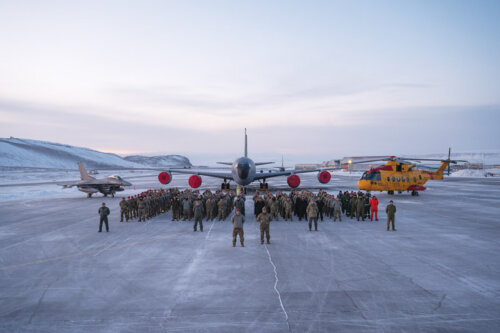






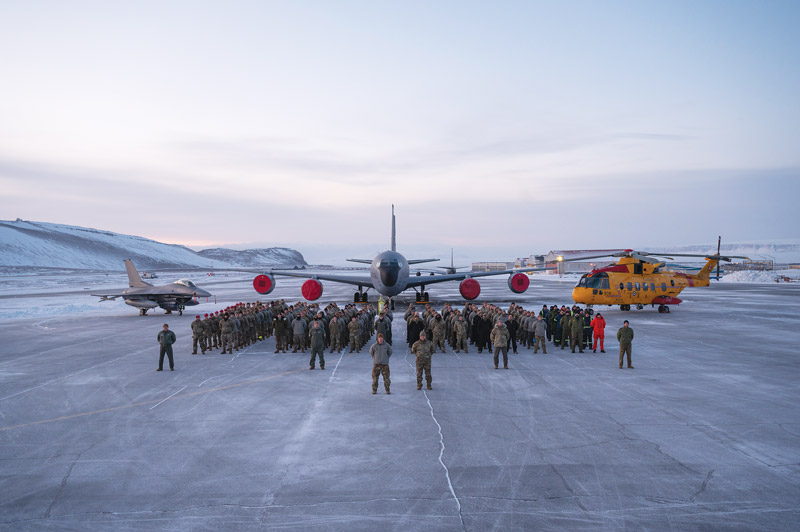
Members of the U.S. Air Force and the Royal Canadian Air Force under the direction of Norad pose for a photo at Pituffik Space Base in Greenland on Feb. 5, 2025. [Technical Sergeant Christopher Ruano/U.S. Air Force]
The recent debate about the merits of the F-35 and the Gripen E fighter jets has highlighted considerations about how Canada plans to reconstitute its air defences. And because that decision impacts the country’s role in the North American Aerospace Defense Command (Norad), it’s critically important. But what exactly is Norad and why does it matter?
Before 1957, Canadian and American air forces had no formal co-operation agreement, despite their shared Cold War hostility to the Soviet Union. At the time, the U.S.S.R. had hundreds of long-range bombers and some 1,600 nuclear warheads. And if the Soviets were to attack Canada or the U.S., the most likely route would cross the Arctic and proceed south over Canada. The Royal Canadian Air Force and the U.S. Air Force felt that an integrated air defence was essential.
Negotiations took place between the government of Prime Minister Louis St-Laurent and the administration of U.S. President Dwight D. Eisenhower, and the details had been hashed out by the time John Diefenbaker’s Progressive Conservatives were elected in 1957. Urged to do so by General Charles Foulkes, chair of the chiefs of staff committee, the new prime minister signed the agreement on May 12, 1958.
Norad was to be headquartered in Colorado with an American commander, while the deputy would always be Canadian; the RCAF’s Norad HQ would be in North Bay, Ont.
Surprisingly, the Liberals were highly critical of the alliance, despite the fact that they had, for all practical purposes, sealed the deal. That annoyed Diefenbaker, and his resentment likely contributed to his fury when the Cuban Missile Crisis erupted in October 1962.
The Soviet Union had secretly moved nuclear missiles to Cuba, just some 150 kilometres from the southern tip of Florida. After the Americans discovered the weapons, President John F. Kennedy demanded they be removed and he put his military on high alert—including U.S. aircraft in Norad. The Americans expected Canada would do likewise.
Although he had been briefed on the matter by U.S. officials, Diefenbaker initially refused. Defence Minister Douglas Harkness argued with him but was rebuffed; Harkness nonetheless quietly put RCAF fighters on alert. Diefenbaker later agreed to the move, but the Kennedy administration was furious, as were many members of cabinet. Shortly thereafter, Diefenbaker’s government couldn’t agree on the acquisition of nuclear warheads for recently purchased BOMARC missiles that were intended to destroy attacking bombers. With his cabinet split on the issue, Diefenbaker’s government lost two non-confidence motions in February 1963 and an election was called. Norad’s two first challenges had played roles in the party’s defeat.
The Liberals won the subsequent election and for years there were no ructions. Norad tweaked its name in 1981, to Aerospace from Air, and added missile surveillance and warnings to its tasks. In the ensuing years, the alliance was tight knit. So much so, that when the Canadian deputy commander happened to be in charge at Norad’s Colorado HQ during the 9/11 terrorist attacks on New York and Washington, no one complained.
But difficulties were brewing. In 2005, Prime Minister Paul Martin’s Liberal government had refused to join a U.S. missile defence program. Surprised, the Pentagon gave the responsibility for it to a command other than Norad. There was a growing sense in Washington that Ottawa wasn’t playing—or paying for—its share in the defence of North America. These concerns increased as Russia and China bolstered their arms production and took greater interest in the Arctic. The U.S. felt it was taking defence seriously; it believed the Canadians seemingly did not.
The Canadian Armed Forces have limited resources in the North—a signals intelligence station at Alert, Nunavut, satellites, a few hundred army regulars, some 4,800 Canadian Rangers, two decades-old icebreakers, 14 surveillance aircraft (for the entire country), and 40-plus-year-old CF-18 fighter jets. The U.S., meanwhile, has an airborne division and modern F-22 and F-35 fighters in Alaska.
When the Canadian deputy commander happened to be in charge at Norad’s Colorado HQ during the 9/11 terrorist attacks, no one complained.
Canada is, however, beginning to upgrade its crucial Norad radars. In 2022, Ottawa pledged $38.6 billion over 20 years for modernized radar and surveillance systems and, in 2025, it purchased over-the-horizon radar systems from Australia, the first phase of which is slated to be operational by 2029 and complete by 2043. Within a decade, the country promises to have new submarines, too, as well as more troops and new fighter jets. But the current lack of military resources in Canada’s North makes Norad all the more important.
Indeed, the RCAF and USAF continue to work together patrolling the North and the Arctic, monitoring Russian military aircraft flying near North American airspace and, in early 2023, even tracking and shooting down a Chinese spy balloon. The balloon, 60 metres high and carrying equipment weighing some 900 kilograms, crossed over Alaska, the Yukon and B.C., then moved diagonally across most of the U.S. before being destroyed near South Carolina.
Should the RCAF have destroyed the balloon over Canada? “That’s just silly,” University of Calgary history professor David Bercuson told CBC at the time. “That just completely ignores the fact that Norad exists [and] that we’re part of it….” Norad handled the issue appropriately, monitoring the balloon, assessing its characteristics and downing it where it couldn’t cause damage and could be further analyzed.
In the process, U.S. air force jets entered Canadian airspace acting under the Norad agreement. If RCAF aircraft had been required in American territory, that too would have occurred. If the U.S. aircraft had been grounded for any reason, Canadian planes would have been tasked for the job. In other words, both countries control their own airspace, but both air forces respond to the directions of Norad commanders. No permission is needed. Both Canadian and American interests are served by the alliance.
Air and space warfare have changed dramatically in recent years, and Norad has adapted—and must continue to do so. That requires Canada to do its part in defending the continent it shares with the U.S. That may be expensive, but the country’s national security demands that Norad remains a priority.
Advertisement