




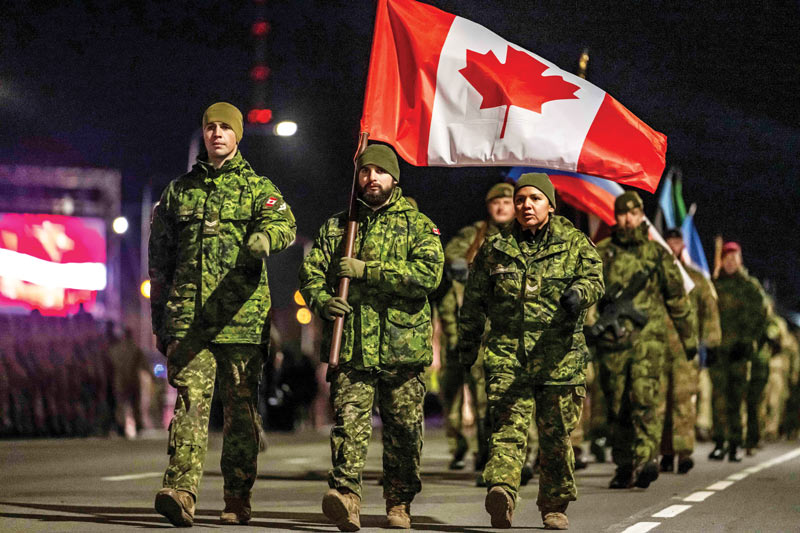
Canadian Armed Forces members participate in a NATO mission parade in Riga, Latvia, on Nov. 18, 2023. [Corporal Lynette Ai Dang/Canadian Armed Forces Photo/Combat Camera]
An Angus Reid Institute poll released in July 2025 offered interesting data on Canadians’ attitudes about their country, the Canadian Armed Forces and their willingness to volunteer if Canada went to war. What’s clear is that opinions vary by age, region and political views—which shouldn’t be surprising. Much less clear is what has shaped these differing positions. As someone who believes it was a great stroke of luck to have been born in Canada and to live in what I have always thought of as a great country, however, some of the data is depressing.
The first question the pollster asked was key: “How proud are you to be a Canadian?” Seventy-nine percent said they were very proud, proud or somewhat proud, with the highest percentage in the Atlantic region (89 per cent) and the lowest (70 per cent) in Alberta; the next lowest, 73 per cent, was in Quebec. Given the separatist sentiment in the latter two provinces, perhaps the numbers may be viewed as somewhat positive. Digging deeper on that question, of those who cast ballots in the 2025 federal election, 85 per cent of Liberal voters and 67 per cent of New Democrat voters were very proud/proud to be Canadian, but only 50 per cent of Conservatives voters and 46 per cent of Bloc Quebecois voters felt the same.
The next question asked if respondents would volunteer for combat service in a war. Only 19 per cent answered yes, although another 30 per cent answered positively if they agreed with the reasons for going to war.
When combining positive responses to each of the two questions, Canadians in the Atlantic region scored highest (56 per cent) with Saskatchewan (43 per cent) and Quebec (41 per cent) the lowest. Meanwhile, Conservative voters (59 per cent) had the highest combined positive response, followed by Liberal (47 per cent), and NDP and Bloc (both 35 per cent) voters.
Again, there are reasons for these results. Quebec is, relatively speaking, unhappy with its place in Canada; and the New Democratic Party has historically been perceived as pacifist and has over the years argued against Canada being dragged into conflict by its allies. Why Conservative voters were so willing to volunteer is unclear.
Notably, only those aged 55 and older offered majority support for volunteering to serve, with 55 per cent indicating they would. Sixty-four per cent of males also responded that way. Perhaps coincidentally, Conservative voters have traditionally been older and male.
Particularly striking, however, was that 55 per cent of men and 38 per cent of women aged 18-34 said they would volunteer. Older people, of course, aren’t as useful in combat; younger people are typically called on to do the bulk of the fighting. Eliminate those physically or mentally unfit for enlistment, and how many would remain?
According to a 2022 Pentagon study, three-quarters of Americans aged 17-24 were ineligible for service because they were either obese, suffering mental or physical issues, or had criminal records. Canada might be in a similar situation. If so, the only way to get enough people to fight for Canada in a major war might well be conscription. Historically, compulsory service in Canada has been contentious, particularly among francophones and some cultural communities. As such, would any government impose conscription?
Sadly, the poll also found feelings about Canada’s military weren’t very positive, having dwindled dramatically in the last few years. In 2019, 79 per cent of Canadians indicated to the pollster that they were proud of the Canadian Armed Forces. Today, only 52 per cent say they are. Again, there are reasons: sexual abuse in the ranks, some right-wing extremists in uniform, and the seemingly ever-present lack of modern equipment and infrastructure.
If so many Canadians no longer view the Canadian Armed Forces positively, why would they volunteer to serve in combat? Patriotism can only go so far, as the recent poll’s results on those who feel proud to be Canadian suggests.
So, why aren’t all Canadians willing to defend their country? Canada has its flaws, of course, but for the last few decades it has focused on many of those errors, mistakes and sins. The 2008-2015 Truth and Reconciliation Commission, for instance, highlighted the ills of the country’s Indigenous residential school system, which was rife with sexual, physical and mental abuse and thousands of children died from a variety of causes, including diseases, while in attendance. And, as the country faced those issues and other social injustices, some Canadians blamed leaders of the past, subsequently arguing, successfully at times, to have their names withdrawn from schools and government infrastructure and have their statues removed.
For instance, John A. Macdonald, the country’s first prime minister, is now being judged by some people by modern standards rather than those of the 19th century in which he lived. History shouldn’t tout only successes, but past errors should be considered along with achievements. When that happens, the willingness of Canadians to defend their country will surely increase.
In 2019, 79 per cent of Canadians indicated to the pollster that were proud of the Canadian Armed Forces. Today, only 52 per cent say they are.
Still, in December 2015, Prime Minister Justin Trudeau called Canada “the first post-national state,” noting there was “no core identity, no mainstream in Canada.” He governed accordingly for the next decade, and as such, there was little effort made to encourage newer Canadians to discover that there is a national identity, a Canadian way, despite how difficult it may be to define. Indeed, even those whose families have lived in the country for generations may have been left puzzled by such leadership. Is it any wonder that some Canadians today then aren’t willing to fight for their country given Trudeau’s post-nationalist ideology that suggested the whole enterprise was unimportant?
The world appears to be in a pre-global war era. Russia’s unprovoked war with Ukraine continues and Moscow has threatened other western countries. China has increased its military spending for 10 straight years and now boasts the world’s second-largest defence budget (after the U.S.). And other countries are at war or showing signs of aggression.
It’s not entirely clear where specifically such a world war would be fought, but it can’t be assumed that Canadian territory would be inviolate. If Canada were to be attacked or, heaven forbid, invaded, most Canadians—including those who aren’t present admirers of the CAF—would almost certainly rally to the defence of their families, friends and homes. Even those most doubtful of their pride in Canada would surely step forward as their forebears did in the wars of the 20th century. Despite its flaws, this country is too precious ever to be lost.
Advertisement