








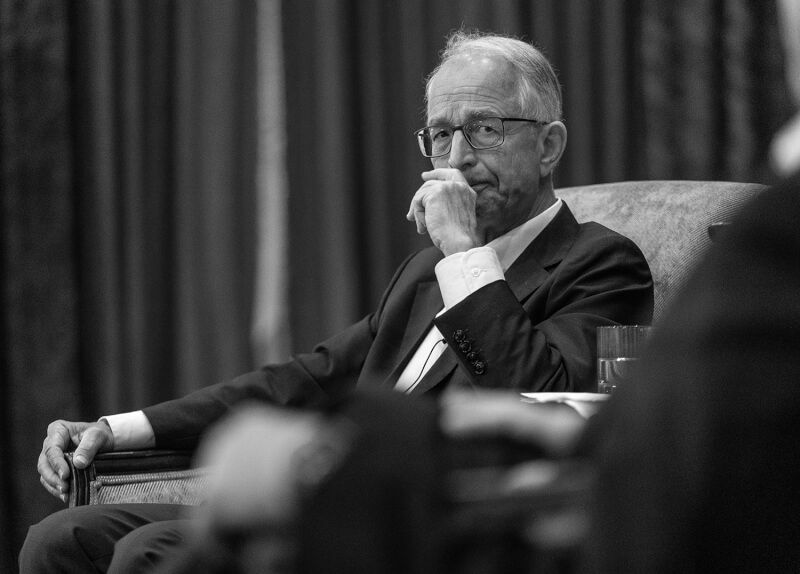
Field Marshal The Lord Richards of Herstmonceux. The five-star rank of field marshal has been the highest rank in the British Army since 1736. Richards’ is one of four living field marshals. [Stephen J. Thorne]
Speaking at a fireside chat ahead of the 35th conference of the Royal Commonwealth Ex-Services League (RCEL), Field Marshal The Lord Richards of Herstmonceux said the United States, Russia and China are steering the world order away from the system of political, legal and economic rules and institutions established by the Americans and their allies after 1945.
The rules-based order has relied on principles such as sovereignty, territorial integrity and dispute resolution through diplomacy. It aimed to promote stability, co-operation and predictability in international relations.
“The rules-based order—that much-vaunted concept—seemed to work if you were the guy imposing the rules, but not necessarily for those who were on the receipt of them,” said Richards. “Are we being hypocritical in our adherence to this rules-based order?”
Field Marshal David Richards is the grand president of the RCEL, which has cared for Empire and Commonwealth veterans in Africa, the Caribbean and Australasia for more than a century.
An artilleryman, he has commanded operations in East Timor, Sierra Leone and Afghanistan, and served as U.K. defence chief from 2009-2013. King Charles recently appointed him to the five-star rank of field marshal, the British Army’s supreme rank since 1736. There are only four living field marshals and 143 in its history.
Speaking before an audience at Ottawa’s Château Laurier hotel, Richards and Canada’s former defence chief, retired general Walt Natynczyk, offered sweeping assessments of the root causes of the instability now at play in the world.
Richards says he believes U.S. President Donald Trump and Russia’s Vladimir Putin are “of a mind to recreate the great power system. And there is something in it, is all I would say.”
“All I’m saying in defence of it—and I’m not an advocate of it because I would wish it wasn’t, perhaps, deemed necessary—but the rules-based order, if we look at it critically…has not been a great success.”
Under the great power system, a few militarily, economically and diplomatically powerful states exert influence on a global scale, shaping international norms, institutions and decision-making processes. The system is characterized by competition and co-operation among these major players, with the potential for both conflict and stability.
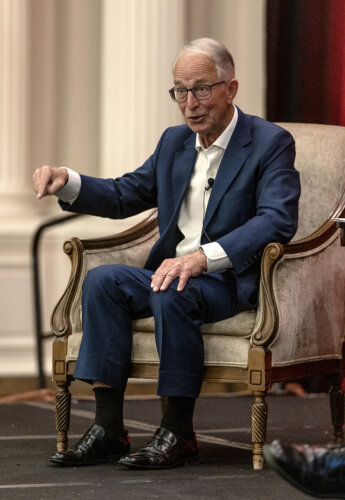
Field Marshal The Lord Richards of Herstmonceux, grand president of the Royal Commonwealth Ex-Services League, drives home a point during the fireside chat. [Stephen J. Thorne]
“Gearing for a war or to deter war through strength, which I’m all for, is not the only thing we should be doing.”
—British Field Marshal David Richards
After some successes enforcing peace in post-communist Eastern Europe and elsewhere, noted Richards, the West encountered “a series of mishaps, and I’m being kind in the use of that term.”
Not everyone agrees with the rules-based order, said Richards, adding “I think we should be humble enough to question: have we got it right? Not necessarily, is my point.”
“If we can somehow in a very complex world bring the big power blocs together to agree on a way ahead in what we in the past would have called a ‘grand strategy’—not a term used very much today—then that would be to all of our benefit,” he said.
“Gearing for a war or to deter war through strength, which I’m all for, is not the only thing we should be doing.”
Richards said he is a great believer in former U.S. president Theodore Roosevelt’s dictum, “speak softly and carry a big stick; you will go far.”
He and Natynczyk acknowledged the benefits of soft power and warned of the consequences of denying or underestimating the effects of climate change and cutting development and humanitarian aid in potentially volatile regions of Africa and elsewhere.
“Disgracefully, we are not helping the nations” that need help, he said, pointedly adding that one of the biggest political issues confronting European politicians is “migration and the numbers that are trying to get into our nations.”
“Well, if it’s such a big political issue—which it is—can’t you see that by putting a finger in the dike of whatever country might be the right way strategically to resolve your problem?
“No, they think tactically.”
In other words: what will bring the most votes in the next election?
The field marshal pointed to Switzerland and the city state of Singapore as examples of successes through grand strategies—“prosperous, single-minded states that know where [they] want to go.”
“Often I’d say, which countries have got a national grand strategy? Where are the statesmen of this era? Well, I think, whether one likes him or not, [Chinese] President Xi has got a grand strategy.”
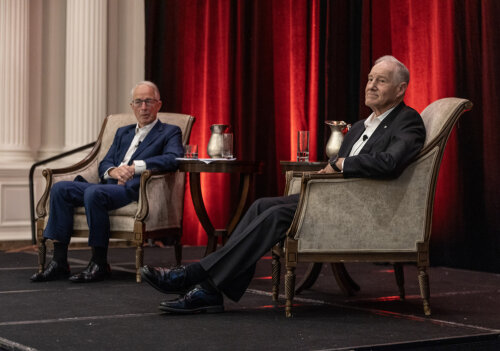
Field Marshal The Lord Richards of Herstmonceux and retired Canadian general Walt Natynczyk held a two-hour fireside chat on the state of the world prior to the 35th conference of the Royal Commonwealth Ex-services League in Ottawa. [Stephen J. Thorne]
“It makes it more difficult for western politicians to compete with these people simply because they’d never really thought about it.”
—British Field Marshal David Richards
He noted leaders such as Xi Jinping and Russian President Vladmir Putin have a lifetime in their work whereas “our leaders, on the whole, they sort of decide to go into politics; they’re ex-teachers, bankers, whatever they might be. They haven’t probably thought much about this, in most cases. But President Putin, he’s been involved in this stuff all of his professional life, thinking about it. It’s in his genes, if you like.
“It makes it more difficult for western politicians to compete with these people simply because they’d never really thought about it until they suddenly find themselves [confronted by] problems they must help solve.”
Richards said values-driven wars, such as Afghanistan—which he called a failure—rarely achieve desired outcomes or prove to be in the national interest.
“It’s a very hard message,” he said. “As one who has had the responsibility of commanding—the great privilege, by the way—of commanding service men and women on operations, you think this a lot: ‘Is this right?’ And as you say goodbye to them from some airfield in Afghanistan in their coffins, you’ve got to think this through.”
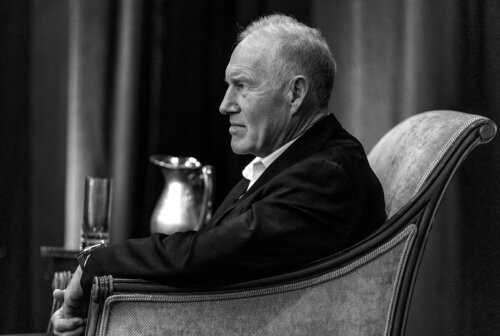
Retired general Walt Natynczyk is a former Canadian defence chief. He served on peacekeeping missions in Cyprus, Bosnia and Herzegovina, and as deputy commanding general of III (US) Armored Corps, with which he deployed to Baghdad in 1998-99. [Stephen J. Thorne]
Richards remembered how former British PM Margaret Thatcher would come down to the military operations centre once a year to be “put through her paces” in a crisis exercise leading up to a potential nuclear war.
He said that when he was defence chief, he would propose the same to his political higher ups. “They said they would, but they never did.”
The Cold War, he said, “was won without anyone actually dying from the Cold War because we played the long game.”
“We need to have more strategic patience in our strategy, which the Chinese do have, by the way. Who’s going into Afghanistan, that cradle of so much that went wrong in the past? The Chinese. So that’s one place where I think we ought to be a little bit more generous or people will fill the void that we are creating.”
Advertisement