








One could almost see it—and certainly sense its poignant presence.
A short walk from Ottawa’s Westin Hotel stands the looming granite and bronze of Canada’s National War Memorial. Officially unveiled in 1939 as the clouds of conflict gathered anew, its great facade goes by a second name: The Response.
In the hotel’s conference rooms from Oct. 20-22, 2025, a clearly different, but likewise essential, call to action occurred at the 14th Canadian Institute for Military and Veteran Health Research (CIMVHR) annual forum. There, some 830 scientists, academic researchers, entrepreneurs, military personnel—both former and active—and numerous other attendees were galvanized by one shared goal-turned-motto: “serving those who serve us.”
Boasting four keynote and 140 podium addresses, 38 sponsors and booths, and 99 poster presentations, Nick Held, CIMVHR’s interim scientific director, kicked off proceedings: “Each year, we set out to make this forum the best we’ve ever had. The exciting news is—with 308 new faces—we’re off to a good start.”
The initial plenary continued with a speech from Minister of Veterans Affairs Jill McKnight. Praising thought leaders for striving toward a “healthier tomorrow,” the cabinet newcomer insisted that their efforts “can be witnessed in people’s real lives, in the pain that finally relents, the service member who returns to work or school, the parent who shows up again for their children, and in the veteran who chooses to live another day,” she said.
Day 1’s subsequent keynote address followed a panel discussion moderated by Nicola Fear, a professor at King’s College London involved with military health research for more than 20 years. Sharing the stage were Bryan Garber, who heads a research team at the Canadian Forces Health Services Group; Julie Drury, acting director general within the policy and research directorate of Veterans Affairs Canada; Jennifer Unger, director of the national search and rescue secretariat; and John Lane, chief psychiatrist for the Department of Veterans’ Affairs in Australia.
Covering a broad range of topics, the conversation eventually turned to similarities between Canada and its ally down under, including the barriers to supporting rural and remote veterans. “Australians and Canadians have served in multiple different theatres of war,” added Lane, “so we have very similar values in terms of service and in the way we expect our veterans to be managed when they come home. In terms of research and policy, though, there are definitely cautionary tales.”
Among those, Lane highlighted the pitfalls of allowing public opinion instead of evidence to drive government strategies, citing marijuana as one prime example. “In Australia, we are on track to spend more on medicinal cannabis than we spend on veterans seeing their GPs for primary health care by the end of the year, which is phenomenally ridiculous.”
The expert also assserted that “the evidence for cannabis [use] for mental health issues is basically non-existent. In fact, there is significant evidence for adverse outcomes.” Doubtless, some in the audience—and beyond—maintained differing opinions.
Veterans Affairs epidemiologist Andrea Jones, carried out Day 2’s keynote address, delving into cancer incidence in CAF personnel and veterans from 1976 to 2016. Suggesting that those individuals may “potentially have unique [cancer] risk profiles that differ from their general population
counterparts,” Jones laid out the findings for approximately 210,000 men and 35,000 “often under-represented” women in uniform. Crude rates for male active members indicated that cancers of the testes, melanoma and prostate were among the most prevalent. For male veterans, Jones noted that “prostate, colorectal and lung and bronchus cancer” were most common.
For female members and veterans, meanwhile, breast cancer posed the greatest risk in both communities, although thyroid and melanoma for the former, and lung, bronchus and colorectal in the latter groups were most prevalent. Despite this, only one type of cancer—melanoma—seemed to occur more in the overall study group compared to the civilian population.
The research didn’t control for health behaviours nor ethnicity, which may be relevant to the higher prevalence of melanoma, cautioned Jones, adding that the Defence Department will conduct a review of sun protection policies and practices for CAF personnel, among other initiatives.
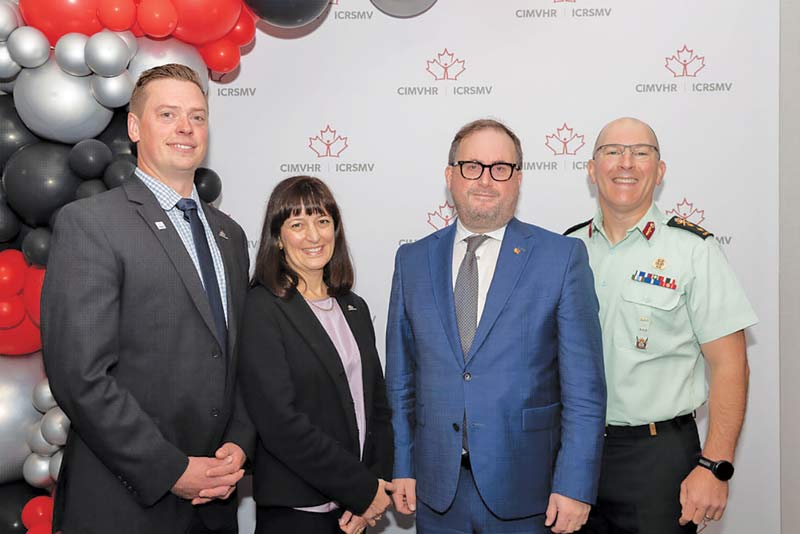
CIMVHR’s interim scientific director Nick Held and its associate scientific director Stéphanie Bélanger with event guests Deputy Minister of Veterans Affairs Paul Ledwell and CAF Surgeon General Scott Malcolm. [Courtesy CIMVHR/Sarah Bradley @ iShootEvents]
On the final day, the discussion took a decidedly northern direction once Major Tristan Alie and Master Corporal Laurent Belanger took the stage. For their presentation, the duo delivered insights into the trials and tribulations of operational resiliency for CAF personnel in remote regions, namely the Arctic, and the issues concerning their medical care.
Alie touched on how climate change is enabling NATO adversaries to encroach on Canadian sovereignty, affirming that “we need to own the solutions.” In asserting that sovereignty through CAF presence, however, the major highlighted multiple dangers encountered by its members, a reality emphasized by Belanger when he provided a vivid description of his own experiences on an exercise in the Arctic.
Alie then spoke of the logistical issues with Arctic blood transfusions: “There are about 12 units of blood in Iqaluit. There are two more in Cambridge Bay, and two more in Rankin Inlet. That’s a total of just 16. A trauma patient may require anywhere between two and eight units of blood. To compare, the Civic Hospital—our trauma hospital in Ottawa—has about 150 units of blood.”
Geographic and climatic conditions were two tremendous challenges to address in patient evacuation. Further, noted Alie, “there are just three hospitals with surgical capacities in the North: Iqaluit, Whitehorse and Yellowknife. If you’re looking at a map, there’s a big empty space without any surgical care. We need to fill the void.”
Their efforts “can be witnessed in people’s real lives, in the pain that finally relents, and in the veteran who chooses to live another day.”
Veteran Health Scholarships
The Royal Canadian Legion’s national President Berkley Lawrence announced the 2025 recipient for the organization’s Doctoral Scholarship in Military and Veteran Health Research. The initiative, totalling $50,000, went to Kim Huynh of Queen’s University in Kingston, Ont., for the student’s work in assessing the effects of non-concussive impacts on brain physiology in military personnel.
Meanwhile, retired vice-admiral and RCL Grand President Larry Murray presented a masters scholarship on behalf of The Legion National Foundation. Anne-Sophie Côté from Université Laval in Quebec City earned the $30,000 grant for her project entitled “Preventing hearing problems in Canadian military personnel.” Côté will focus on “validating a novel in-ear device that will measure real-time noise exposures and cochlear vulnerability,” which could revolutionize future prevention measures.
Advertisement