





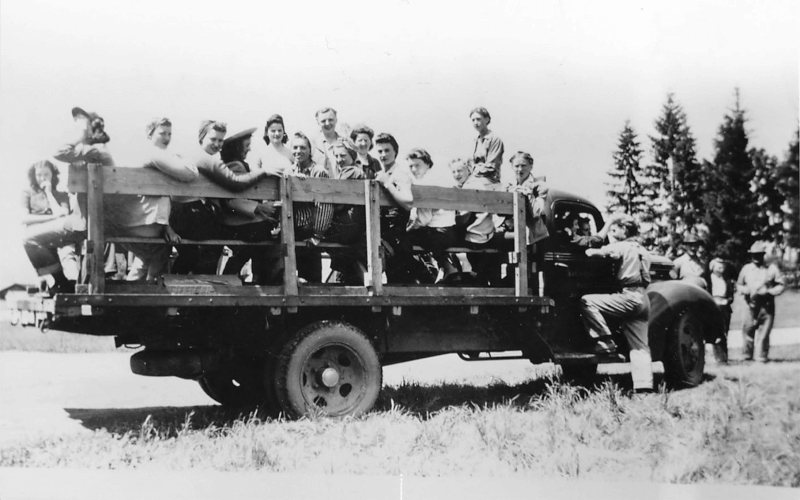
Women workers at B.C.’s Coldstream Ranch are trucked to orchards and fields in 1946. [courtesy Museum and Archives of Vernon]
“We often generalize the participation of women in the Second World War,” said historian Kelsey M. Lonie, “but in a country as large as Canada, regional differences contributed significantly to the opportunities and willingness of women to volunteer.”
Such was the case of Prairie women and girls, many of whom sought service in B.C.’s agricultural sector, plugging gaps left by men and, moreover, the province’s own female workers who often pursued alternative war industries.
Now, their exploits have been highlighted in Lonie’s latest book, A Vacation for Victory: An Illustrated History of the Women’s Land Army in Canada. So named because of recruitment drives that occasionally framed the role as a holiday rather than strenuous labour, the new publication—scheduled to be released on May 19, 2026—offers a comprehensive yet nuanced exploration of these farmerettes, all against the backdrop of the broader food story in WW II.
Lonie spoke to Legion Magazine about their long-unsung efforts.
Historian Kelsey M. Lonie’s latest book, A Vacation for Victory: An Illustrated History of the Women’s Land Army in Canada, explores Prairie women working on B.C. farms during WW II. [Courtesy Kelsey M. Lonie]
On a familial Farmerette connection
I grew up partly raised by my grandparents, who had both served in the Second World War. My grandpa was in the army and my grandmother was on the home front. I was always fascinated by their stories, their resiliency.
My grandma would talk about what it was like in Saskatchewan, having grown up on a farm north of Prince Albert. Farmers were such a necessary part of wartime production, feeding civilians and soldiers and Allied countries that were cut off from other food supplies. By the time the Second World War rolled around, she and her five sisters were basically running the farm.
One story that really stood out from the war was that she would travel in the summers to British Columbia to pick fruit. She would live in a cabin, meet all sorts of interesting characters, make new friends, make some money, then come back home to help with the harvest in the fall.
During the COVID-19 pandemic, I got a little bit tired of teaching, so I took a sabbatical to pursue a master’s degree in history. At the same time, I heard author Bonnie Sitter talking about fruit-picking girls in Ontario called farmerettes. She had co-written a book called Onion Skins and Peach Fuzz on the topic. I thought that that sounded like what my grandma did in B.C.
Some quick Google searches didn’t really bring up a lot of results, so I went to the Saskatchewan provincial archives and there it was: Women’s Land Army in British Columbia [during the] Second World War. “Bingo,” I said and I decided I would do my master’s degree on it.
When it was done, my supervisor said that it could be a book. I reached out to McGill-Queen’s University Press, and the rest is history.
On B.C. farming before WW II
There was almost a college-girl elite to women picking fruit in B.C. during the First World War because there had been an [earlier] influx of gentleman farmers. These were very wealthy young men who came over from Britain to start fruit orchards in the Okanagan region, and who brought with them this elitist culture.
When the young men went off to war, women from high social standings came in to fill the void. They would come out with a matron who took care of them. They would then pick fruit and attend parties.
B.C., however, really changed in the inter-war period. The gentleman farmer era came to a close. Men came back from the war, and they didn’t really want to go back to orchard life. Instead, other people—Polish immigrants, Doukhobors [an ethno-religious group of Russian origin] and Japanese-Canadians—took it over, all trying to eke out a living.
When the Second World War began and authorities were asking B.C. women to serve, the young women of the region wanted to get out. They wanted to find better-paying work along the coast where the shipyards were, many of which were offering an equal wage to men. Meanwhile, women along the coast showed no interest in moving inland to regions that were isolated.
On the mobilization of Prairie women
A very different group of people had settled in the Prairie provinces. They knew that farming was what they had immigrated for. They started homesteads, had children, then encountered a serious lack of ability to grow anything, especially in Palliser’s Triangle, the southern part of Saskatchewan into Alberta.
The Great Depression may have exacerbated things, but there was already a serious lack of anything really growing from the 1920s onward.
It was horrific. People were starving and hopeless. By the time the Second World War started, however, the women saw an opportunity to travel and conduct work for a wage when they were already doing the same job for free on their own farms. It sounded so appealing that they came out in droves.
On the B.C. farmerette program of WW II
There were women who were transferred by train all the way across two provinces, bringing their supplies with them. They were dropped off at a train station, picked up by one of the farm labour program representatives, and taken to these little shacks—and really, shacks are what they were.
Every day, a farmer would come and request, say, 12 labourers. Twelve women would then get on the truck with him and go to his orchard or field and work. Sometimes, they were climbing ladders and they were often carrying big baskets around their neck and shoulders. At the end of the day, they were paid before returning to their shacks, and the food they were given was any extra produce from the day’s harvest. A lot of women survived on fruits and vegetables.
If I argued anything in the book, it was that they certainly left a legacy and that it shaped and redefined and expanded the roles and identities of these women and girls. Their stories are equally powerful—but in different ways—to the wartime women we hear about more regularly, such as Rosie the Riveter.
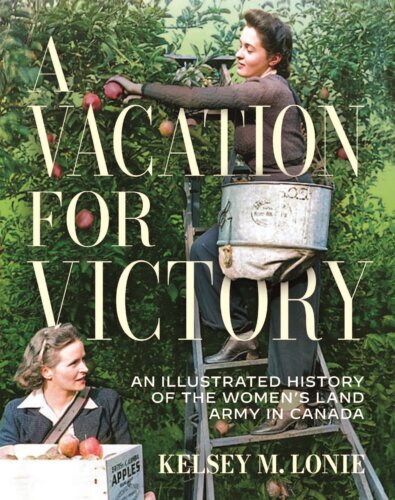
Lonie’s latest book, A Vacation for Victory. [McGill-Queen’s University Press]
On highlighting their service in print
One of the biggest challenges was finding their voices. There aren’t many first-hand accounts from these women when they were actually there, but you certainly see what they achieved in photographs. You also hear it in oral history, in stories passed down through their children and grandchildren.
It’s interesting because they had remarkably positive stories. Of course, nothing is perfect—they didn’t always have sunny days, so to speak—but their recollections are still so positive, with friendships that lasted a long time.
I don’t think there’s any one reason that they’ve been forgotten for so long, but I think it’s time that changed. It’s about peeling back those layers, finding those stories, and making sure they’re told.
Advertisement