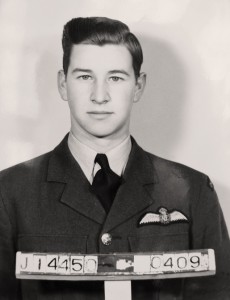



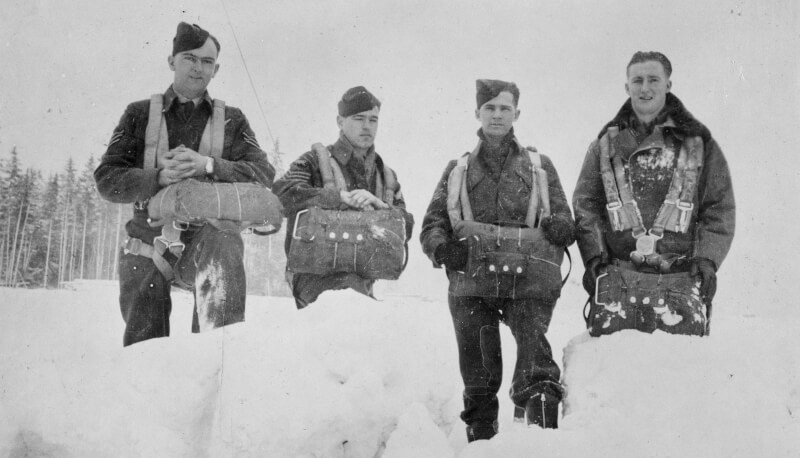
Australian arimen attend a training school in Saskatchewan in 1942. [Australian War Memorial]
“In Australia, just as in Canada,” explained Karl James, head of military history at the Australian War Memorial, “there has been much political and popular discussion surrounding the stability and reliability of our great and powerful allies. Many of the assumptions and defence assurances that the western Allies have taken for granted in the years since the Second World War are being tested.”
The author and editor cited the works of his Canadian colleagues, Marc Milner’sSecond Front (2025) and the late Tim Cook’s The Good Allies (2024), as prime examples of recent discourse on such topics, notably within the context of Canada’s relationship with the U.S. and U.K.
“The emphasis on our shared traditional allies, Great Britain and the United States,” he continued, “is understandable. It has meant that other bonds, such as those far across the Pacific Ocean, have been neglected.”
Australians and Canadians served and sacrificed on many of the same battlefields of the 20th and 21st centuries’ greatest conflicts, from the trenches of Gallipoli to the quagmire of Passchendaele to the hills of Kapyong. These are just some of the names that resonate in countries half a world away from each other.
In a Legion Magazine exclusive, James shed light on an unsung fellowship.
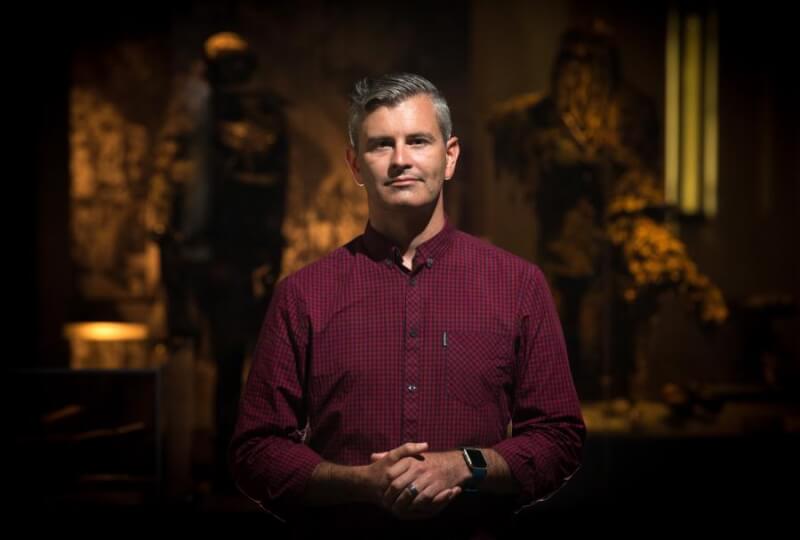
Karl James, head of military history at the Australian War Memorial. [Australian War Memorial]
On colonial-era ties
As former colonies and then dominions of the British Empire, Australia and Canada have historical points of similarity, such as conflict with our respective Indigenous Peoples, to the shared association with navigator and explorer Captain James Cook.
The first Australian military units to participate in a British Imperial expeditionary force were sent to Sudan in 1885, the same conflict that saw Canada’s first participation in an overseas war. In South Africa, Australian and Canadian mounted units served alongside each other during the Boer War between 1899 and 1902.
On Australian-Canadian interactions in WW I
During the First World War, Australian forces were engaged at Anzac on the Gallipoli peninsula in 1915. The Newfoundland Regiment fought further south, around Suvla Bay, as part of a larger British formation.
It was not until the Western Front that Australians and Canadians encountered each other in large numbers and shared similar experiences. They participated, most notably in 1917, during different phases of the Battle of Passchendaele, Belgium, and together again to inflict the “black day of the German Army” on Aug. 8, 1918, during the Battle of Amiens in France.
Enduring parallel experiences and suffering similar losses, Lieutenant-General John Monash’s Australian Corps and Lieutenant-General Arthur Currie’s Canadian Corps both played crucial roles. Both formations have been labelled as the “shock troops” of the British army, while Monash and Currie continue to be celebrated, even a century later, as “the best” generals of the war.
Although respecting each other’s martial abilities and well-won reputations, out of the lines, Australian troops rarely got along well with the Canadians, whom the diggers often referred to as “cousins.” Perhaps, as one Australian historian has suggested, this was because neither sensed the need to impress or curry favour with the other. Possibly, too, it was just nationalistic rivalry.
This was exemplified in the lingering question as to who killed the German ace Manfred von Richthofen, the Red Baron, in April 1918. Was it the Canadian pilot Captain Arthur Roy Brown or was Richthofen shot down by ground fire from Australian troops? It was the latter.
On shared service in WW II
A generation later, Australian and Canadian ground and naval forces served mainly in different theatres during the Second World War. Australian troops fought in the Mediterranean, the Middle East, the Indian Ocean, Singapore, and the South West Pacific. Canadian ships and troops were concentrated in the Atlantic, Hong Kong, Italy and northwest Europe.
There were exceptions, of course. Australian naval officers and ratings operated landing craft during the ill-fated Dieppe Raid in northern France in August 1942. Two Australians are known to have served in the Canadian Army during the Normandy Campaign in 1944, the most prominent being Brigadier (later Major-General) John (Rocky) Rockingham.
It was the air war over occupied Europe that saw the most significant co-operation and partnership during the war.
Through the Empire Air Training Scheme—or in Canada, the British Commonwealth Air Training Plan—some 10,000 Australian aircrew received advance training in Canada before heading to Britain to serve with the Royal Air Force’s Bomber Command or in other roles.
Most Australian airmen served in non-Royal Australian Air Force squadrons. It was not unusual to find an Australian flying—and becoming a casualty—alongside Brits, Canadians, New Zealanders and others in the same aircraft. More than 200 Australian airmen died serving in Royal Canadian Air Force squadrons. One hundred and forty-nine of these airmen are buried in Canada.
From 1944, there was speculation or hope that a Commonwealth army could be based in Australia to serve in the Pacific or Asia, fighting to liberate Malaya or to participate in the invasion of Japan. It did not eventuate during that conflict.
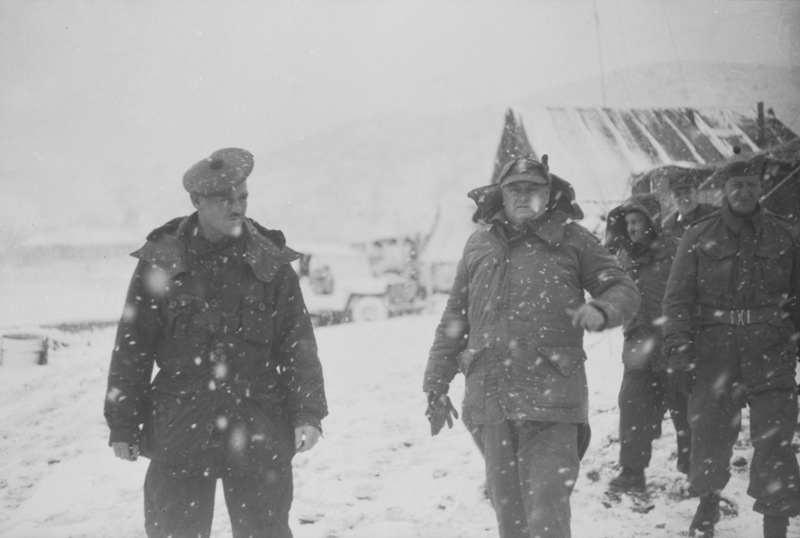
Australian-born Canadian Brigadier John (Rocky) Rockingham in Korea in December 1951. [Australian War Memorial.]
On Cold War co-operation
In the Korean War, Australian, British and Canadian battalions again served side by side, most notably during the Battle of Kapyong and the Battle of Maryang San in April and October 1951. These were key actions that helped defeat the Chinese offensive threatening Seoul.
Later in the Cold War, however, Australia’s and Canada’s priorities diverged. Each country took a more independent outlook. Australia focused on Southeast Asia and, later, the defence of mainland Australia. Meanwhile, Canada looked to NATO and took a leading role in peacekeeping operations.
On the modern-day bond
Since the 1990s, Australia and Canada have served simultaneously on 25 United Nations and multinational peacekeeping missions across the globe: in Africa, the Americas, Asia, Europe, and the Middle East.
The deployment to Cambodia and East Timor saw the closest Australian and Canadian co-operation. In Dili [the capital of East Timor], Australian visitors to the Canadian headquarters were amused to see that the Canadians, not yet acclimatized to Timor’s heat and humidity, had painted a snowy scene on the wall in the foyer.
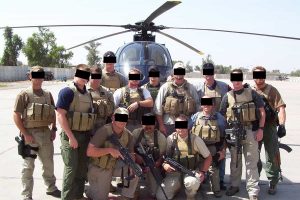
More recently, the cousins were reunited in southern Afghanistan in the 2000s. Australian and Canadian special forces operated together, and several RCAF pilots were embedded in the Australian army’s Chinook helicopter detachment based at Kandahar Airfield (KAF). Indeed, Australian personnel posted to KAF all seem to have enjoyed Tim Hortons’ coffee and donuts on The Boardwalk; such recollections feature strongly in veteran interviews.
When looking back on our shared historical roots and experiences from South Africa to South Korea, John Blaxland, an Australian professor of intelligence and strategic studies, has assessed that Australia and Canada are “‘Strategic Cousins,’ albeit distant ones.”
Already intelligence partners as members of the Five Eyes (along with the U.S., U.K. and New Zealand), Australian and Canadian forces may again find themselves allies fighting alongside each other in the future battle space of the 21st century.
This interview has been edited for brevity and clarity.
Advertisement