



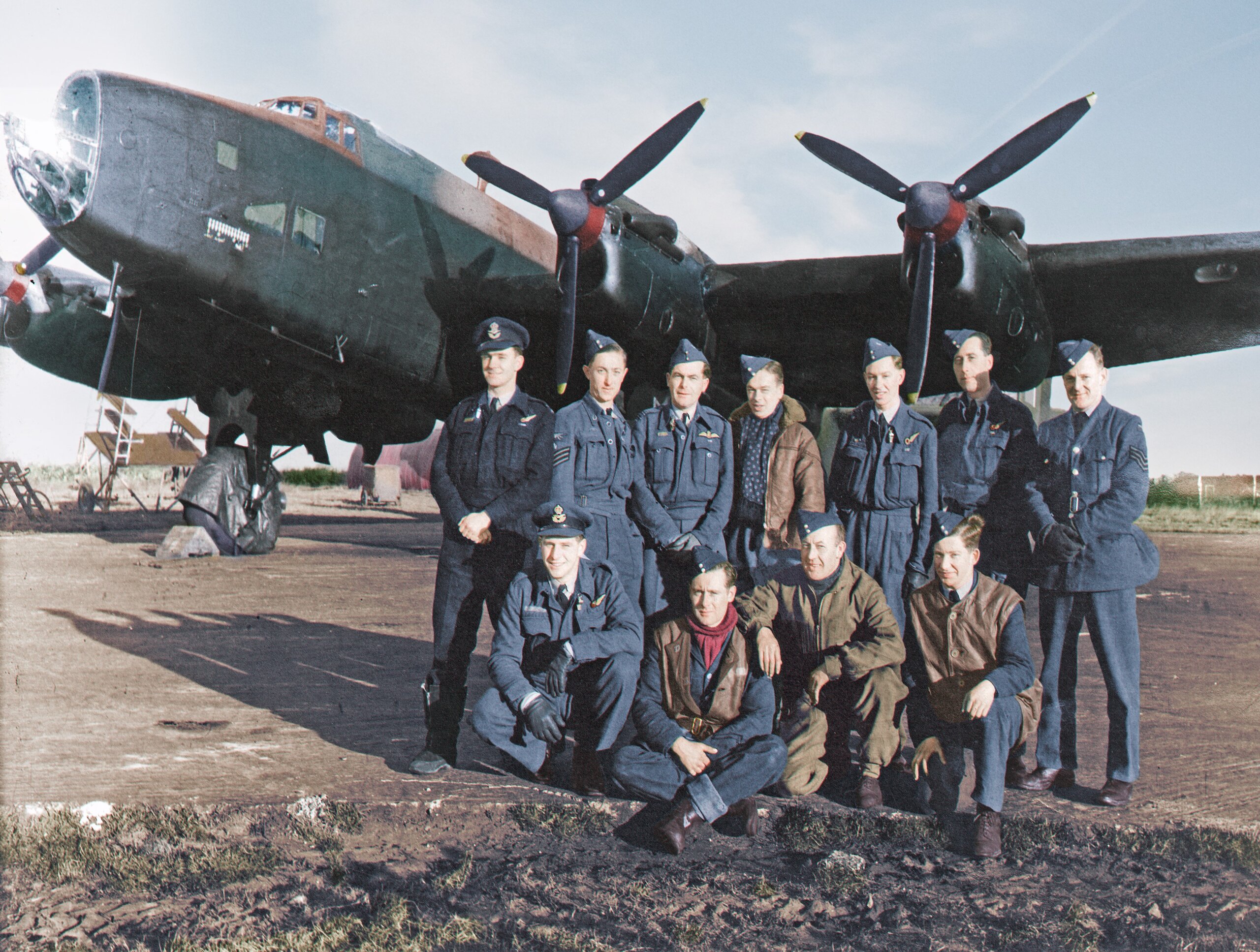
A crew of 10 Squadron, Royal Air Force, that undertook five mine-laying, or gardening, operations in early 1944. [Courtesy Jane Gulliford Lowes]
Forget-me-nots and nectarines; broccoli and sweet pea; daffodil and quince. These aren’t words typically associated with the Royal Air Force’s Bomber Command, including its Canadian formations, during the Second World War.
The Ruhr, perhaps; Berlin and Hamburg, certainly—and Dresden. Such names, controversial though some might be, resonate.
Nevertheless, argues British historian Jane Gulliford Lowes, there’s an untold air war story in the likes of geraniums and jasmines.

“Bomber Command needed code words when it implemented mine-laying operations from the spring of 1940,” she explained, referring to the RAF’s campaign to disrupt enemy shipping in German-held coastal and inland waters.
“It could have been almost anything. It could have been cricket terminology or dog breeds, but they instead used a horticultural theme.”
So it was that minefields laid by airmen were labelled “nasturtium” and “radish” to baffle adversarial ears. So it was that the sorties themselves became known as “gardening” operations, sowing chaos and ensuring that substantial Reich resources were diverted for defence.
Success, however, came at the cost of an estimated 450 Allied aircraft.
Gulliford Lowes, who also co-hosts the “Never Mind the Dambusters” podcast, has since highlighted the story—not least its Canadian connections—in her latest book, The Invisible Campaign: Bomber Command Gardening Operations 1940-1945.
Here, in a Legion Magazine exclusive, the author unearths the tale.

Historian Jane Gulliford Lowes, author of The Invisible Campaign: Bomber Command Gardening Operations 1940-1945. [Courtesy Jane Gulliford Lowes]
On the book’s origins
This all really stemmed from when I was writing my second book, Above Us, The Stars: 10 Squadron Bomber Command – The Wireless Operator’s Story. That was a story about the crew of my great uncle, a chap called Jack Clyde. They served between May ’43 and March ’44, including on mine-laying operations.
When I was researching the story, I barely found any information about these types of operations. It was strange because this was quite a big part of what Bomber Command did, so that made me really curious as to why this particular subject had been ignored by so many historians.
I started doing a master’s degree and I decided to research this topic for my thesis. That’s basically where the book sprang from.
On mine-laying operations
Gardening operations involved aircraft laying usually magnetic mines in shallow waters to target enemy shipping. Why were aircraft doing it? Because they could get into places that the Royal Navy couldn’t.
We’re not talking about dropping mines in the middle of the ocean. That’s what the navy does best. No, we’re talking about flying low over enemy coasts, into harbours and along estuaries, ports, rivers, canals and more.
Nearly every Second World War bomber under Bomber Command was used for gardening operations, which gives you an indication of just how important these operations were. Bomber aircraft were adapted specifically so they could carry these mines, beginning in 1940 with Hampdens. We then moved on to Manchesters, Bostons, Halifaxes, Lancasters, Stirlings, Wellingtons, and Blenheims [among others].
The mines could lie there for months, even years, before anything happened. Obviously, that meant that there were no instant results, nothing to see, nothing to report back. It was considered a fairly routine and non-glamorous task because of that.
For a time, the RAF policy was to send newbie crews out to get a bit of experience, the thought being that these operations were less dangerous. However, the policy was quickly scrapped because it was realized that mine laying was just as dangerous as everything else.
On the stakes
At the beginning of the campaign, mines had to be laid at very, very low altitudes in heavily defended areas. In ’41, ’42 and early ’43, losses were very high.
And then there was the weather. [Bomber Command overseer] Arthur Harris came up with a technically brilliant plan to ensure that his limited resources were put to the best use: airmen bombed in good weather and undertook mine-laying operations in bad weather.
This then meant flying in appalling conditions, always at night and often in the absolute depth of winter. Lots of airmen ended up in the North Sea—no one ever saw or heard from them again.
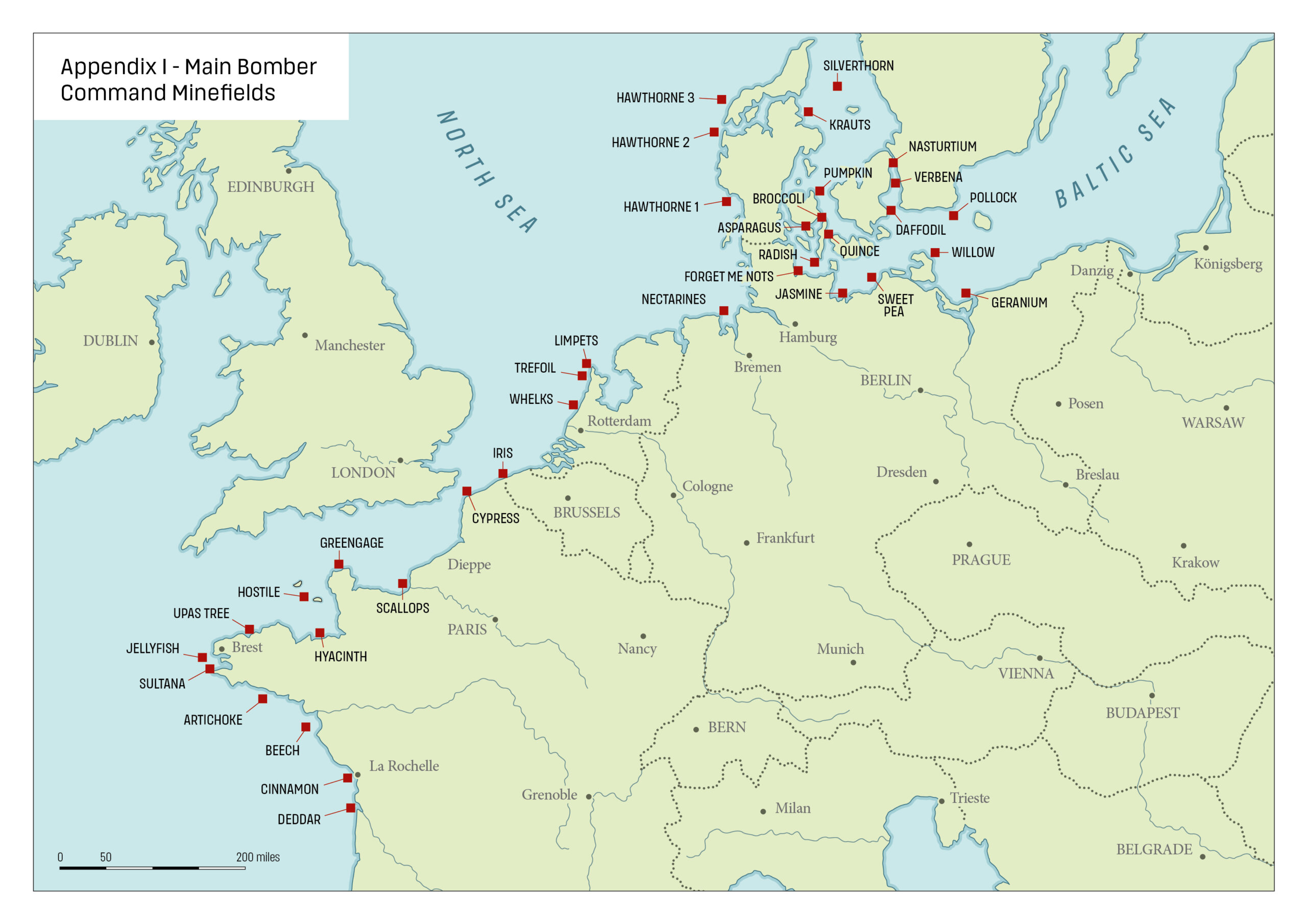
A map of Bomber Command WW II minefields. [Courtesy Jane Gulliford Lowes]
On Canadian involvement
Canadians made a massive contribution to Bomber Command, particularly in 4 Group and, later, in 6 Group. The Canadians and their Halifaxes were involved in a great deal of mine laying.
There’s one really tragic story that wasn’t uncommon, unfortunately. There was a mine-laying operation on the evening of May 12, 1944, with Mosquitos from 692 and 139 Squadrons [tasked with mining the Kiel Canal in Germany]. One aircraft failed to return after being shot down by a German night fighter. Both men, pilot officers [David] Burnett and [George] Hume, bailed out safely but were murdered by local Nazi party officials. They were buried in a sandpit close to the canal.
Hume was later interred in Hamburg cemetery, but Burnett’s body was never recovered; he’s commemorated on [Britain’s] Runnymede [Air Forces] Memorial.
On mine-laying misconceptions
First, the campaign wasn’t widely understood, either at the time or in the years since. I think there was a view, certainly within the RAF and the wider armed forces, that these mine-laying operations were basically just doing a favour for the Royal Navy. That couldn’t be further from the truth.
There is another myth that mine laying was the easy option compared to strategic bombing. It absolutely was not.
There’s also this idea that Harris thought it was a waste of time. That’s again completely incorrect. I think that misconception comes from his correspondence leading up to D-Day, when he complained about the number of mine-laying operations that his men were undertaking. He’s not saying it’s a waste of time; he’s simply complaining about everything Bomber Command is expected to do in the run-up to D-Day.
On the legacy of gardening operations
When I give talks on this subject, one of the first questions I ask the room is, “how many ships do you think RAF Bomber Command sunk through these operations?” People will often say 30, 40, maybe 50 tops. The answer is around 750.
I wanted to ensure that the achievements of these men were recognized because they’ve been almost completely dismissed. They’ve been largely written out of history. That’s why, throughout my book, I’ve tried to include many of the human stories—stories like Burnett and Hume—so as not to focus purely on the academic arguments. I hope I’ve been able to achieve that.
Advertisement