








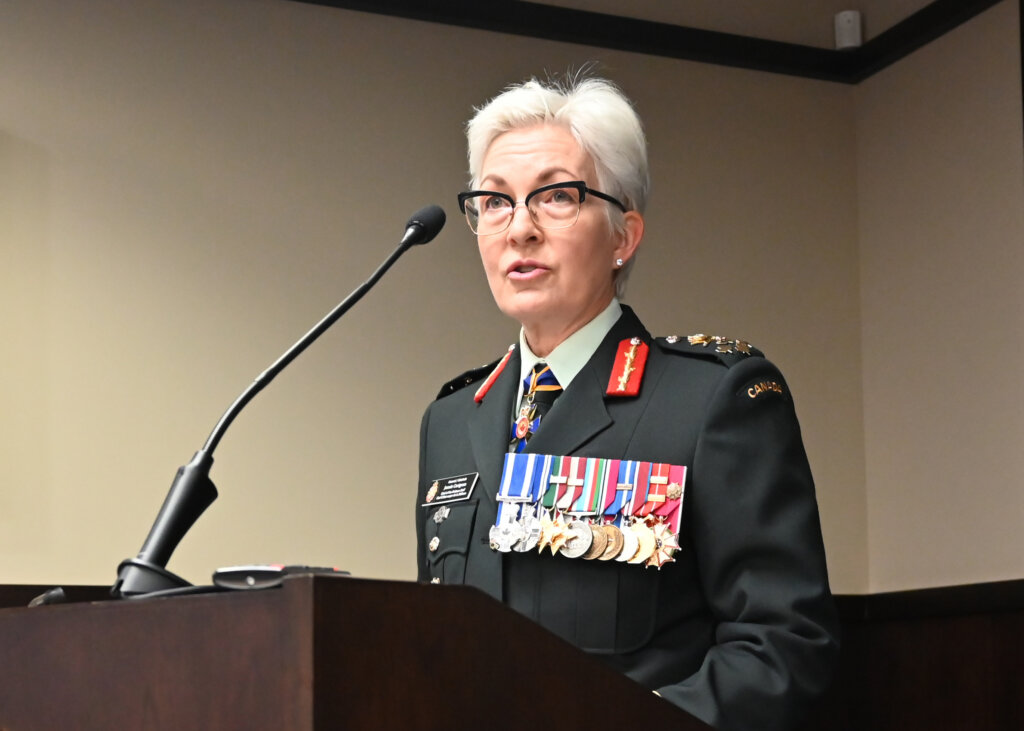
Defence Chief General Jennie Carignan addresses The Royal Canadian Legion’s Dominion Executive Council in April 2025. [Aaron Kylie/LM]
General Jennie Carignan has an idea of how she went from aspiring dancer to military recruit to Canada’s defence chief. “In a nutshell, I would say it’s the diversity of experiences, the diversity of positions and types of missions, and layered on top of that, education to be prepared for different situations.”
Born in Asbestos (now Val-des-Sources), Que., Carignan enlisted in the Canadian Armed Forces in 1986. “I basically left home to join the military at 17 years old,” she said, having been raised in a family with a history of service. Whether such realities ultimately influenced her career trajectory, however, is less certain to her.
“I probably didn’t pay much attention to my [police officer] father’s lifestyle, but I do remember, of course, the uniform, the weapon, the sense of authority, and the importance of his role within our community. Maybe unconsciously, this was part of my decision process to join the military.”
Motivations aside, Carignan rose through the ranks, taking her to the Golan Heights, Bosnia, Afghanistan and Iraq—and, of course, to the most senior military position in Canada on July 18, 2024.
Today, Carignan presides over an institution striving for change, from its practical applications in an increasingly turbulent world to its cultural identity and beyond. In a Legion Magazine exclusive, the defence chief makes her case that the CAF is up to the task—both in 2026 and well into the future.
On today’s broad geopolitical climate
I like to describe the environment as VUCA: volatile, uncertain, chaotic and ambiguous. That’s the acronym that resonates and describes best what I observe and what we live.
I think my experience has prepared me well for what we’re observing and living, and for putting into practice what I’ve learned.
Of course, nobody likes change. However, we need to see things for what they are and not for what we would like them to be. This is what I repeat to myself as we face issues that we hadn’t necessarily anticipated. So, it’s about being prepared for all types of scenarios and then reacting appropriately every time.
Regardless of what’s happening, we focus on preparation, on readiness, on transforming to adapt to the current environment—and the future environment.
On today’s Canada-U.S. military relationship
My role as chief of the defence staff is to respond to the government of Canada’s objectives, and my counterpart in the United States does the same thing. This past year, we both had a change in government, so we’re both adjusting to the objectives of our governments.
We consistently communicate to better align our posture, to both respond to our governments, but at the same time to do our business of defence. We share the same continent. We share a binational command. And it’s incredibly important that communication, interoperability and collaboration remain very healthy so that we can best do our work.
Missiles don’t know borders. The strength of the Norad binational command with the United States is very collaborative.
We both have to translate our political leaders’ intentions into military effects. We’re both doing this. At times, we have different interests—as in our governments have different interests or different objectives—but many times, we have very common interests and objectives. That’s when we can bring our strength to bear by collaborating. That is what we’re expected to do under any circumstances.
On the CAF’s readiness
We have more work to do, but the Canadian Armed Forces are executing all of their mandated operations as we speak. This includes domestically for various types of responses—for climate events, often. Just last year, between January and December, we responded to seven or eight domestic operations in six provinces, so we’re ready.
We’re also leading a multinational brigade in Latvia. We have over 2,000 CAF members on a constant rotational basis in Latvia, ensuring security on the eastern border of NATO.
So, we’re filling all of our mandated requirements, but also moving into the future, looking at other capabilities that we need to develop.
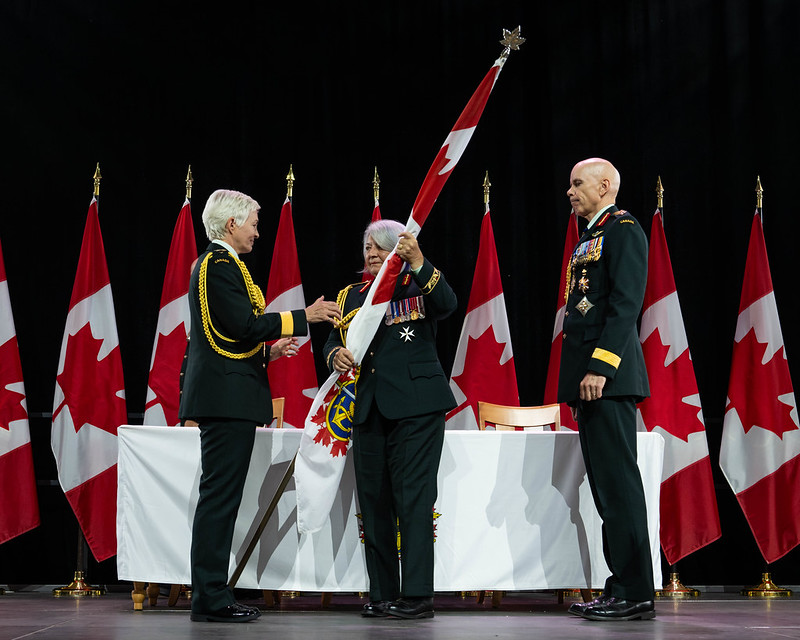
Gov. Gen. Mary Simon (centre) oversees the defence chief change of command ceremony between generals Wayne Eyre and Jennie Carignan at the Canadian War Museum in Ottawa in July 2024. [Corporal Denny Dubs/DND]
On evolving the CAF
We have to adjust and transform to the new threats that we see on the horizon. As an example, new technologies developed by states can now reach our continent, where that didn’t used to be the case. Our geography, which protected us extremely well—that’s not the case with the development of new missile technologies. We have to transform and equip ourselves with the necessary capabilities to be able to better detect, defend and defeat what might come to us.
This is how, basically, we’re transforming the Canadian Armed Forces. A typical example of this is our air defence systems. In our previous large commitment in Afghanistan, we didn’t use—we didn’t need—air defence systems because when you operate in a counter-insurgency operation and you have air supremacy, air defence systems aren’t required. Plus, they become obsolete over time, so we divested to acquire the necessary capabilities.
We now have a different posture. Looking at the air threats, air defence systems are absolutely required at various layers, from space to ground. We have to equip ourselves differently, which is what we’re working on.
On lessons from other crises
When we look at the lessons learned out of Ukraine, it’s incredibly important because our enemies are also learning. We have to have an innovative decision-making process that allows us to adapt faster. The other part is that we’re learning resiliency amongst communities. Resilient communities are ready and prepared for various types of crises, whether it’s military, climate-related or pandemics.
Of course, there are a broad range of lessons on how humans interact with the battlefield in Ukraine—what systems work, what systems don’t. We’re onboarding those as we’re building new capabilities.
On Canada’s Arctic security
We’re in collaboration with many other government departments because we have to take a comprehensive approach to the Arctic. This is not just a military problem. It is search-and-rescue related. It is natural disaster related. It could be pollution related from, say, a cargo ship spill. We have to have the capability to respond to all of this, but those capabilities are not all military.
From a military perspective, the coverage for a large territory is layered. It’s a mix of technology, boots on the ground and the ability to project power in various parts of the Arctic. We currently have a permanent presence in the Arctic, and this is done both with permanent installations and the Rangers located in 67 different communities in the Arctic. Layered on top of that are various sovereignty operations and exercises that we’re conducting to project power in the various areas to cover all of our territory.
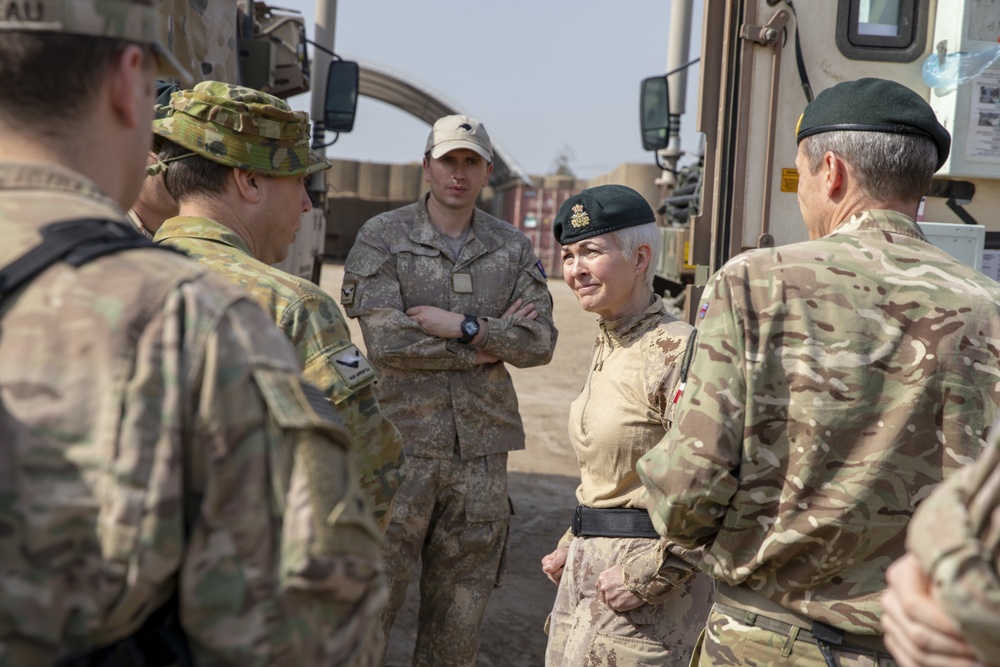
Carignan, serving as commander of the NATO mission in Iraq, speaks with comrades on Feb. 7, 2020. [U.S. Army/Wikimedia]
On those considering service
I would say give it a shot. I know sometimes it might seem a little bit intimidating, but there are 107 different types of military trades. There’s a broad range of different roles in the military and there are different arrangements depending on how long people want to stay. Regardless of how long people decide to stay in the military, be it a three-year period or a 40-year period, it’s a good foundation upon which to build.
On her defence chief tenure and beyond
The CAF is constantly evolving, changing and adapting, because otherwise, we become irrelevant. During my mandate, I’m fully aware that I will be accompanying and leading the CAF for a while, and I want to bring it as far as I can, so that my successor can take it further and keep evolving and preparing it over time.
It is a long-term endeavour to have a credible defence that offers a deterrence to our adversaries. What we want to be sure to do is offer that deterring effect, because if we do that, and this is successful, then we don’t have to fight—that’s the whole point.
We’re implementing our defence policy that came out in 2024. It is very clear in that policy that Canada and the Arctic are a priority as part of the work that we’re doing. We also have our commitment to Europe, NATO and the Indo-Pacific.
What we’re doing is providing the necessary capabilities that we need to defend: it’s a new destroyer fleet for the navy; a new submarine fleet as well; it’s new fighter jets; it’s new satellite systems to better cover our territory; it’s new long-range precision strike capability and it’s the ability to defeat missiles with air defence.
A lot is going on to ensure we have everything we need, but those capabilities are also applicable to our commitment to NATO. It’s about procurement and ensuring that we have NATO covered and ensuring our persistent maritime presence in the Indo-Pacific. We’re also talking about cyber and various types of capability developments that are tailored to the needs of our partners in the Indo-Pacific.
Fundamentally, I would like my successor to inherit an institution that is in a better state than when I took it over. Our aim is always to improve over time.
Advertisement