




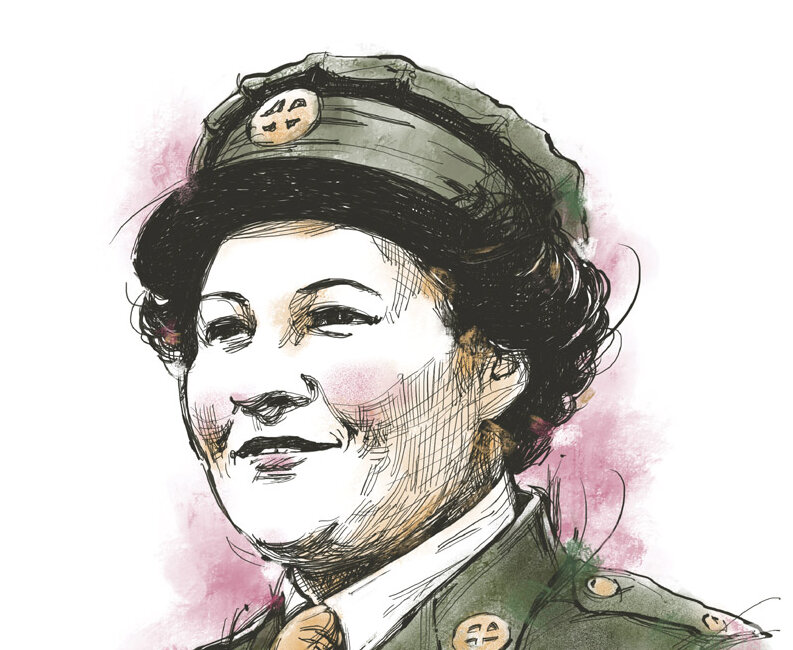
Illustration by Kerry Hodgson
Women have always played a part in Canada’s wars. Initially employed mainly as nurses, their role began to change during the First World War, when women known as VADs (Voluntary Aid Detachments) served not only as nurses’ aides, but as ambulance drivers, cooks and clerical staff.
During the Second World War, the role of women expanded exponentially, as the three separate services each created their own female components. By the end of the war, almost 46,000 women had enrolled in more than 160 occupations; 41 of them died on active service.
When the Second World War began, Saskatchewan native Joan Bamford Fletcher wanted to do her part and joined the Canadian Red Cross as a driver. She also studied motor mechanics with the Canadian Auxiliary Territorial Service. But Fletcher wanted to do more.
She was born in Regina on July 12, 1909. Around 1906, her parents immigrated to Canada from England, where her father came from a family of successful cotton merchants. In Saskatchewan, he established a horse ranch. Reflecting the family’s status, Fletcher was educated at schools overseas in London and later in Brussels.
When she returned to Canada, Fletcher eventually worked at the Prairie Farm Rehabilitation Administration. The organization had been established in 1935 to help farmers deal with soil erosion, soil conservation and water resources during a long drought.
But Fletcher was more interested in helping her father raise horses. She had always enjoyed working with them and could often be found on the family ranch, helping to train them.
In 1941, Fletcher paid her way to Britain and joined the First Aid Nursing Yeomanry or FANY, affectionally known as the Fannies. The all-volunteer FANY had been established in 1907 but was not part of the British forces.
“It shook the Japanese to find themselves under the command of a woman.”
During the First World War, Fannies were largely employed as ambulance drivers. Initially, they worked for the Belgians and French before the British forces accepted them.
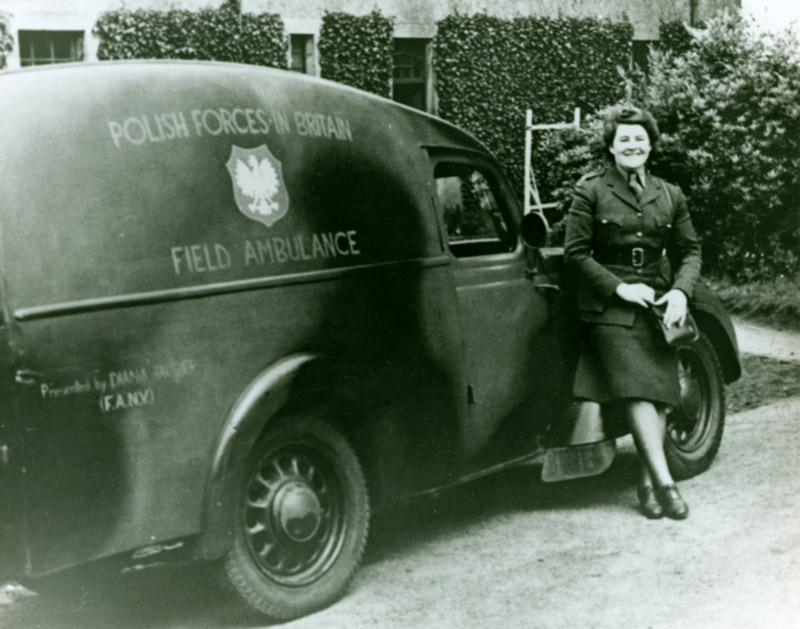
Joan Bamford poses for a photo during her wartime service in Britain.[CWM/19800177-004]
After the German invasion of Poland in September 1939, about 24,000 Poles escaped and formed fighting units in Scotland. The FANY provided these Free Poles with drivers, clerks, cooks and administrative services. Fletcher was sent to Scotland, where she drove cars and ambulances for the exiled soldiers. Vehicle repair and maintenance was also an important part of FANY duties.
As the war drew to a close in the spring of 1945, Fletcher was part of a FANY welfare group assigned to southeast Asia. She arrived in Calcutta (now Kolkata) in April and sailed on a hospital ship to Singapore. Due to mine-filled waters, her group did not arrive until Sept. 2, the day the Japanese signed the surrender documents.
Fletcher was part of a group that travelled to various prisoner-of-war camps to help the sick, using vehicles confiscated from the Japanese. They distributed Red Cross parcels they found in Japanese supply depots, which had been intended for the PoWs. While there, she was promoted to lieutenant and assigned as personal assistant to the brigadier in command.
During the war, the Japanese had interned about 130,000 Allied civilians across southeast Asia, 108,000 of whom were Dutch nationals. In October, authorities sent Fletcher to the Dutch East Indies (now Indonesia) to evacuate the Bangkinang internment camp. The internees had existed on starvation rations and been treated harshly. During their imprisonment, many died from malnutrition and diseases such as malaria, while those who survived were weak.
The Bangkinang facility was located in the central part of the island of Sumatra. At the end of August 1945, it held mostly Dutch citizens, some 539 men and 1,244 women and children.
Fletcher arrived to find the internees in very poor condition. Her job was to evacuate them to safety at Padang on the island’s west coast for repatriation. At the time, there were no Dutch or other Allied military personnel in the area and Indonesian nationalists stepped into the power vacuum the Japanese surrender had created.
On Aug. 17, after news of the Japanese surrender was confirmed, the leaders of the Indonesian nationalist movement, Sukarno and Mohammad Hatta, declared Indonesia an independent republic. Nationalist groups roamed the country and imprisoned many Dutch civilians.
Fletcher turned to the only readily available source of manpower and vehicles—the Japanese 25th Army. She persuaded their commanders to provide 15 trucks, 40 armed soldiers and an interpreter, English-speaking Sergeant Art Miyazawa. Drawing on her experience as a driver and her knowledge of motor mechanics, Fletcher had broken-down vehicles salvaged and repaired, adding 10 trucks to her convoy.
“It shook the Japanese to find themselves under the command of a woman,” she later noted.
The rough, narrow road from Bangkinang to Padang stretched for 450 kilometres through jungles and across mountains. It took 20 hours to complete each trip.
Fletcher travelled back and forth along each convoy, to deal with rebel barricades, sabotaged bridges and hazardous road conditions. On the third convoy, Fletcher got caught between two vehicles, causing a four-inch gash on her scalp. A Japanese doctor treated the wound, and she was back to work two hours later.
This accident earned her the respect of the Japanese soldiers who were working with her.
“From there the Japanese couldn’t do enough for me,” said Fletcher. “My interpreter told me they had discussed that night and he said they would like me to know I had won the respect of every man in the convoy, but they decided they would never marry a European woman—they were too tough.”
When the monsoon season came, it turned roads into long quagmires, which the rebels continued to barricade.
When British troops finally arrived, the brigadier in charge allowed Fletcher to remain in command of the convoys at her request. She concentrated on working with the Japanese to complete the evacuations.
During her second-last journey, Fletcher and a Japanese officer were in a jeep at the head of the convoy when they had a flat tire. After fixing it, she noticed that two Dutch internees in the vehicle behind them were missing and a rebel was attempting to steal the car.
Fletcher shouted “Out!” at the rebel, who instantly followed her command and ran away. She and Miyazawa quickly found the two Dutch passengers in a nearby hut, tied up and held by three armed rebels.
“I was yelling at the top of my voice, to keep up my courage, but they didn’t understand a word of it,” Fletcher later recounted. “I added colour by cursing a blue streak.”
She grabbed a knife, cut the internees free and quickly exited the hut. Fortunately, the rebels did not follow.
By the time the final convoy occurred, 70 Japanese soldiers were assigned to the journey, with many of the vehicles mounting machine guns. Fletcher also put five armed soldiers in the lead vehicle, which she had fitted with a sturdy bumper to crash through any barriers. Fletcher remained unarmed throughout the evacuations.
During the six weeks it took to clear Bangkinang, Fletcher supervised the evacuation of nearly 1,800 internees during 21 trips. The captain of the Japanese transport company that supplied the vehicles presented her with a precious family heirloom—his 300-year-old Samurai sword—as a token of his respect and esteem.
In return, Fletcher arranged for the Yamashita Butai, the unit that had helped her, to be exempted from a year’s hard labour, which most Japanese soldiers had to perform after the war.
By late November, Fletcher was in Hong Kong, where she came down with swamp fever—malaria. She returned to England in July 1946, but the disease returned and settled in her left jawbone. As a result, she lost half of her lower teeth and part of her jaw, which was replaced through plastic surgery.
On Oct. 29, 1946, The London Gazette announced that Fletcher had been appointed a Member of the Order of the British Empire, “For services to the Forces in the Far East.” When she learned of the award, the unassuming Fletcher’s remark was typical: “My, it was a surprise.”
She was also awarded the British General Service Medal with the South East Asia 1945-46 bar.
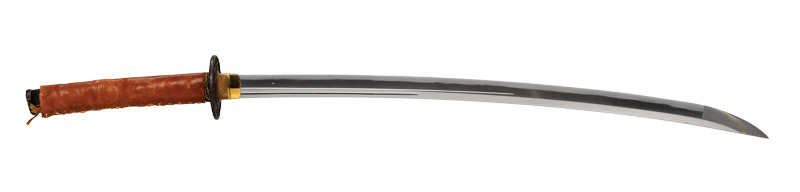
The sword Bamford was gifted from a Japanese soldier she worked with in the Dutch East Indies. [CWM/19800177-001]
Fletcher returned to Canada on the Queen Elizabeth for a well-deserved rest and to visit her parents, by now living in Vancouver. But the fearless woman’s exploits were not yet over.
Because Fletcher could speak Polish and had worked with their soldiers in exile in Scotland, the British government asked her to go to Poland to work with the information section of their embassy in Warsaw in 1947. The country was just coming under Communist control at the time and Fletcher remained there until 1950.
One day in Warsaw, she received an alarming telephone call, stating that the Polish secret police were going to arrest her. Ostensibly, it was because of her association with a British officer who was sent to jail for 18 months for helping a Polish woman flee the country.
Later, Fletcher stated that the incident was created by the Soviets and the story about the Polish girl was propaganda. She believed it was because she helped three Britons involved in a dispute with Polish authorities.
Fletcher stated the secret police followed her everywhere she went in Warsaw and her hotel room was searched several times.
Fletcher fled Warsaw on a Royal Air Force courier aircraft, avoiding arrest by a few hours. She “went through customs with a nightdress, a toothbrush and the six aspirins I had swallowed to hold my stomach down. I was a nervous wreck. I didn’t carry anything that would give them an excuse to hold me.
“I am glad to be going home to get as far away as I can from Communism.” For their part, Polish authorities maintained they had never intended to arrest her.
Fletcher returned to Canada aboard the Empress of Canada and spent her last years in Vancouver. She remained in touch with Art Miyazawa and even attended a reunion of Yamashita Butai’s soldiers.
Fletcher died suddenly on April 30, 1979.
The Yamashita Butai’s honour roll of deceased veterans includes Fletcher. After her death, Miyazawa recalled the “fair-minded woman lieutenant who amazed our troops with her consummate knowledge and expertise in handling the assignment at hand.”
Rescue from Sumatra
After her death, Joan Fletcher’s tale of courage largely disappeared for several years. Then, in 2001, a five-part television series was produced for History Television that focused on women who served Canada during the Second World War. Titled “Women of Courage: Untold Stories of WW II,” the segment about Fletcher is called “Rescue from Sumatra.”
Advertisement