



[Annie Bowers]
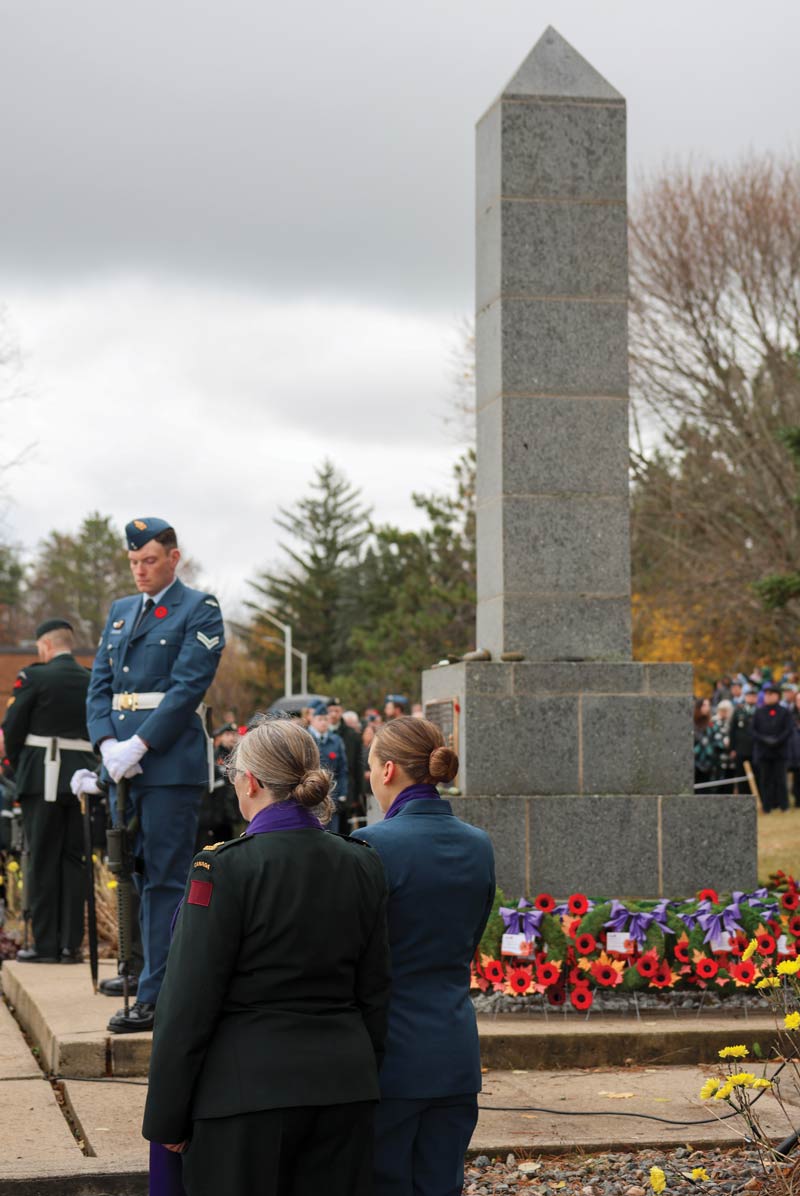
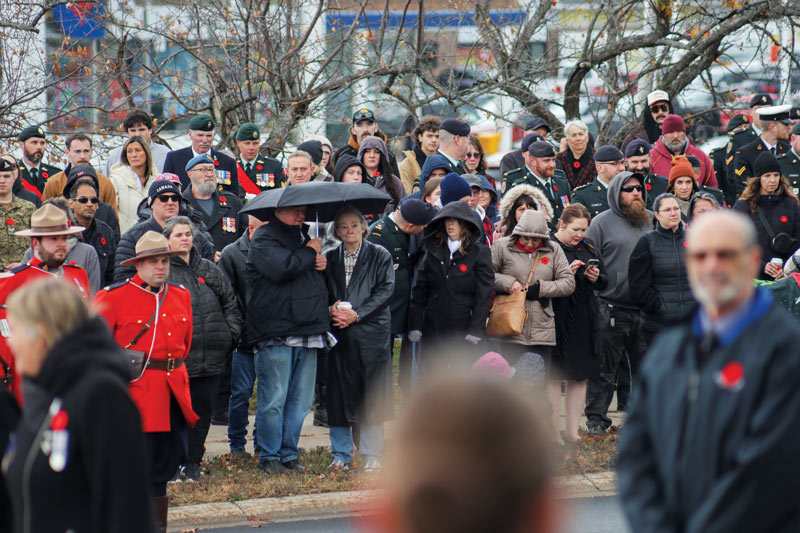
Beneath the last vestiges of autumn, the people gathered. They came like a rolling tide, a sea of uniforms and civvies undeterred by ominous clouds and a biting chill. Clutching coffee cups to warm purpling hands, overcoats fastened tight amid the threat of downpour, the crowd waited for the moment soon at hand. That they would congregate was never in doubt—not in Oromocto, N.B., on Remembrance Day 2025. Not in a town where a sense of community and service, military or otherwise, intersect like its own namesake tributary and that of the Saint John River near its Cenotaph off MacDonald Avenue.
As leaves fluttered in the fading fall breeze, spectators jostled for space on an increasingly congested sidewalk. Among the very first to arrive, and ultimately one of the very last to leave, was local Chase Meade.
“I come every year,” he affirmed. “For everything [the armed forces] go through for us, it’s okay to take an hour out of our busy lives. To stand here and pay our respects.”
Underscoring his family connections to Canada’s military, the quietly contemplative Meade asserted that “we wouldn’t have a country like it is now” without the sacrifice of others—not least the assembled personnel from nearby 5th Canadian Division Support Base, Gagetown.
Recognized as the country’s second largest Canadian Forces base after Suffield in Alberta, the 1,100-square-kilometre Gagetown site boasts some 1,500 kilometres of roads, 900 kilometres of tracks and 740 buildings. It was developed during the 1950s as part of Canada’s NATO commitment. Those commitments remain with the garrisoned 5th Canadian Division Support Group, perhaps now more than ever before. The number of personnel operating at Gagetown—named after another local community—fluctuates in the thousands, but in whose collective service all nearby municipalities benefit.
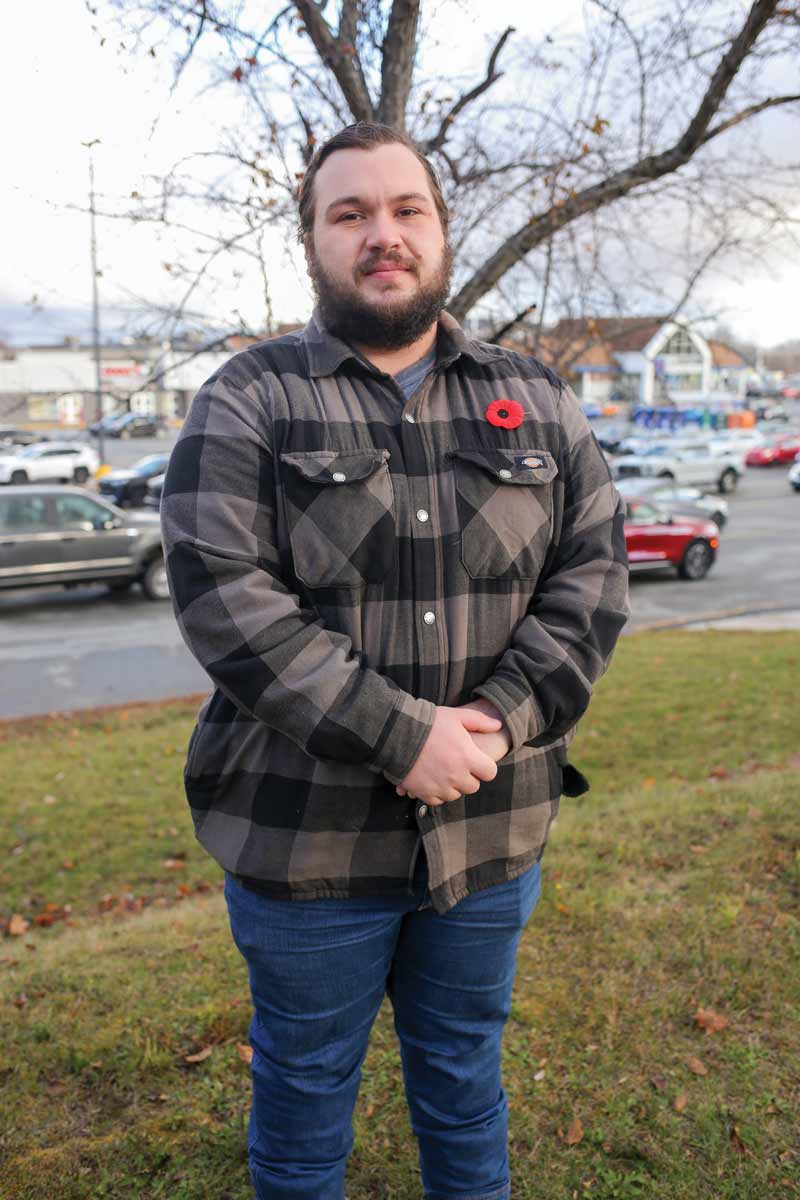
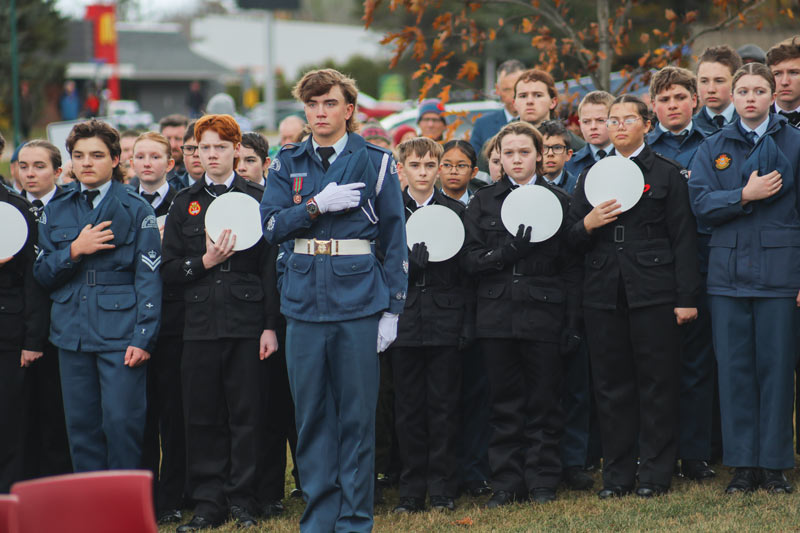
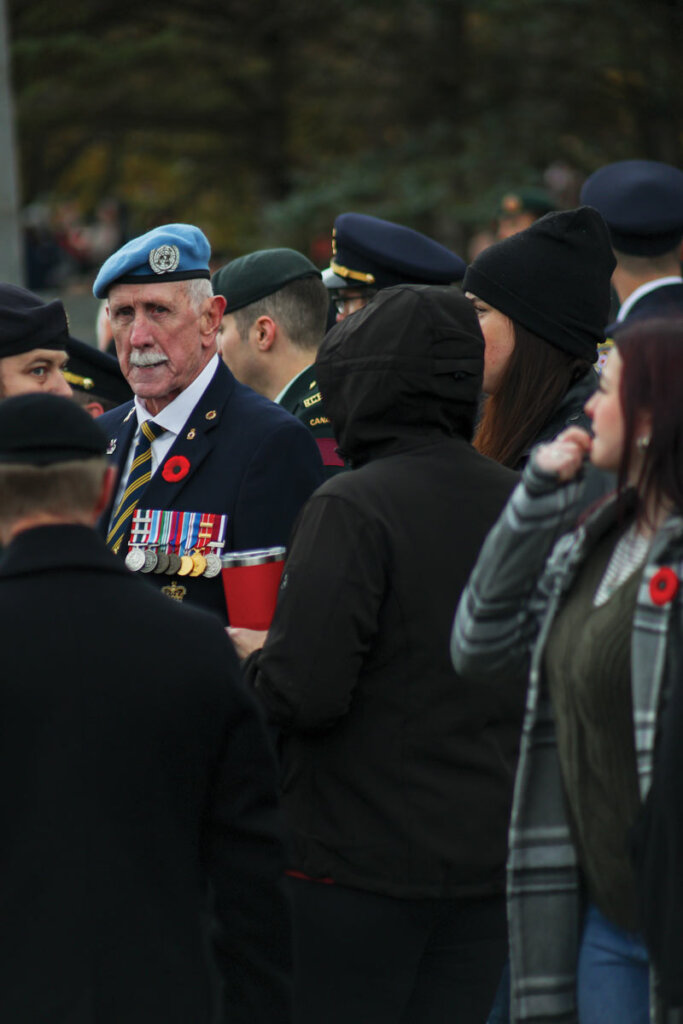
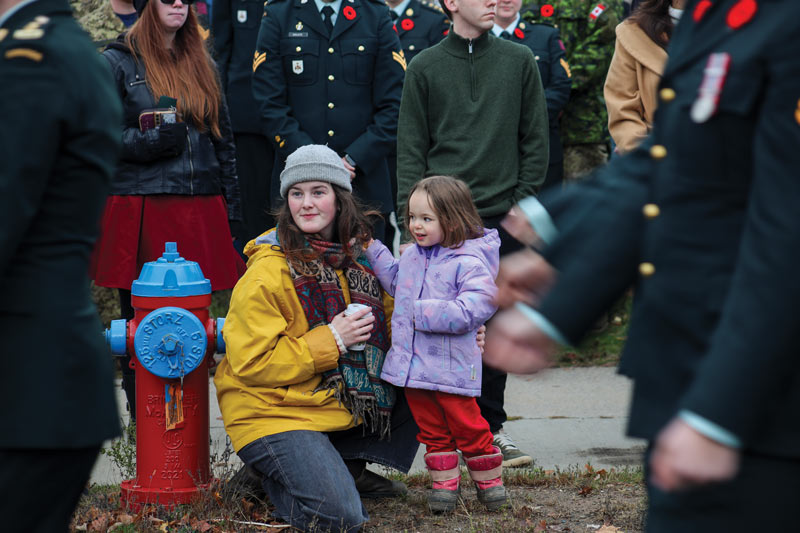
Cadets, veterans, serving personnel and the public, including local Chase Meade gather at the Cenotaph in Oromocto, N.B., on Remembrance Day 2025. [Annie Bowers]
[Annie Bowers]
[Annie Bowers]
[Annie Bowers]
Nor are those gains limited to the more expected duties of donning a uniform.
“They help out the economy around here greatly,” said Meade of military members who, the federal government reports, bolster the area with upward of $200 million annually and a further $700 million to the provincial economy. The base functions as the second-largest public sector employer in New Brunswick, after the province itself, and the third-largest employer overall.
[Annie Bowers]
“They support our schools,” added Meade, “and actually helped build the schools. Without the military, we wouldn’t have the population that we do.”
Indeed, of Oromocto’s 10,000 inhabitants, roughly 75 per cent are either base staffers or belong to a family of one, a reality evinced in both the Remembrance Day crowd’s attire and, in the case of those who looked like civilians, of which there were many, in a willingness to display heartfelt gratitude in more than one sense.
Shortly after 10:20 a.m., the parade seemed almost ready as the mournful sound of bagpipes drifted down the street. Welcome smiles and laughter, however, persisted among the abundance of children scattered throughout the crowd, all swaddled in countless layers of clothing or blankets, some to the point of hampered movement.
Nevertheless, in their presence alone, a new generation had gathered to remember, to understand its meaning under the guidance and guardianship of serving parents, and, in the paucity of veterans from decades-old conflicts, to fill the growing void.
Particularly ubiquitous were uniformed fathers who, balancing stoic composure afforded to the day’s events with an attentiveness required for children, hoisted their sons and daughters over shoulders or supervised them within strollers and buggies.
Wearing his Royal Canadian Air Force blue, Andre Proulx-Yergeau from Quebec entertained his one- and three-year-olds in their well-cushioned wagon right until the parade marched on.
“Last year,” he remarked, “my eldest came along [for the Remembrance Day service] while Mom was at home with our youngest as it was too cold.” Now that both have grown a little, declared the 21-year CAF member and relative Oromocto newcomer, “I’ll try my best to bring them every time.”
Proulx-Yergeau had a simple yet practically universal reason for doing so. “It’s a mark of respect for sure,” he noted, a sentiment shared by comrades near and far when the bagpipe- and drum-laden procession finally passed en route to the war memorial. “The fallen have given us what we have today,” he offered in parting.
“We remember where we came from so that we know where we’re going.”
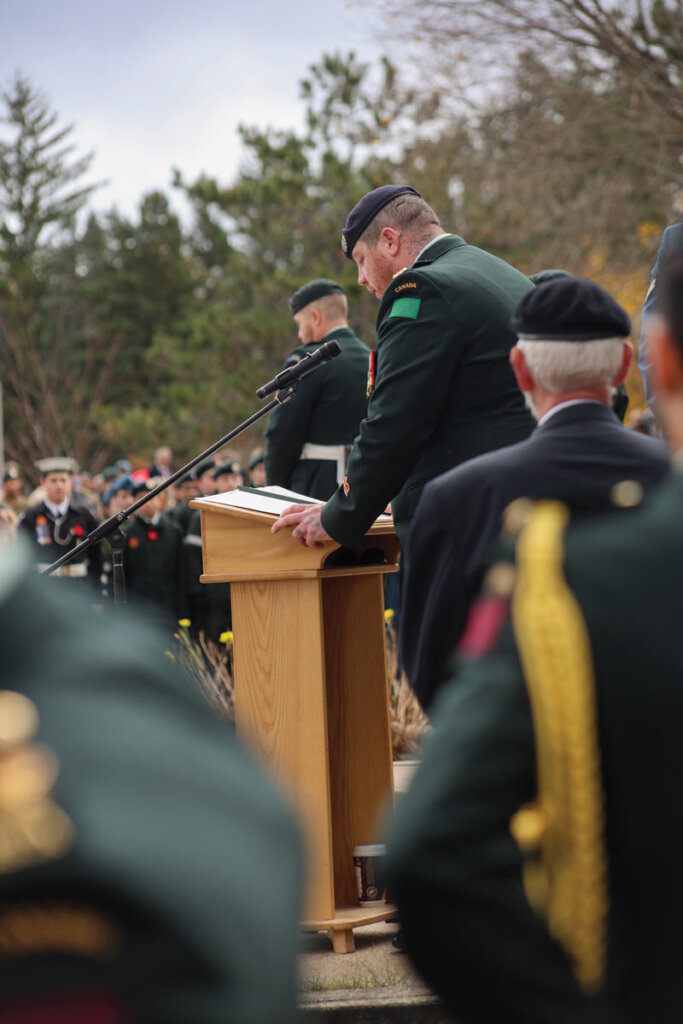
A moving rendition of the national anthem by Carolyn Dawson set the event’s tone. Master of ceremonies, Warrant Officer James Love, then took to the stage to deliver opening remarks, paying tribute to “those who have served and continue to serve our country…often putting the needs of fellow Canadians and of peace before their own.”
Love also recognized Oromocto’s crucial role as a military community, praising the bond between civilians and CAF personnel alike. Such sentiments were reinforced by the two service chaplains in offering their own reflections in French and English.
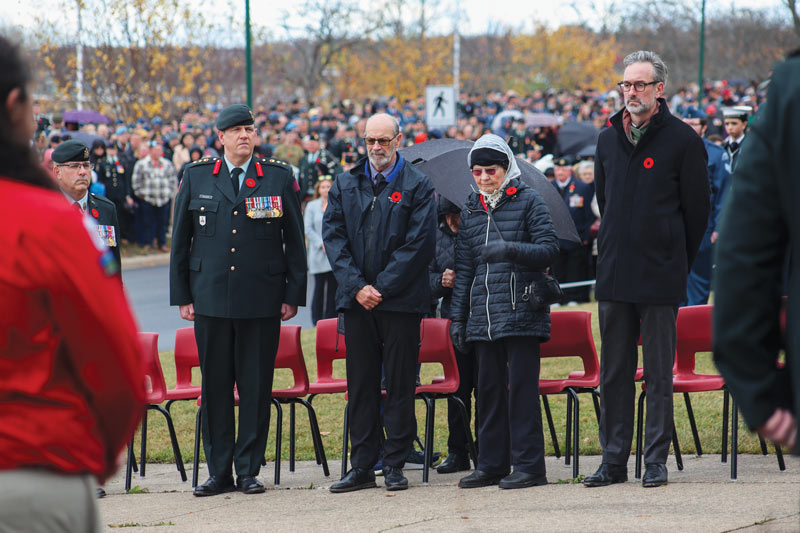
Colonel Paul Williams, Mayor Robert Powell, 2024 National Memorial (Silver) Cross Mother Maureen Anderson and local MP David Myles during the 2025 Oromocto Remembrance Day ceremony.[Annie Bowers]
[Annie Bowers]
[Annie Bowers]
[Annie Bowers]
“Today, there are no words,” declared one pastor, “no words to recognize the enormous sacrifices that have been done over the years by our Canadian Forces members and their families. No words,” she furthered, “as we remember those who serve and those who we’ve lost. There are no words, but that’s all right. We don’t need words, because today, across our country, and in the world, we will remember them with our silence and through our shared memories.”
“We remember where we came from so that we know where we’re going.”
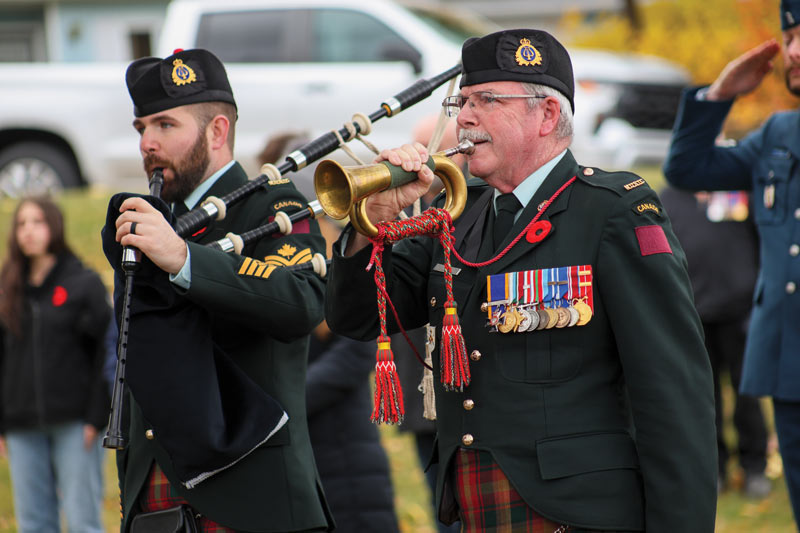
When that silence came, heralded by the bugler’s “Last Post” and the firing of guns from Sir Douglas Hazen Park not five minutes’ walk away, the estimated 2,000 spectators, save perhaps for a handful of startled infants, paused in solemn rumination. It was as if the heavens knew, for in the absence of words, the rain fell—not that any souls in the crowd paid it much mind apart from those with poppy-emblazoned umbrellas.
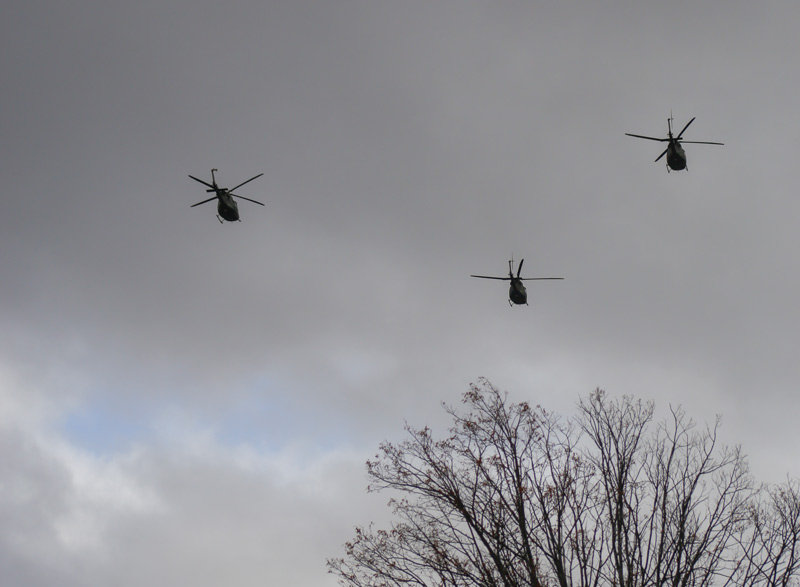
The piper’s “Lament” still echoed down the street as, from briefly accommodating clouds, a flypast from 403 Helicopter Operational Training Squadron—based at Gagetown—stirred children to crane necks upward. Most uniformed parents, meanwhile, maintained focus, their eyes fixed on the cenotaph with steady salutes.
Wreaths were thereafter placed at the monument by dignitaries, including local MP David Myles and MLA Mary Wilson; Oromocto Mayor Robert Powell; Colonel Paul Williams, commander of 5th Canadian Division Support Group; and Kevin McCarty, acting president of The Royal Canadian Legion’s Oromocto Branch, who gave remarks near the ceremony’s end.
With silence held and parted—at least for another year—the right words were found. McCarty deferred to poet Rudyard Kipling to encapsulate the day’s events.
Lord God of Hosts, be with us yet,
Lest we forget—lest we
Advertisement