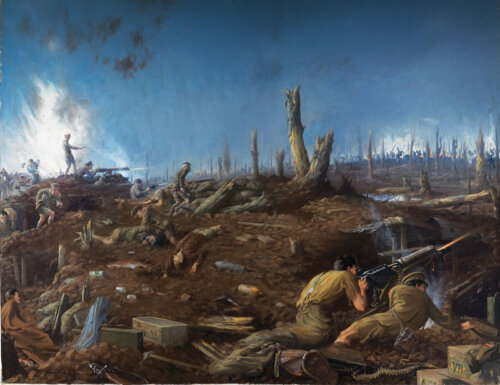



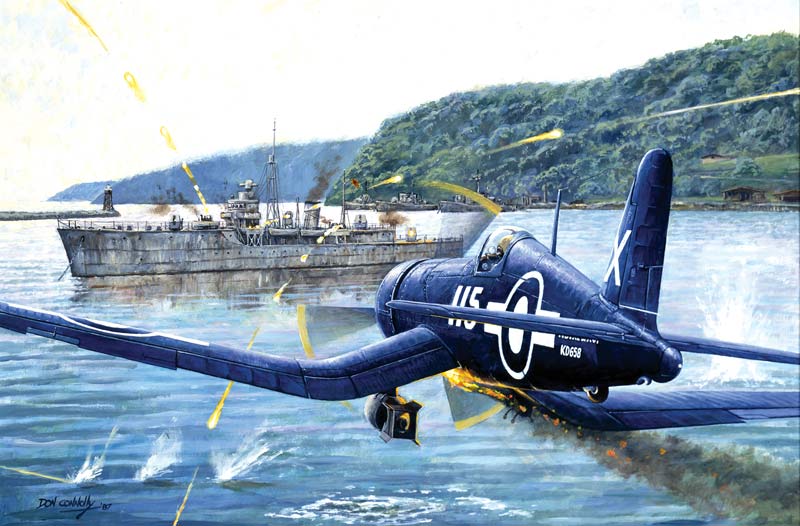
Artist Don Connolly depicts pilot Robert Hampton Gray attacking the Japanese ship Amakusa in Onagawa Bay on Aug. 9, 1945.[Don Connolly/CWM/19880046-001]
The Second World War in the Pacific began as it ended, with Canadians in the face of enemy fire. As the Canadians in the Battle of Hong Kong were some of the first Allied forces to fight against the Japanese in December 1941, Lieutenant Robert Hampton Gray of the Royal Canadian Naval Volunteer Reserve (RCNVR) was one of the last in August 1945.
Gray, like the defenders of Hong Kong and many other Canadians in the Pacific during WW II, ended up in that faraway theatre in a roundabout way.
From Trail, B.C., Gray enlisted in the RCNVR in July 1940 as an ordinary seaman. Soon after entering service, he was one of many enlistees chosen to go to Britain to train as a potential officer. A delay led him to transfer to the Fleet Air Arm to learn the ropes as a naval aviator. His training brought him back to Canada to Kingston, Ont., for a time in 1941.
His subsequent service took him around the world. Gray served in Britain, South Africa and East Africa before being transferred to 1841 Naval Air Squadron aboard HMS Formidable in August 1944. He was assigned to fly a Vought F4U Corsair with the group.
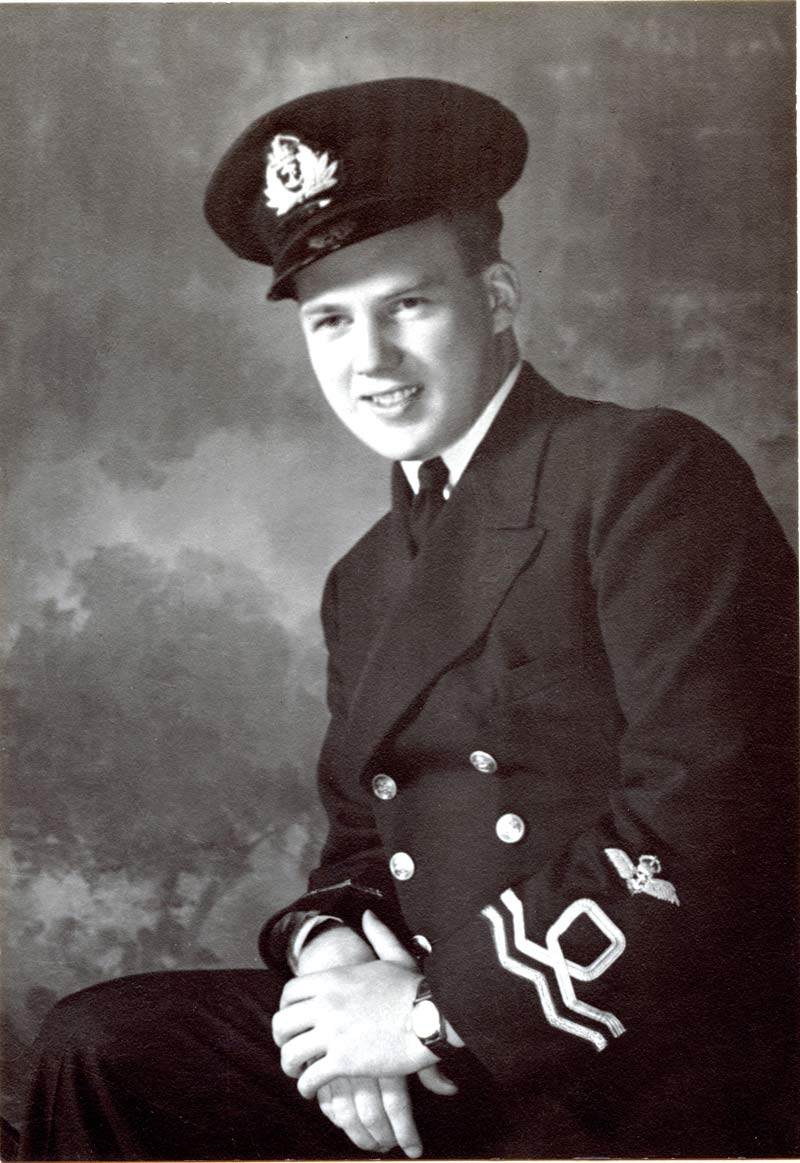
Portait of Robert Hampton Gray [LM archive]
“It is considered that with more sea experience he should develop well and be in every way suitable for higher Air Command.”
After being aboard Formidable for only a few weeks, Gray was Mentioned in Dispatches for his role in an attack on the German battleship Tirpitz on Aug. 29, 1944.
Gray’s leadership potential was quickly noted, and he was promoted to lieutenant and given command of a flight, comprised of four Corsairs. “It is considered that with more sea experience he should develop well and be in every way suitable for higher Air Command,” said a February 1945 report that covered Gray’s first six months aboard Formidable.
Lieutenant-Commander R.E. Jess, also an RCNVR aviator serving with the Fleet Air Arm, said that despite Gray looking quiet “he was obviously the fighter type—aggressive almost to the point of recklessness. He had to be good to be a fighter pilot and he had to be good to do the things he did and live as long as he did.”
In April 1945, Formidable joined the British Pacific Fleet. The aircraft carrier supported the operation against Okinawa by attacking Japanese airfields and aircraft in the Sakishima Islands. On April 16 and 17, Gray led his flight in patrolling the area over the islands to protect other aircraft attacking ground targets. They encountered no enemy planes on either day.
On April 20, there was much excitement as Gray’s flight thought it had spotted an enemy aircraft, but it turned out to be a friendly Liberator bomber. For the rest of April and into May, 1841 Squadron continued these uneventful missions protecting other planes.
“I really do think that I will be home before the end of this year and I hope to stay at home when I come next.”
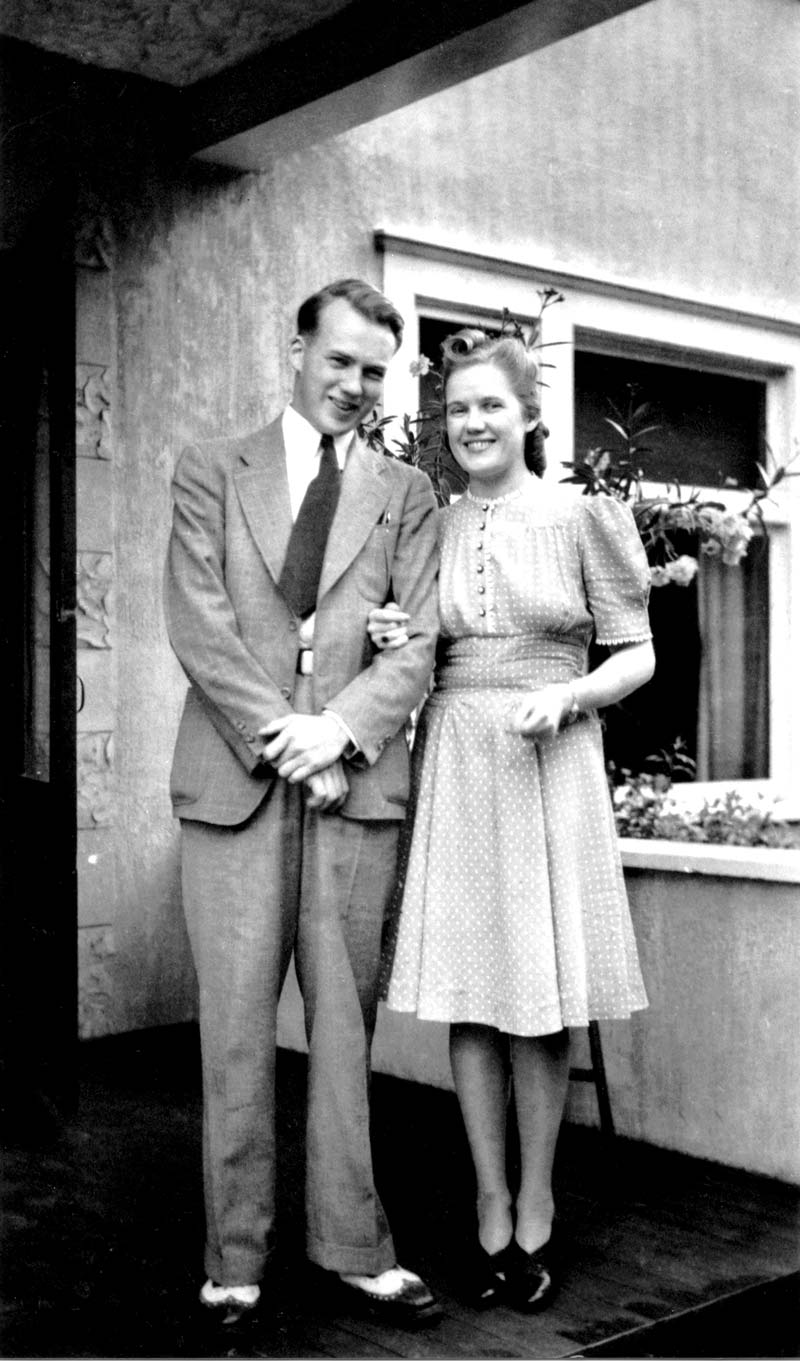
Gray with his sister served with 1841 Naval Air Squadron aboard HMS Formidable. [LAC/PA-115794]
On May 4, Formidable faced one of the great scourges of the Allied navies during the war. It was attacked by two kamikaze aircraft. The first hit the ship, while the second was shot down.
“Okinawa is, of course, the place where the Americans are having such a terrible time,” wrote Gray in a letter to his parents that same day. “It is fairly hard flying but not dangerous. We have had some trouble with the Japanese suicide bombers but have suffered very little damage.”
By July 1945, Formidable and its aircrews began to attack the Japanese main islands. Gray led a flight of planes that strafed airfields in the Tokyo area on July 18. Six days later, he led an attack on ships in the Japanese inland sea that damaged one merchant ship, and strafed two seaplane bases and an airfield.
On July 28, despite poor flying conditions due to rain and heavy clouds, Gray led another assault on the inland sea, where he bombed a Japanese destroyer, which was later reported to have sunk.
“For determination and address in air attacks on targets in Japan,” he was awarded the Distinguished Service Cross.
Because of his exemplary service in the Pacific, Gray was recommended for promotion to acting lieutenant-commander on July 31, 1945. His service record noted the advancement was deserved because Gray continued “to show his ability and skill as flight commander and has led his divisions in recent operations with undoubted success. Energetic and resourceful in his other duties and can always be relied on. A brave skilled and reliable pilot in action.”
His abilities as a pilot, of course, were well known to those who served with him.
“You will undoubtedly be hearing about us on the news,” Gray wrote to his parents on July 15, 1945. “I will be with those who are mentioned but do not worry, please. I really do think that I will be home before the end of this year and I hope to stay at home when I come next.”
On Aug. 9, 1945, around 8:30 a.m., Gray’s flight took off from Formidable. They were assigned to attack Japanese positions and aircraft at Matsushima airfield, located on the northern end of Japan’s main island near Sendai. Having discovered most of the airfield and aircraft there had already been destroyed, Gray turned his attention to vessels he had spotted in Onagawa Bay.
As the flight approached the bay, it took heavy anti-aircraft fire from shore batteries and at least five warships. Around 1 p.m., Gray peeled away from the formation and dove solo toward the Japanese Etorofu-class destroyer escort Amakusa. As Gray pressed an attack, his Corsair burst into flames, but he held steady until he was about 50 metres from the ship. He then released several bombs. At least one of them struck amidships, quickly sinking Amakusa.
Gray crashed into the bay moments later. This “fearless bombing run” cost him his life. His body and aircraft were never found. He was one of the last Canadians killed in action during the war.
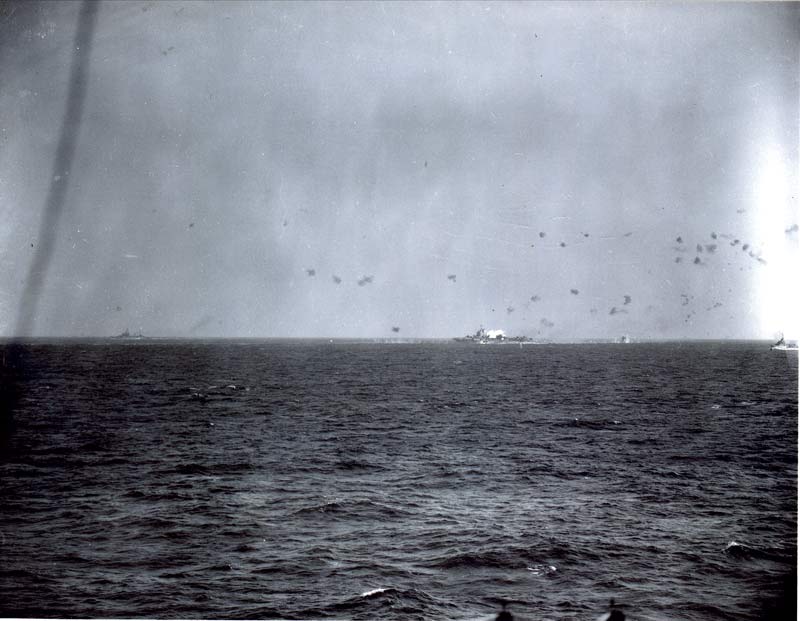
HMS Formidable, pictured here fighting off Japanese kamikaze aircraft on May 9, 1945.[ LAC/C-005006]
“The bottom fell out of life on board after it happened and the victory when it came seemed so hollow somehow.”
For his actions at Onagawa Bay, Gray was posthumously awarded the Victoria Cross. “Lieutenant Gray has constantly shown a brilliant fighting spirit and most inspiring leadership,” read his citation. Gray was the first and only member of the RCNVR to be awarded a VC. His was also the last Canadian VC-earning action.
Gray’s loss was heavily felt by those who knew him. In a letter to Gray’s parents detailing his final flight, Lieutenant-Commander Richard Bigg-Wither, commander of 1841 squadron, wrote: “That is the story—it hurts very much to write about. The bottom fell out of life on board after it happened and the victory when it came seemed so hollow somehow. He was so well loved by us all and simply radiated happiness wherever he went.”
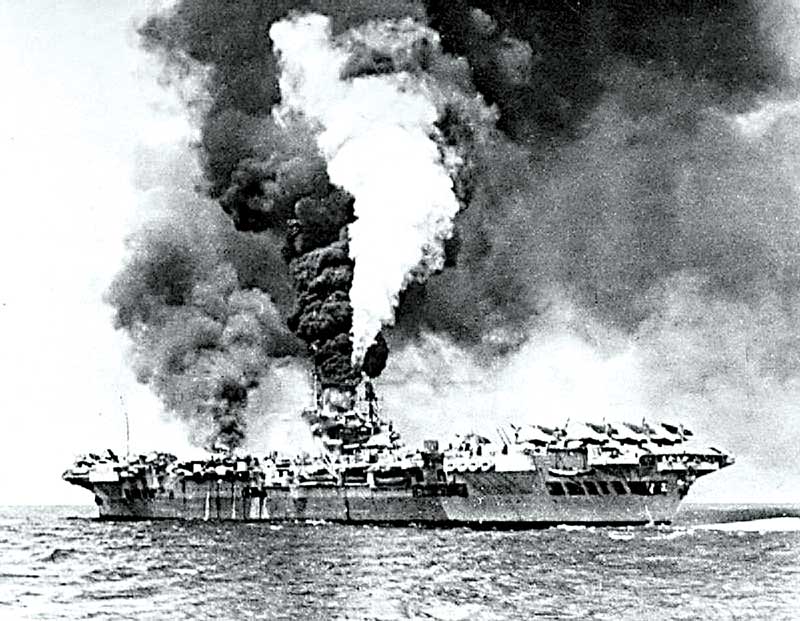
Days earlier, the aircraft carrier burns after being struck by a kamikaze plane [IWM/A 29717/Wikimedia]
In addition to his VC and DSC, during his service Gray was awarded the 1939-1945 Star, Atlantic Star, Africa Star, Pacific Star, Defence Medal, Canadian Volunteer Service Medal with clasp, and War Medal 1939-1945. It’s a unique medal set for a Canadian WW II veteran.
Gray has since been memorialized around the world. He is commemorated, along with 3,266 other Canadian war dead lost at sea, on the Halifax Memorial, as well as in many other communities across Canada. A monument to Gray was also unveiled near the location of his final attack and death, in Onagawa in 1989. It was damaged in the 2011 earthquake and tsunami but was repaired and moved to high ground near the town hospital the following year.
And Gray’s legacy continues to be honoured by the Canadian Armed Forces. HMCS Robert Hampton Gray, the RCN’s sixth Harry DeWolf-class offshore patrol vessel, was launched on Dec. 9, 2024.
Advertisement