








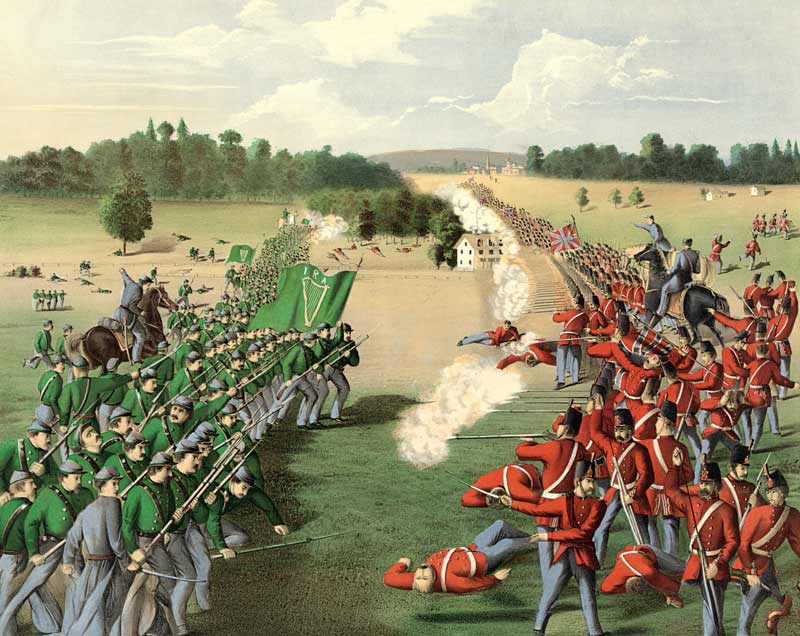
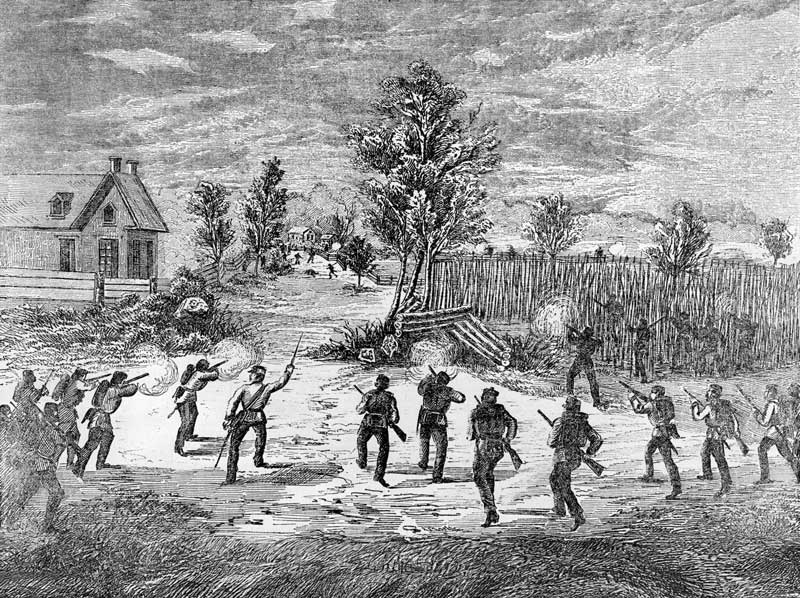
An artist depicts action at the Battle of Ridgeway. John O’Mahony.[Library of Congress/2006677453]
Someone else’s war had landed on Canada’s doorstep.
The bitter ethnic and sectarian struggles between the British and the Irish crossed the Atlantic to North America along with waves of Irish immigrants escaping the Great Famine of the 1840s. Many longed for an independent Irish republic, and the end of the U.S. Civil War (1861-1865) seemed to provide an opportunity to help achieve that goal.
Relations between the U.S. and Britain and its North American colonies were strained. The latter had supported the breakaway Confederate States during the war and a series of crises, including the British outfitting of the highly successful Confederate raider CSS Alabama and an armed Confederate raid on St. Albans, Vt., from Canadian territory, infuriated the Americans.
There was great relief in British North America (BNA) when the massive U.S. army demobilized. Among these men, however, were tens of thousands of Irish-born, combat-hardened veterans, some of whom were attracted to Fenianism, the philosophy that Ireland’s independence must be achieved by revolution. The name Fenian is derived from the Gaelic Fianna, the tribal Irish militia of folklore.
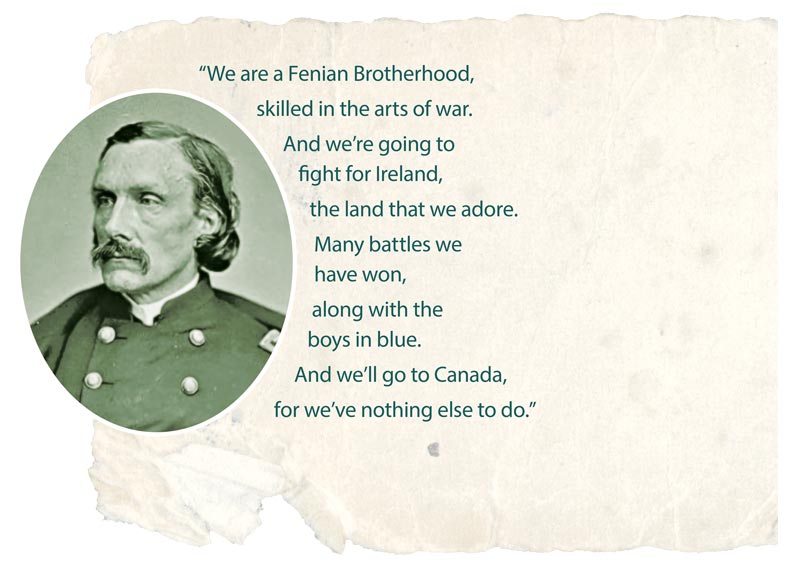
leader of the Fenian Brotherhood, which invaded British North America from the U.S.[U.S. National Archives/Wikimedia]
Irish revolutionaries founded the Fenian Brotherhood in the U.S. in 1858, and its leaders, John O’Mahony and William R. Roberts, believed that attacking BNA would create a new front in the struggle for Irish independence. They raised funds, recruited U.S. Civil War veterans, and planned to seize parts of Canada to blackmail Britain into granting Ireland independence.
Much of their military potential, however, would depend on whether the U.S. government would tolerate Fenian aggression from American soil. Resentment for Britain had to be tempered by war-weary Washington’s more pressing desire for national reconstruction. The Americans didn’t want war.
The self-governing colonies of Nova Scotia, New Brunswick and Canada—then divided into Canada West (present-day Ontario) and Canada East (Quebec)—each maintained their own volunteer militia supported by British forces on garrison duty.
In April 1866, the Fenians planned to seize Campobello Island, N.B., in the Bay of Fundy. Campobello, conveniently located near Eastport, Maine, seemed like an easy conquest that might earn the Fenians U.S. recognition as a legitimate belligerent.
About 700 Fenians, led by Bernard Doran Killian, congregated in and around Eastport, while about 500 ex-U.S. army .58-calibre Springfield muzzle-loading rifled muskets were surreptitiously shipped to them.
Opposing the Fenians were up to 5,000 troops, a mix of British regulars, New Brunswick militia and volunteer Home Guards, while Royal Navy ships stood by. It was more than enough to deter the would-be invaders who did nothing more than raid nearby Indian Island on April 14 and 22.
U.S. authorities subsequently impounded the ship used to transport the Fenian arms and issued a stern statement that American neutrality would be enforced.
Still, Canadian militiamen were anxious to prove their worth against the Fenians and had revised the lyrics to a U.S. army marching song accordingly:
They didn’t have long to wait.
Cheer up, let the Fenians come!
For beneath the Union Jack
We will drive the rabble back
And we’ll fight for our beloved Canadian home.
The statement encouraged the Irish of Canada to join the struggle “in the name of seven centuries of British inequity and Irish misery and suffering.”
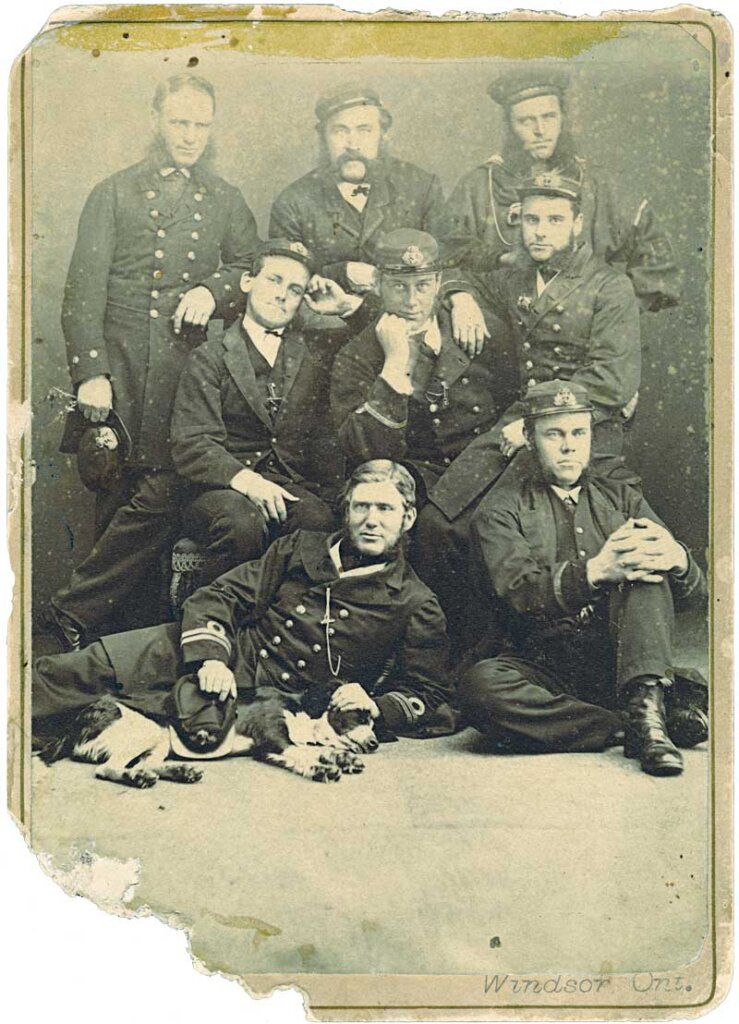
Canadian militia officers of the Fenian Raids. [John Dixon/LAC/e007152308]
An artist depicts the Battle of Trout River. [LAC/C-048861]
In the early hours of June 1, as many as 1,200 armed invaders crossed the Niagara River into Canada West. They came in three waves in barges towed by hired tugboats and landed near Fort Erie. They styled themselves the Irish Republican Army and wore a motley mix of Union and Confederate uniforms with civilian clothes. They were armed with accurate and reliable Springfield rifles and knew how to use them. The Fenians were under the command of John O’Neill, a former cavalry officer of the U.S. army who had been born in County Cork, Ireland.
Fort Erie, a small centre of 600, was undefended and O’Neill’s forces cut telegraph wires, pulled up some railway tracks and marched to Frenchman’s Creek, about five kilometres to the northwest. They bivouacked there for the night while awaiting reinforcements from Buffalo, N.Y. (that never came). In the meantime, the Fenians stole horses, tools and food from locals.
The Fenians issued a lengthy proclamation insisting that they had “taken up the sword to strike down the oppressor’s rod, to deliver Ireland from the tyrant, the despoiler, the robber.” The statement encouraged the Irish of Canada to join the struggle “in the name of seven centuries of British inequity and Irish misery and suffering, in the names of our murdered sires, our desolate homes, our desecrated altars, our million of famine graves, our insulted name and race.”
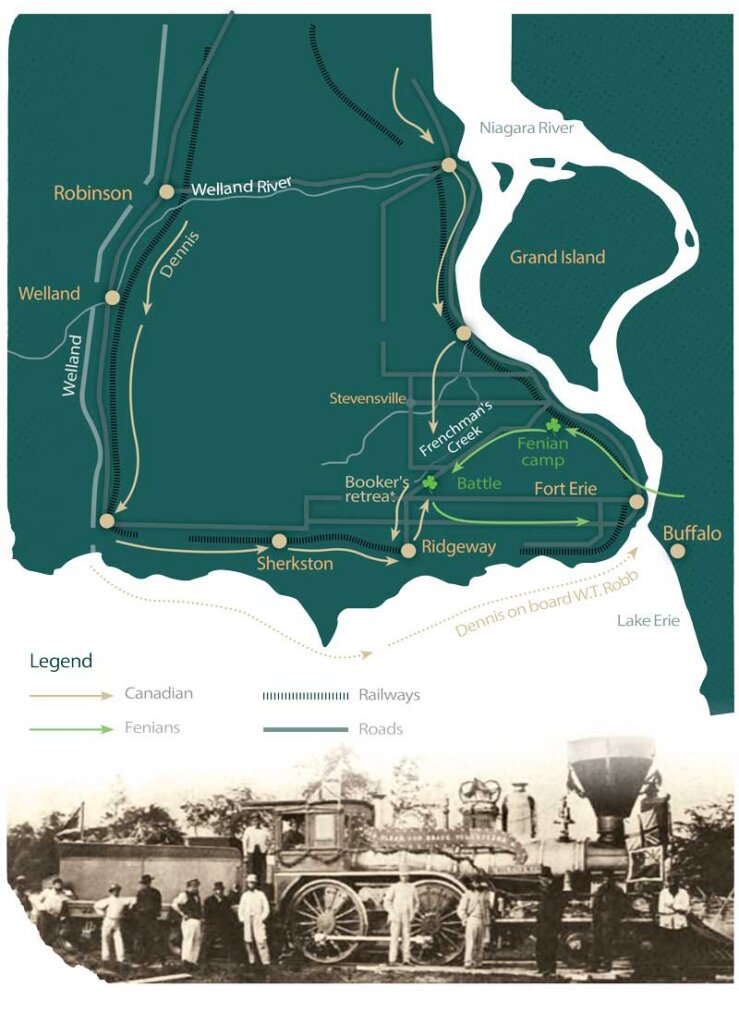
Canadian soldiers travel the Welland railway to meet the Fenians. [ LAC/C-048861]
There were some small secret Fenian cells in Canada, particularly in its biggest cities, but the substantial Irish population didn’t join the invaders.
News of the Fenian landing led to the mass mobilization of 22,000 militiamen from Canada West and thousands of Canadian and British troops flooded into the Niagara region. Many were deployed to protect the Welland Canal linking lakes Ontario and Erie.
On the day O’Neill landed, British Lieutenant-Colonel George Peacocke’s force of British regulars and Canadian militia totalling 1,700 concentrated at St. Catharines. Peacocke ordered most of his men south to Chippawa, en route toward Fort Erie.
Also that day, a second Canadian force made its way to Port Colborne on Lake Erie. It was under the command of British-born militia Lieutenant-Colonel Alfred Booker, commanding officer of the 13th Battalion from Hamilton, and comprised some 400 men of the Queen’s Own Rifles of Toronto (QOR), and about 400 men from the 13th, the York Rifles and Caledonia Rifles. Booker had never commanded in action before and his troops were short of basic equipment, ammunition, food, maps and provisions for medical care.
At 3 a.m. on June 2, O’Neill moved at least 750 of his men (others were left behind at various locations while some had deserted) southwest to Limestone Ridge, three kilometres north of the village of Ridgeway, where they prepared defensive positions. At about the same time, Peacocke ordered Booker to Stevensville, about 20 kilometres to the northeast of Port Colborne. There, the Canadian columns would join and engage the U.S. invaders.
But Peacocke was late in departing Chippawa, so the two Canadian columns didn’t meet in time, allowing the experienced Fenians to engage Booker’s force on its own.
“The fire of the now pursuing Fenians became hotter than ever, causing our poor fellows to fall on all sides.”
Booker’s troops arrived at Ridgeway by train, believing the Fenians were in the vicinity of Frenchman’s Creek, and not just a few kilometres away at Limestone Ridge. No cavalry unit was mobilized with the infantry at first and neither Booker nor Peacocke had mounted men to act as scouts to provide accurate information about the Fenians’ locations.
Some of the Canadian militia units wore red tunics while the rifle battalions and companies wore green. Almost all were armed with .577-calibre Enfield single-shot rifled muskets similar in performance to the Springfield. The one exception was the 5th Company, QOR, whose 49 men were armed with modern, seven-shot, .52-calibre Spencer repeating rifles—although they had never fired them.
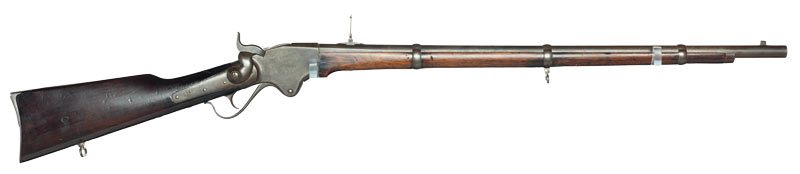
Some Canadians had Spencer rifles.[Wikimedia]
Booker’s men hadn’t slept the previous night and had eaten nothing. Many were under 20 years old. At about 7:30 a.m., their column stumbled upon the enemy. Peacocke had ordered Booker to avoid engaging the Fenians but, controversially, Booker later claimed he hadn’t received the message in time.
O’Neill sent about 150 skirmishers toward the Canadian column. The experienced Fenians, hastily entrenched and concealed in an orchard and behind fences, opened fire on them from about 200 metres.
Fenian rearguards and stragglers were chased across the border at sabre point by the Royal Guides.
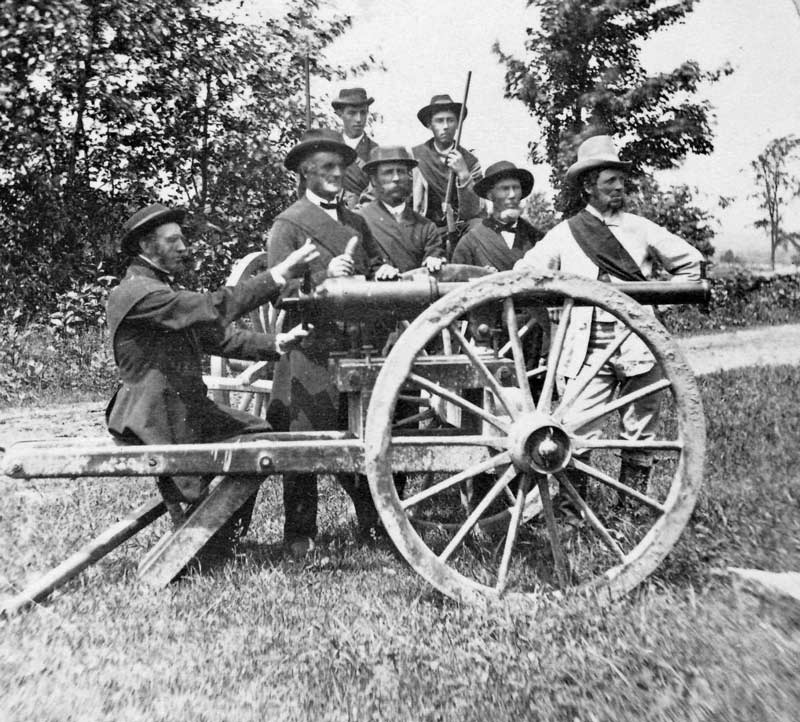
Members of the volunteer Home Guard pose with a captured Fenian cannon.[Missisquoi Museum/Wikimedia ]
The QOR were in the front, followed by the Yorks, the 13th Battalion and the Caledonians. Booker deployed his troops in extended lines, and the two sides skirmished for about two hours. The inexperienced Canadian militiamen continued advancing toward the main Fenian force, giving as good as they received. But confusion and the fog of war soon intervened.
After spotting several mounted Fenian scouts, the Canadians anticipated a cavalry charge even though no such force was in sight. Booker presumptuously ordered the QOR to “prepare for cavalry” and form a square, the standard means by which infantry defended against a mounted attack. But this manoeuvre left the men bunched together and vulnerable.
The Fenians quickly took advantage of the Canadians’ mistake and poured withering fire into the packed ranks of exposed men, inflicting numerous casualties. Realizing his error, Booker ordered the battalion to withdraw to reform its ranks. But when the other units witnessed this, they assumed a general retreat had been ordered and they wavered. Soon, panic spread, abetted by a bold Fenian bayonet charge. The entire Canadian line broke, and the militiamen fled the battlefield toward Ridgeway with the Fenians giving chase.
“The fire of the now pursuing Fenians became hotter than ever,” wrote the QOR’s adjutant, Captain William Dillon Otter, “and the volunteers being crowded up in a narrow road, presented a fine target to their rifles, causing our poor fellows to fall on all sides.”
He reported that the Canadian troops were “completely crestfallen.”
At Ridgeway, the QOR had suffered nine killed and 21 wounded, the 13th Battalion six wounded, and the York Company two wounded. Fenian losses are more difficult to ascertain but were at least eight killed and maybe twice that number wounded.
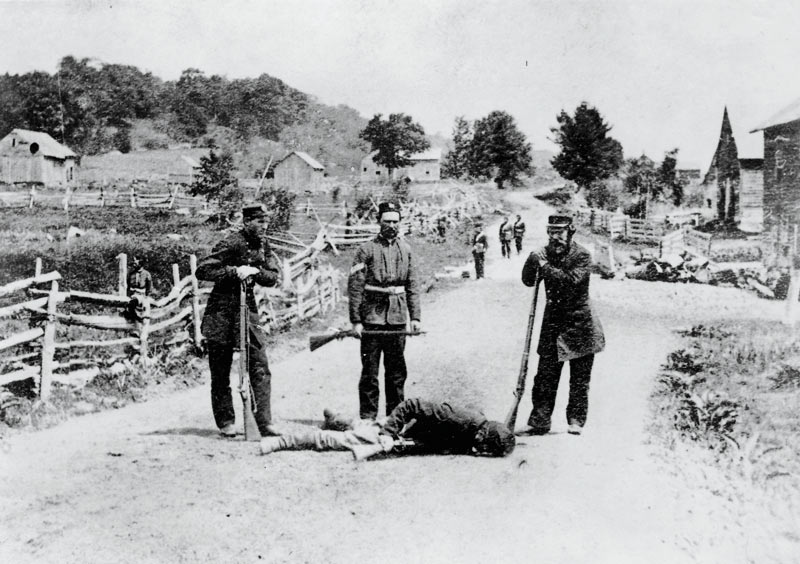
Over slain invaders near Eccles Hill.[Missisquoi Museum/Wikimedia ]
The Irishmen had won the Battle of Ridgeway. But because superior Canadian and British forces were closing in and no Fenian reinforcements would be forthcoming thanks to U.S. preventative action, O’Neill elected to retreat to Fort Erie and evacuate back to Buffalo. But he still had time for one more small victory.
While the Battle of Ridgeway was being fought, Lieutenant-Colonel John Stoughton Dennis, who had under his command 79 men from the Dunnville Naval Brigade and the Welland Canal Field Battery, used the tugboat W.T. Robb to convey his force to Fort Erie. The Canadians landed and captured a group of surprised Fenians, but the militiamen were soon faced with the bulk of O’Neill’s men who were returning from Ridgeway.
A fight ensued with the badly outnumbered Canadians. Dennis ordered his men to scatter. Although he himself evaded capture, 54 Canadians were taken prisoner and six had been wounded. The W.T. Robb managed to escape with a few Canadians and 59 Fenian prisoners.
A few days later, the Fenians struck again, this time in Canada East. At 10 a.m. on June 7, some 1,000 Fenians commanded by ex-U.S. army officer Samuel B. Spears crossed the Vermont border into Missisquoi County near Lake Champlain. Spears contented himself with occupying a tactical position on Pigeon Hill, about three kilometres inside Canada. Fenian patrols also descended on Frelighsburg and other nearby villages.
Spears waited for reinforcements that never came. U.S. military authorities had seized Fenian arms at St. Alban’s, Vt., and had begun sealing the border after President Andrew Johnson demanded American neutrality be upheld. After two days of looting farms and homes, the poorly disciplined, ill-equipped and demoralized Fenians withdrew back to the U.S.
It was a wise decision as thousands of Montreal and area militiamen and British troops were converging on them. Fenian rearguards and stragglers were chased across the border at sabre point by the Royal Guides (mainly members of the Montreal Hunt Club). They also captured 16 prisoners.
U.S. forces promptly disarmed the fleeing Fenians and arrested their officers. The raids of 1866 were over.
In 1867, Canada, New Brunswick and Nova Scotia federated into the Dominion of Canada; the Province of Canada was split into the provinces of Ontario and Quebec. The Fenian attacks and ongoing threats from south of the border had played an important role in spurring Confederation.
Meanwhile, Fenian “General” John O’Neill, the ballyhooed victor at Ridgeway, hadn’t abandoned his hopes of invading Canada. By May 1870, he had found financing, gathered men and arms in secrecy, established a headquarters in Franklin, Vt., and hatched another ambitious (albeit unrealistic) plan to invade southern Quebec and capture Sherbrooke.
Once it became known that the Fenians had mustered in Franklin, 13,000 Canadian militiamen were mobilized. Seizing the initiative and without waiting for reinforcements, about 40 members of the volunteer civilian Home Guard, consisting mainly of farmers wearing red sashes and armed with hunting rifles, rushed to the border on May 24. They established strategic positions at the base of Eccles Hill, one kilometre inside Canada. They were joined by an equal number of Dunham and Missisquoi volunteers.
On the morning of May 25, about 200 Fenians invaded, followed by an equal number of reinforcements. The small band of Canadians opened fire, the Home Guards leading the way. The Fenians returned fire but were pinned down. Soon, the Canadian civilians were joined by a company of the red-coated 60th Missisquoi Battalion, a unit of the Victoria Rifles from Montreal and a detachment of the 1st Volunteer Militia Troop of Cavalry of Montreal. Skirmishing continued until late afternoon.
Perhaps shocked at the Canadians’ determination, the poorly disciplined Fenians panicked and scuttled back to the U.S. Many discarded their arms, equipment and uniforms on the way. They had suffered three killed and about 10 wounded. There were no Canadian losses. American authorities arrested O’Neill.
A small raid two days later at Trout River, near Huntingdon, 130 kilometers west of Eccles Hill, ended similarly, with one Fenian killed and another wounded.
The final Fenian raid occurred in October 1871, when the indefatigable O’Neill and some 35 followers attempted to seize a customs building and Hudson’s Bay Company post on the Manitoba-U.S. border. Farcically, surveyors had determined that the buildings were actually in the U.S., so the hapless Fenians never actually set foot in Canada.
Canada’s citizen soldiers had done well, even in defeat at Ridgeway, to safeguard the country. The Fenians would come no more.
Advertisement