







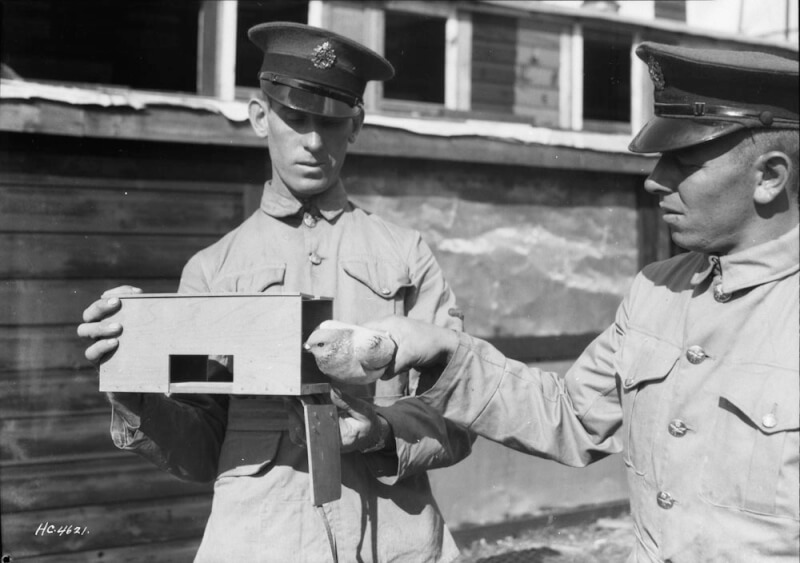
Royal Canadian Air Force personnel work with carrier pigeons in the Ottawa area in 1931. [LAC/3388456]
From May to November 1940, 320 messages were sent from British Royal Air Force (RAF) aircraft by pigeon, and 307 were delivered.
One of the messages brought news from Holland to the East Midlands, England, in four hours ten minutes. An exceptionally good performance was that of two pigeons which were released 340 miles from home in an entirely strange direction. They had to cross two countries and a sea, but both homed, the first in 11 flying hours.
One young pigeon delivered an S.O.S. against a Channel gale over 175 miles of sea, taking eight and a half hours to battle through.
Pigeons are particularly vulnerable to heavy rain, fog or gales when flying over the sea. One bird homed from Norway through a blizzard last winter, but subsequently died of the strain.
Homing pigeons are under the control of the Signals Directorate of the Air Ministry. The section responsible is officered exclusively by experts who have gained distinction in the sport of pigeon racing in peacetime and also have a wide active service experience.
Acting under the general direction of the Air Ministry is a committee of prominent racing pigeon fanciers set up to organize the Racing Pigeon Service. Through this organization thousands of racing pigeon fanciers are enabled to put the services of their birds or their own skill at the disposal of the nation.
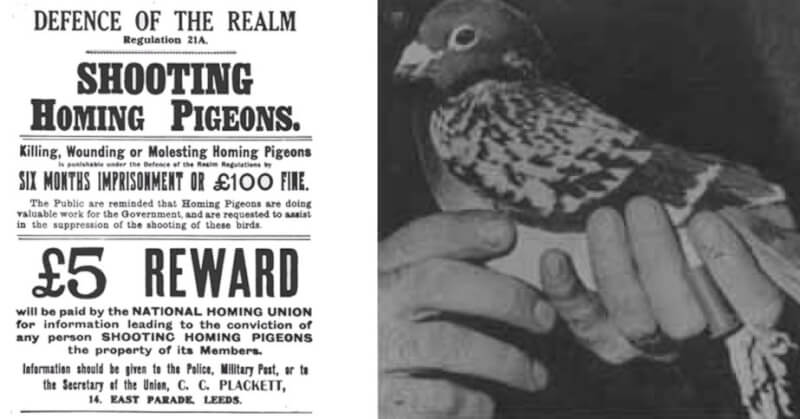
British WW I poster regarding the killing of war pigeons being an offence under regulation 21A of the Defence of the Realm Act. [warhistoryonline.com]
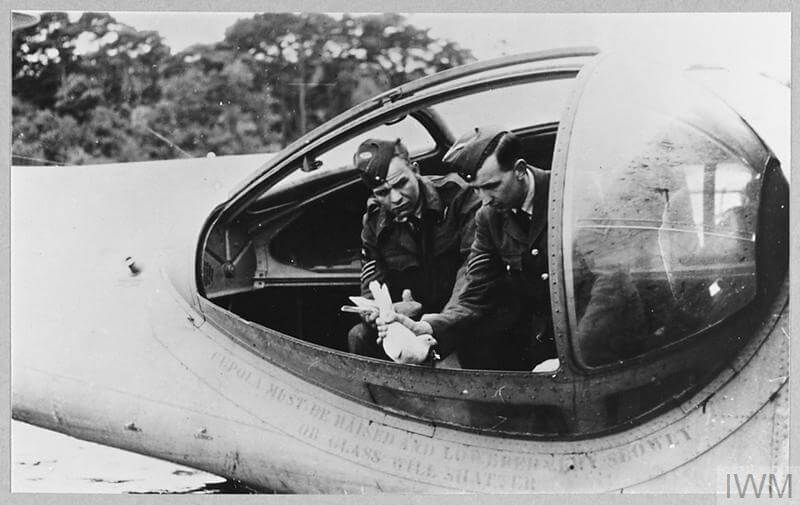
Carrier pigeons of Royal Air Force Coastal Command were an important unit in the Battle of the Atlantic. Coastal command crews attended a special pigeon course (pictured above) instructed by expert pigeon handlers. [IWM/205446456]
The pigeon’s task in this war is much more difficult than in the last, owing to the greater speed and range of aircraft, and the fact that modern message forms are now attached to the bird’s leg, enclosed in a message carrier, before the flight. A white patch on the outside of the carrier enables the position of the distressed to be written in a few seconds at the moment of release.
In case the bird alights on a ship, instructions for the re-transmission are printed on the back of the S.O.S. form. This has saved much time on at least one occasion.
The shooting of homing pigeons is an offence. For their better protection against birds of prey the destruction of peregrine falcons has been authorised. A survey has disclosed 78 eyries. From some of these a heavy toll has been levied on message-carrying pigeons.
The RAF has a number of pigeon lofts of its own in charge of N.C.O.’s and airmen known as “pigeon keepers.” These men are all expert pigeon fanciers.
—By The RAF Pigeon Service
Advertisement