







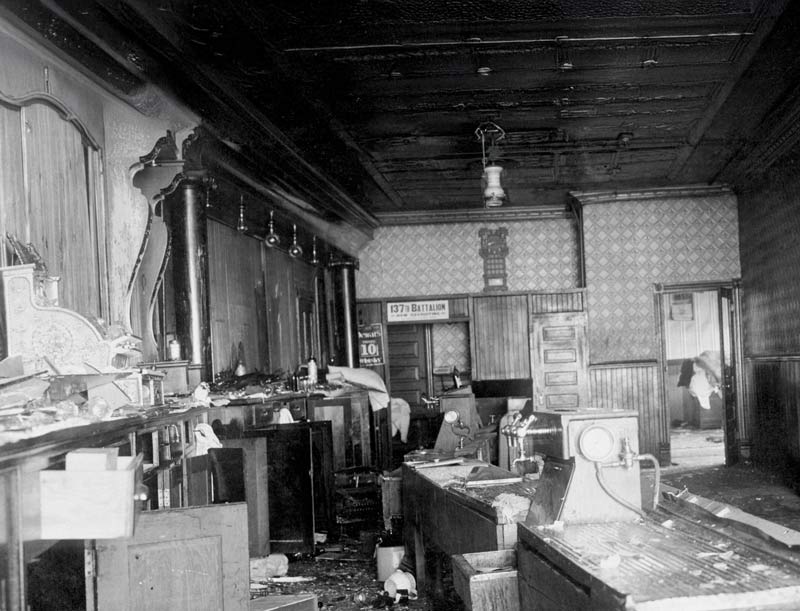
The bar in Calgary’s Riverside Hotel after soldiers and civilians ransacked it in February 1916, mistakenly believing the business was owned by Germans. [W.J. Oliver/University of Calgary/CU198005]
Private Gottfried Kraft pitched a rock through the front window of the White Lunch café on 8th Avenue S.E. in Calgary. It was Feb. 10, 1916, and the recruit of the 89th Battalion, Canadian Expeditionary Force, had just started an anti-German riot.
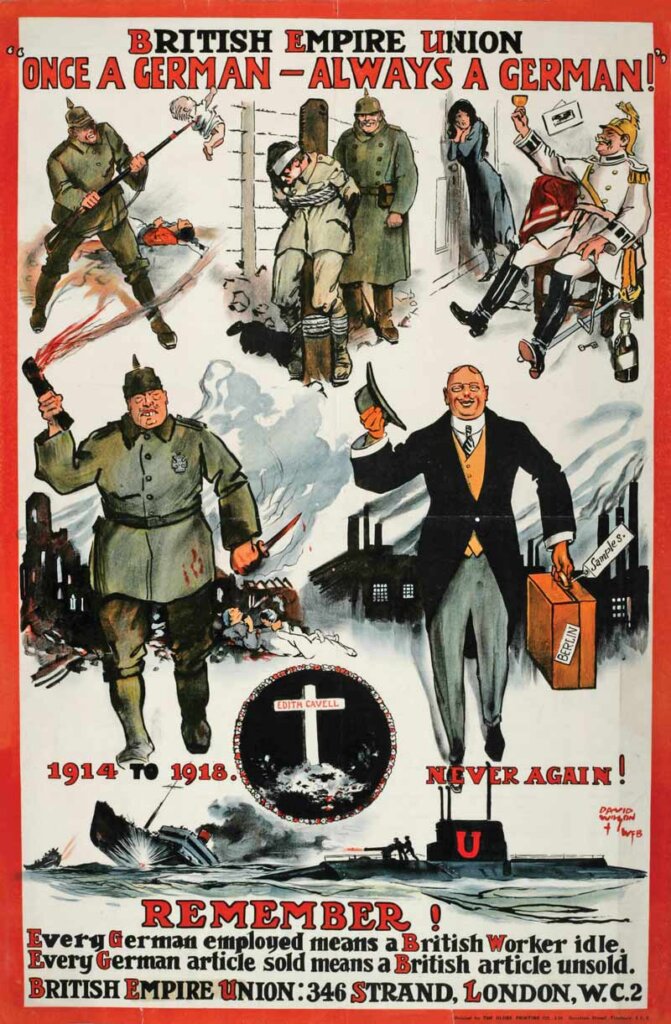
WW I British propaganda posters such as this stoked anti-German sentiment throughout the Empire.[David Wilson/CWM/19720121-086]
The city’s small police force couldn’t hold back the hundreds of uniformed soldiers and some 2,000 civilian bystanders who swarmed over and around them to ransack the building.
More riots followed in Calgary that year, one of many communities plagued by soldier violence during the First World War. As casualty lists lengthened, news of the fighting darkened, and reports and rumours of atrocities at the front circulated, many Canadians began to see the enemy not just as Germany, but German immigrants in their own country.
From Nova Scotia to B.C., soldiers were involved in—indeed, led—many wartime riots, wrote historian P. Whitney Lackenbauer, author of several papers on the topic. While not all the riots were serious, “the sheer number of episodes and men involved bespoke a serious problem.
“Calgary, in both frequency and severity, was one of the main centres of discontent,” he wrote. It was also the site of Canada’s second-largest military recruitment, training and transit camp.
“Once a German—Always a German,” proclaimed one propaganda poster—and many Canadians, soldiers in particular, believed it. In August 1914, some 80,000 so-called “enemy aliens” were required to register and report to police. In November, the first of 8,579 mostly Ukrainian- and German-Canadians were sent to internment camps.
Never mind that most of the German-speakers who had come to Canada since 1874 were from eastern European countries other than Germany and that half of the estimated 400,000 people of German descent in Canada in 1914 had been born in North America. Or that many had been refugees escaping oppression.
What may have been an ember of doubt was fanned to flames by anti-German sentiment. Early in the war, Britain used propaganda to fuel recruitment and civil support for the fighting both at home and in its dominions—Australia, New Zealand, South Africa, Newfoundland and Canada.
The May 1915 sinking of the passenger liner RMS Lusitania by a U-boat sparked riots across the dominions, including in several Canadian cities.
In Victoria, home of more than a dozen Lusitania victims, rumours spread that the incident had been celebrated at the local Kaiserhof Hotel, which advertised itself as “the home of German hospitality.” Off-duty soldiers swarmed the building, soon joined by a mob of spectators, the beginning of two days of rioting and pillaging businesses with German-sounding names.
During the war, individuals, businesses—even communities—changed their German-sounding names out of fear for their safety. The Kaiserhof became the Blanshard, for instance, while Berlin, Ont., was renamed Kitchener, after Field Marshal Herbert Kitchener, the British secretary of state for war at the outset of the First World War.
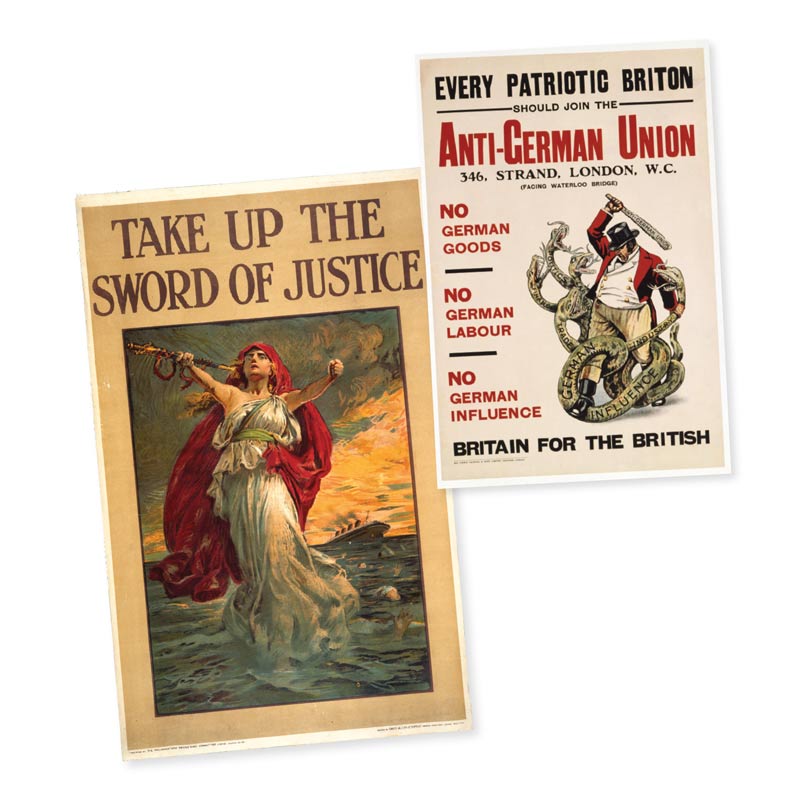
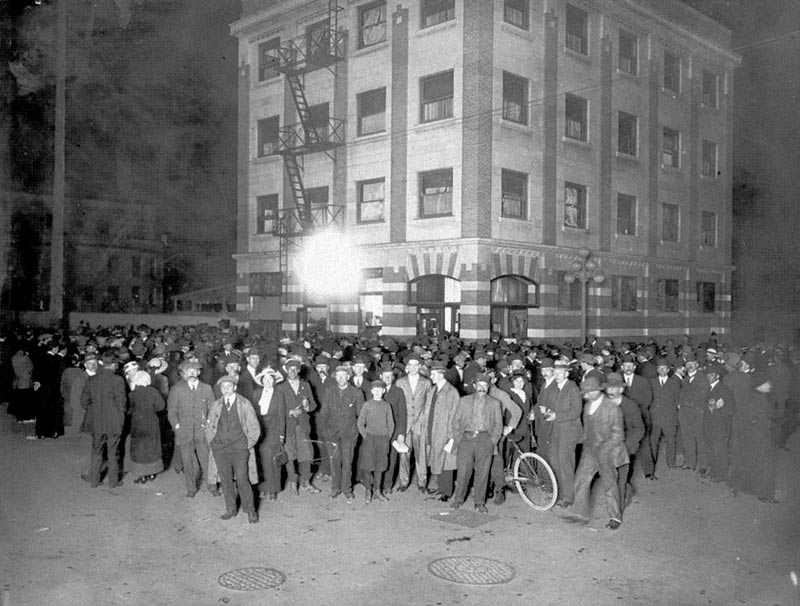
The May 1915 sinking of RMS Lusitania proved a rallying cry and drew rioters to Victoria’s Kaiserhof Hotel. [Library of Congress/2003675668; reddit.com/PropogandaPosters;]
“Calgary, in both frequency and severity, was one of the main centres of discontent.”
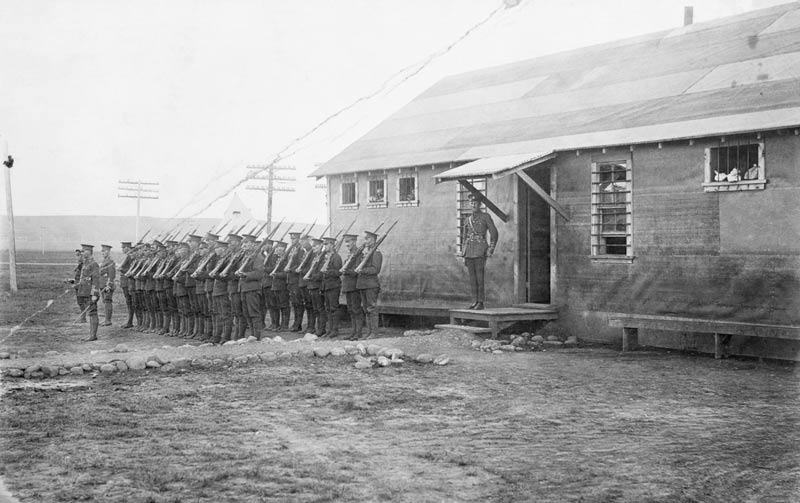
In 1911, about six per cent of Calgary’s population of some 43,000 spoke German, enough to establish the Germantown neighbourhood north of the Bow River. German speakers owned and managed many businesses, making them a wartime target of rumour and suspicion, especially among the 45,000 recruits who passed through Sarcee Camp in the city.
During the cold winter of 1915-16, long marches and outdoor exercises were replaced by indoor training, leaving thousands of young men edgy and frustrated with nowhere to burn off their energy.
“Young recruits swaggered around the streets and bars…restless and anxious to get overseas!” recruit Harvey Daniel Duncan wrote in his diary at the time.
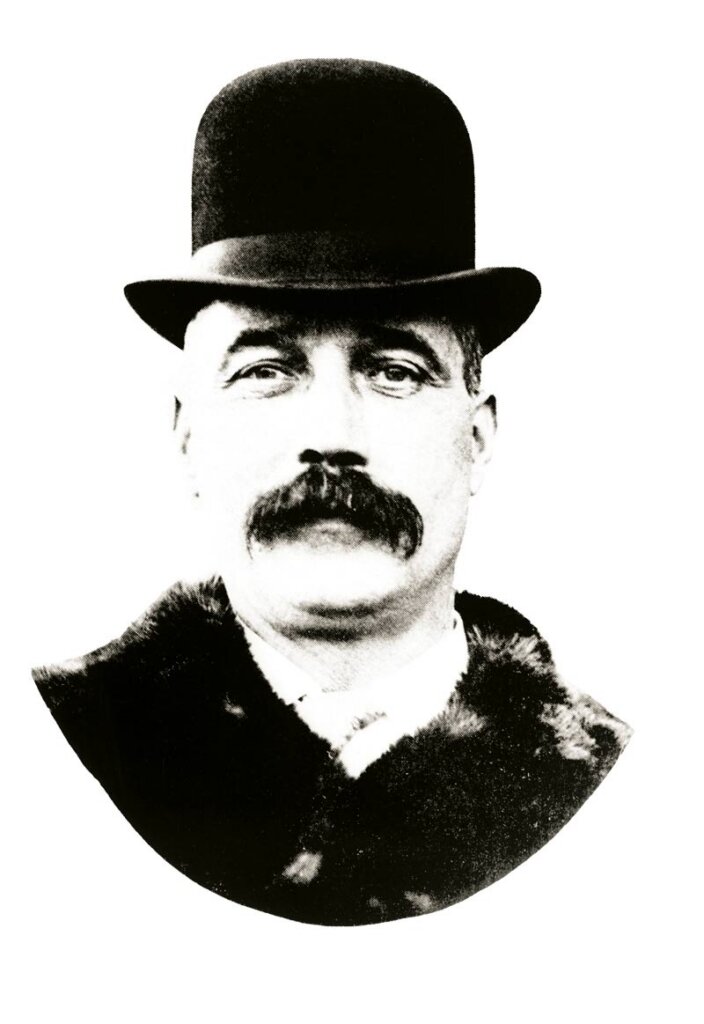
Calgary Police Chief Alfred Cuddy(below) ultimately couldn’t contain the frustrations of soldiers stationed at the city’s Sarcee Camp. [BC Archives/A-02709; University of Calgary/CH1130872]
[University of Calgary/CU1110689]
On Feb. 10, a rumour started that a café had fired two returned soldiers and replaced them with German speakers. That night, two mobs of soldiers headed downtown to storm the White Lunch’s two locations, gathering thousands of onlookers on the way.
Forewarned, Police Chief Alfred (Alf) Cuddy and 15 officers formed up in front of the eatery’s 8th Avenue location and ordered the men to disband.
But then, Private Kraft launched his rock. A hail of other stones followed.
“The policemen were swept aside like chips in a gale and for an hour the mob did its will with the place,” a newspaper reported.
The rioters destroyed furniture, shattered marble counters, smashed the kitchen and looted the cash register. Ignoring a British ensign, the marauders headed to the dance academy upstairs and wrecked it, too.
A second mob of soldiers attacked the other White Lunch café a few blocks away at the same time. The restaurant “looked as though it were situated ‘somewhere in Ypres,’ and that a howitzer shell had exploded inside,” the Calgary Albertan reported.
Chief Cuddy told city council that he didn’t order his men to use force, fearing it “would only tend to antagonize the soldiers and might possibly have resulted in murder.”
The mob dispersed only after Brigadier-General Ernest A. Cruikshank arrived and ordered the men back to barracks.
The next day, Cruikshank warned the troops of penalties for such behaviour and had officers double their guards. Despite that, a group of some 500 soldiers and civilians proceeded that evening to the Riverside Hotel in Germantown, mistakenly believing the business was owned by Germans.
They overwhelmed police, pillaged liquor in the bar and destroyed everything in each of the hotel’s 48 rooms, even ripping radiators from the walls and destroying kitchen appliances. They knocked out the keystone over the entrance, causing the exterior wall to crack.
Further attacks were deterred by 700 soldiers detailed to stand guard in front of other German businesses.
Afterward, while terrified local German-speaking residents barricaded themselves in their homes, Cruikshank banned soldiers from bars, ordered the arrests of military men in town without passes and increased guards around Calgary.
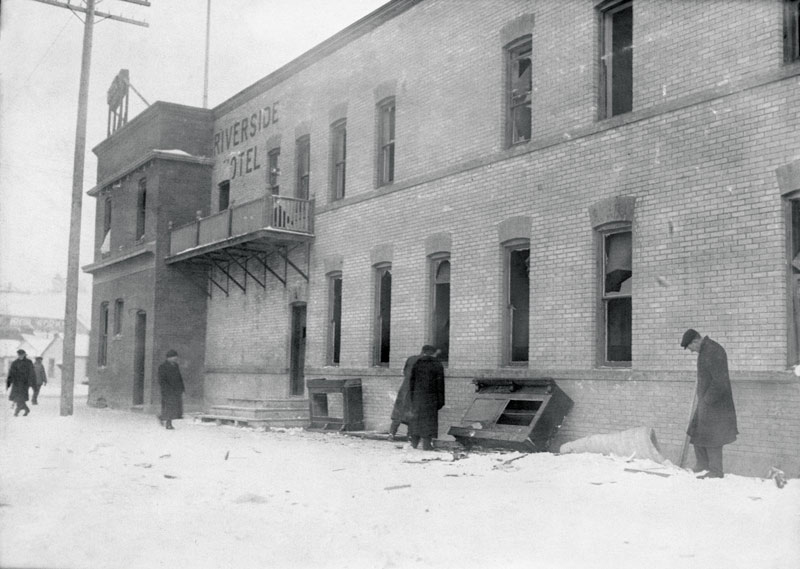
Calgary’s Riverside Hotel in the aftermath of the February 1916 anti-German riot. [University of Calgary/CU1105865]
Hoping to prevent more riots, city employees born in enemy countries were dismissed with promises that returned soldiers and veterans would replace them. Businesses were urged to follow suit.
“Evidence suggests strongly that soldiers, rather than civilians, started the disturbances.”
“The disgraceful behaviour of the troops at Calgary [showed] great lack of tact [by officers] and want of discipline on the part of the men,” intoned Gov. Gen. Prince Arthur, Duke of Connaught, who wanted to know how it was being addressed.
A court of inquiry was established on Feb. 11, Prime Minister Robert Borden told Parliament.
More than 100 witnesses were called to testify. Non-commissioned officers and recruits were unco-operative witnesses; some claimed to be bystanders, others had foggy memories or blamed drunkenness. None would identify the ringleaders.
After the inquiry, 13 soldiers were tried in civilian court and five were convicted, among them Kraft, who threw the rock that launched the looting; he sailed to Europe to join the war effort in May.
The inquiry was unable to assign responsibility. As in other riot-stricken cities, military and civilian authorities blamed each other. Chief Cuddy said the military hadn’t acted to maintain discipline and prevent disorder; General Cruikshank blamed “inflammatory letters and articles [in newspapers] and the injudicious remarks made by civilians.”
But “evidence suggests strongly that soldiers, rather than civilians, started the disturbances,” concluded historian Lackenbauer.
And not for the last time.
On Oct. 11, five men of the 211th Battalion were convicted and fined for liquor offences under Alberta’s new Temperance Act; unable to pay their levies, they were sent to the Royal North-West Mounted Police lock-up.
That evening, hundreds of soldiers in “rough formation with bugles blowing” demanded their release, marching first to Calgary police headquarters then charging the Mounties’ barracks and trashing it while looking for the guardroom.
Private Julio Pelegrino of the 211th Battalion was shot in the shoulder after threatening four Mounties guarding the prisoners.
Enraged, the mob turned on a redcoat returning to barracks. Amid cries of “mob him,” “get a club and kill him,” and “lynch him,” an inspector pulled the hapless officer to safety.
The mob disbanded only after General Cruikshank arrived. He promised there would be justice for the arrested soldiers and posted a military guard to prevent further discord.
The riots were “a failure on all levels of the military as recruits took the law into their hands, their officers failed to hold them sufficiently accountable as soldiers and the department denied any legal implication whatsoever,” concluded Lackenbauer.
Across the country, citizens absorbed the cost of the soldiers’ destruction. The military insisted the acts were done not by soldiers but “by citizens who chanced at the time to be enrolled as soldiers.”
But a lesson was learned.
Three decades later, after servicemen, predominantly sailors, rioted and vandalized more than 500 businesses in Halifax following VE-Day celebrations, a royal commission blamed the navy for poor planning, discipline and response. Rear-Admiral Leonard Murray was removed from command.
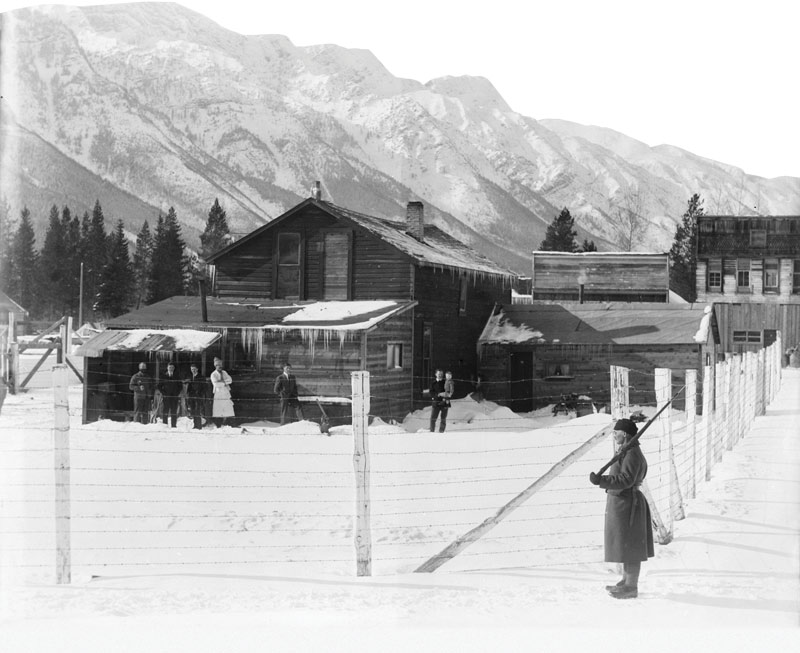
In 1914, thousands of mostly Ukrainian- and German-Canadians were imprisoned as “enemy aliens” at facilities such as B.C.’s Morrissey Internment Camp. [LAC/PA-046200]
The federal government paid more than $1 million in compensation for damage in Halifax and 41 soldiers, 34 sailors and 19 airmen were charged with offences, and some were given lengthy prison sentences (though most were later reduced).
Advertisement