






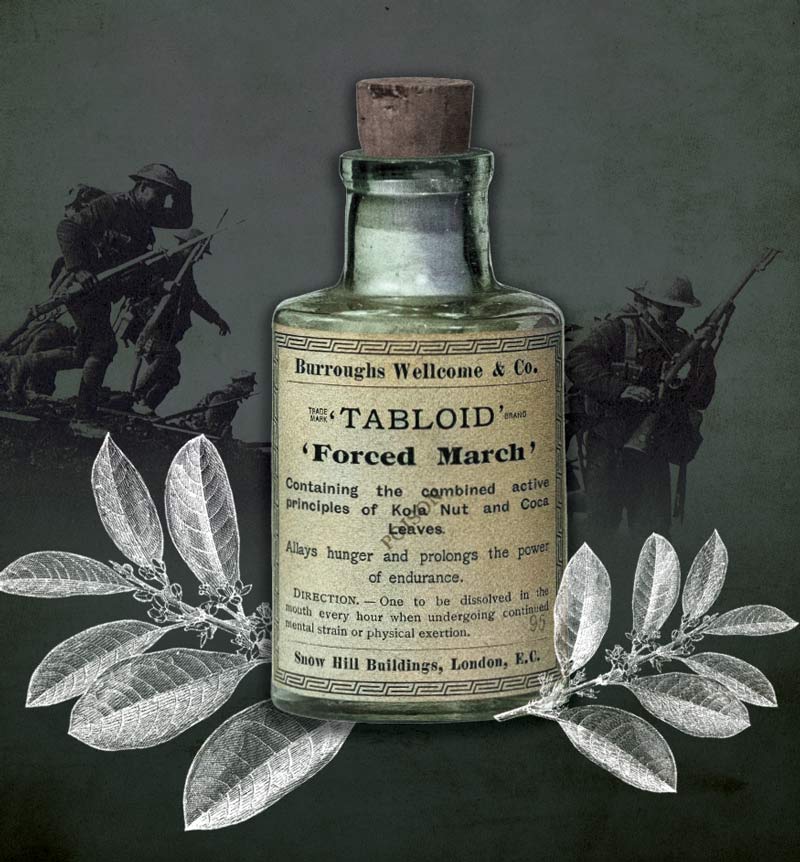
It was alleged that cocaine, often in over-the-counter meds such as “Forced March” tablets, was used by soldiers to help deal with wounds or to face action. [Wellcome Collection/Wikimedia; LAC/C-046606;]
During the third year of the Great War, Canadian troops posted in the U.K. were swept up in a moral panic about cocaine use. The alarm was spawned by a handful of court cases but was largely driven by wartime anxiety and concern about young men abroad behaving badly.
On Feb. 10, 1916, British petty criminal Horace Dennis Kingsley and prostitute Rose Edwards were convicted in a Folkestone, U.K., court for selling cocaine to Canadian soldiers. They were each sentenced to six months of hard labour.
Though legal in the U.K., cocaine was subject to strict regulation. Only pharmacists (known as chemists in Britain) could dispense the drug and every transaction had to be registered with the government. Private, unregistered resale was forbidden.
Press coverage of the Kingsley/Edwards trial suggested that cocaine use was rife among the Canadian Expeditionary Force.
A captain with the Canadian Army Medical Corps (CAMC) estimated there were at least 40 cocaine addicts at a single CAMC hospital in the U.K.
Two weeks after the trial, a chemist in Dover was convicted for unregistered cocaine sales. The person who acquired the drug had been “accompanied by a Canadian soldier,” wrote the Coventry Evening Telegraph.
Of course, these accounts represented the actions of a few soldiers within a very large army. Canadian troops had been pouring into Britain since the fall of 1914, when a 17,873-strong contingent arrived to help fight the Kaiser. In 1916, the Canadian Corps comprised some 100,000 soldiers, many of them stationed in bases across England waiting to be deployed.
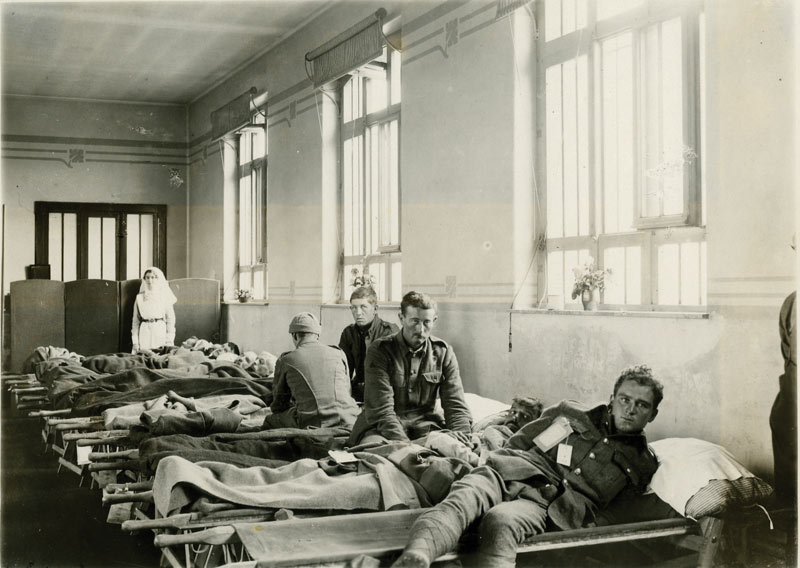
Soldiers rest at a Canadian casualty station in July 1916 (below) and during training in France in October (opposite background). [CWM/19920044-385]
“The charge is made by The London Chronicle that Canadian soldiers have introduced the cocaine habit into England. This is certainly not true.”
Nonetheless, these two cases, and a few similar incidents, were enough to spur the British press into a frenzy. A slew of stories ensued with headlines such as “Opium and Cocaine—Canadian’s Visit to a Lady’s Flat” (the Evening Herald of Plymouth, England) and “Canadian Soldiers and Cocaine” (Coventry Evening Telegraph).
These articles offered dire warnings about the drug’s effect on military morale: “Cocaine is more deadly than bullets when a man yields to its influence…in the end [it will] render him worthless as a soldier and a man,” huffed the Times.
The Canadian press picked up on the story and wallowed in the same moral indignation as its British counterparts. Cocaine was “as effective as German shrapnel in the destruction of Canadian troops,” exclaimed The Toronto Daily Star.
This reaction was somewhat hypocritical given the long-standing military tradition of using intoxicants to numb fear or induce bravery (Canadian and British troops in WW I still received a regular rum ration—an officially sanctioned alcoholic morale booster).
Such facts were ignored as newspapers expressed outrage and assigned blame.
“There is unfortunately little doubt, in the minds of the police and the military authorities, that the cocaine habit was largely introduced in this country by members of the Canadian contingent,” wrote the London Daily Chronicle on July 25, 1916.
“The recent introduction of the [cocaine] habit among our troops is probably correctly attributed to the Canadians, whose example has been followed at first out of mere curiosity,” echoed the Evening Gazette of Middlesbrough, England, the following month.
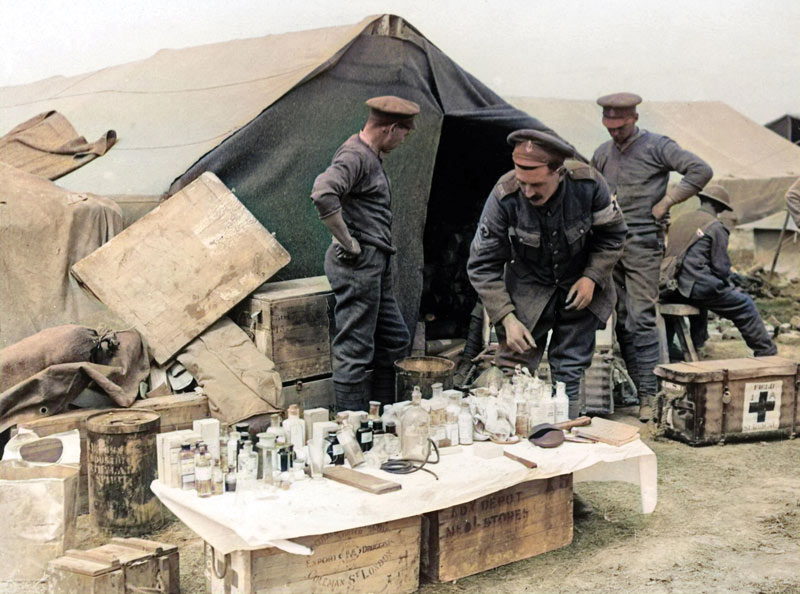
A medical dispensary at a British camp on the Western Front during the Great War.[Chronicle/Alamy/2RGDYDC]
The Canadian media framed the issue as an example of New World naïveté versus Old World corruption. According to The Toronto Daily Star, Canadian troops were being victimized by British “cocaine sharks” and needed to be protected from such predators.
Largely left unanswered was why war-weary combatants might be attracted to cocaine. In a rare insight, the Times noted that the drug had the ability to “charm away [a soldier’s] trouble, his fatigue, his anxiety; it will give him fictitious strength and vigour.” But such context was fleeting.
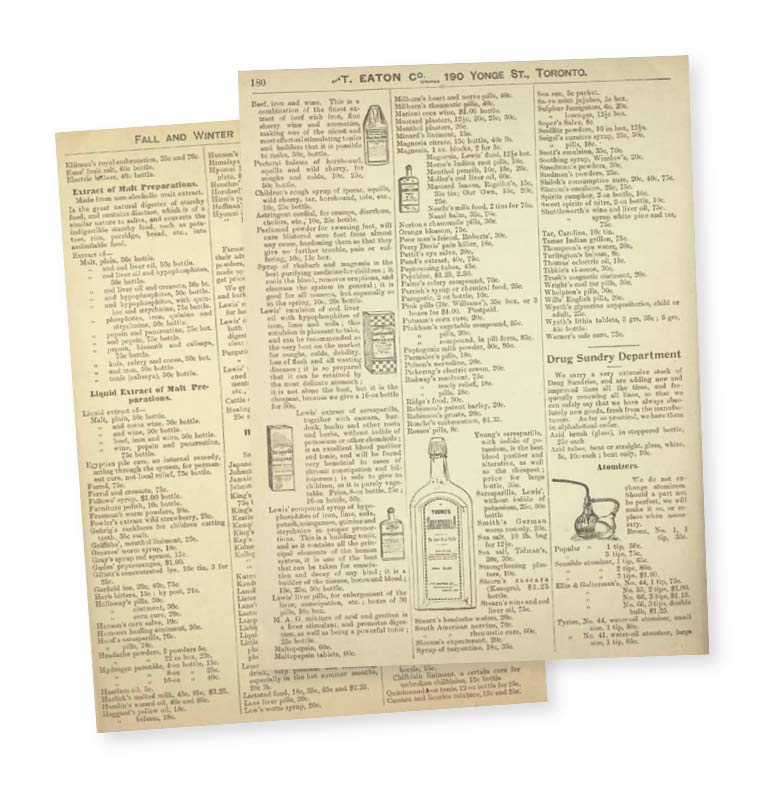
Ironically, just a few years earlier, cocaine had been touted as a health elixir by some of the same newspapers now castigating its users. Synthesized from South American coca leaves in the mid-19th century, cocaine was widely used in medicines, drinks and tonics. Cocaine-laced beverages included Coca-Cola in its original formula and Vin Mariani wine.
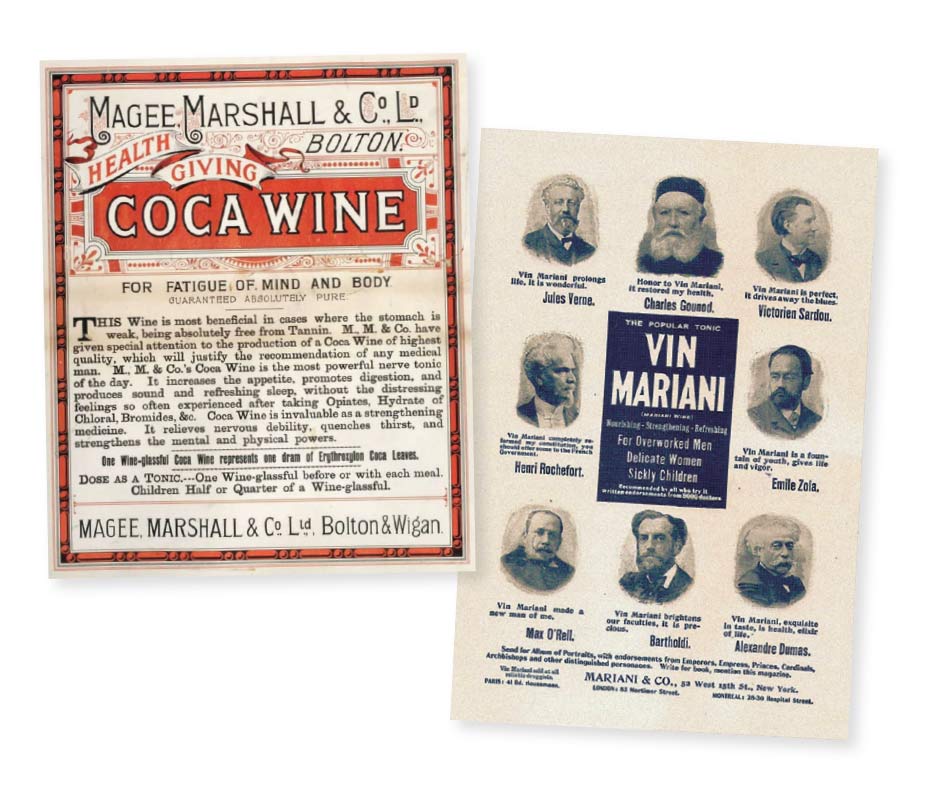
Beverages with cocaine, such as tonics and coca wine, were touted as health elixirs prior to WW I—available in Canada from the Eaton’s catalogue.[oddanthenaeum.com]
The latter was the “best and safest tonic pick-me-up for exhaustion, want of energy and general debility” read an ad published in 1900 in the Times, which cited celebrity users such as Pope Leo XIII, U.S. President William McKinley and French writer Émile Zola. In Canada, Eaton’s 1899-1900 fall and winter catalogue offered “Mariani coca wine” for a dollar a bottle and generic “coca wine” for half that price.
Coca-infused “Forced March” tablets were another popular restorative (“Allays hunger and prolongs the power of endurance” read the product label). Made by Burroughs Wellcome & Company, the pills were included in the kits of British explorers Ernest Shackleton and Robert Scott during their Antarctic expeditions.
Cocaine’s addictive qualities soon became apparent, however, and public enthusiasm for the drug waned. Federal laws prohibiting cocaine were passed in Canada in 1911 and in the U.S. three years later.
The Great War cocaine mania prodded the British government to tighten its own regulations. Using the Defence of the Realm Act (a draconian wartime measure), U.K. authorities banned military personnel from purchasing the drug. Exceptions were made for soldiers with one-time-only prescriptions from registered medical practitioners. And anyone filling one had to write their name on the scrip along with dispensing data and the address of their medical facility.
“After a careful examination of the evidence, there is no evidence that there is any serious cocaine habit amongst the civilian or military population of Great Britain.”
Introduced in the summer of 1916, these regulations were warmly received by the media in both Canada and the U.K. Standing almost alone, The Canada Lancet medical journal acknowledged the new rules but protested the depiction of Canadian troops as coke fiends intent on spreading misery.
“The charge is made by The London Chronicle that Canadian soldiers have introduced the cocaine habit into England. This is certainly not true, as very few of the Canadian soldiers are victims of the habit,” stated the Lancet’s September 1916 edition.
[openculture.com]
Such sporadic dissent did little to stem the wave of criticism aimed at the CEF. In fact, even the Australian media piled on (drug use “was quite a common vice among Canadians; cocaine was sprinkled on the back of the hand and sniffed,” read an Oct. 31, 1916, report in The Western Argus Aussie newspaper).
In November 1916, the U.K. home secretary appointed a committee to investigate the cocaine controversy. Its members (whose ranks included future prime minister Stanley Baldwin) studied the matter, then concluded that cocaine use was dangerous but rare. While noting that some “foreign” soldiers did imbibe on occasion, the panel dismissed the notion that illegal drug activity was rampant in Britain.
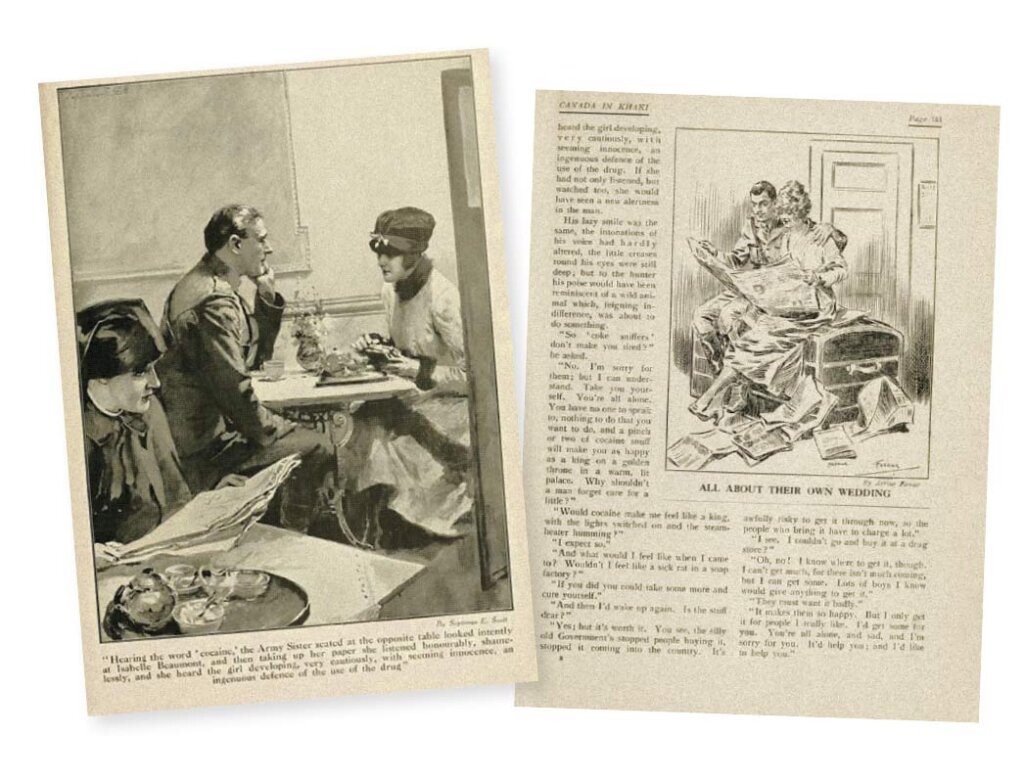
Wartime magazine Canada in Khaki published “The Saving of Tom McKay,” a tale about a wounded Canadian soldier who ultimately averts the perils of cocaine.[Canada in Khaki]
“After a careful examination of the evidence placed before us, we are unanimously of the opinion that there is no evidence of any kind to show that there is any serious, or perhaps even noticeable prevalence of the cocaine habit amongst the civilian or military population of Great Britain. There have been a certain number of cases amongst the Overseas troops quartered in, or passing through the United Kingdom, but there is hardly any trace of the practise having spread to British troops and, apart from a small number of broken-down medical men, there is only very slight evidence of its existence amongst the general population,” reported the Daily Telegraph of London on March 10, 1917.
If this sober analysis largely ended the panic, some Canadian commentators still had more to say. The same year the committee issued its findings, a blatant bit of propaganda called Canada in Khaki was released in Great Britain on behalf of the Canadian War Records Office.
Published by the Pictorial Newspaper Co., Canada in Khaki consisted of a collection of patriotic essays, stories and odes to Canadian virtues. A feature called “The Saving of Tom McKay” concerned a rugged Canadian outdoorsman who joined the CEF and was wounded in battle. Recovering in London, McKay encounters a beautiful young English woman named Isabelle Beaumont who takes him to a tearoom.
When asked, “What do you think of people who take cocaine?” McKay admits he knows little about “coke sniffers.”
“A pinch or two of cocaine snuff will make you as happy as a king on a golden throne in a warm, lit palace,” purrs Beaumont, before selling the drug to the convalescing Canadian.
The pair rendezvous several times at the café. McKay buys large quantities of coke, but his behaviour is a ruse. At the story’s climax, McKay contemptuously displays all the unopened packages of cocaine he has purchased and tells Beaumont he’s going to burn them in a fire. He demands his money back and threatens to turn her over to police if she won’t comply.
Having exposed Beaumont’s wicked ways (and gotten a refund), McKay contemplates marriage with “Sister Barbara” (an army nurse and a tearoom regular who has fallen in love with him). It’s hinted that McKay plans to take Barbara back to Canada and away from London’s sinister streets.
Asinine as this tale might be, it perfectly mirrored British concerns about the presence of Canadian troops during the Great War, a small number of whom, it seems, may have sought oblivion in drugs.
Advertisement