







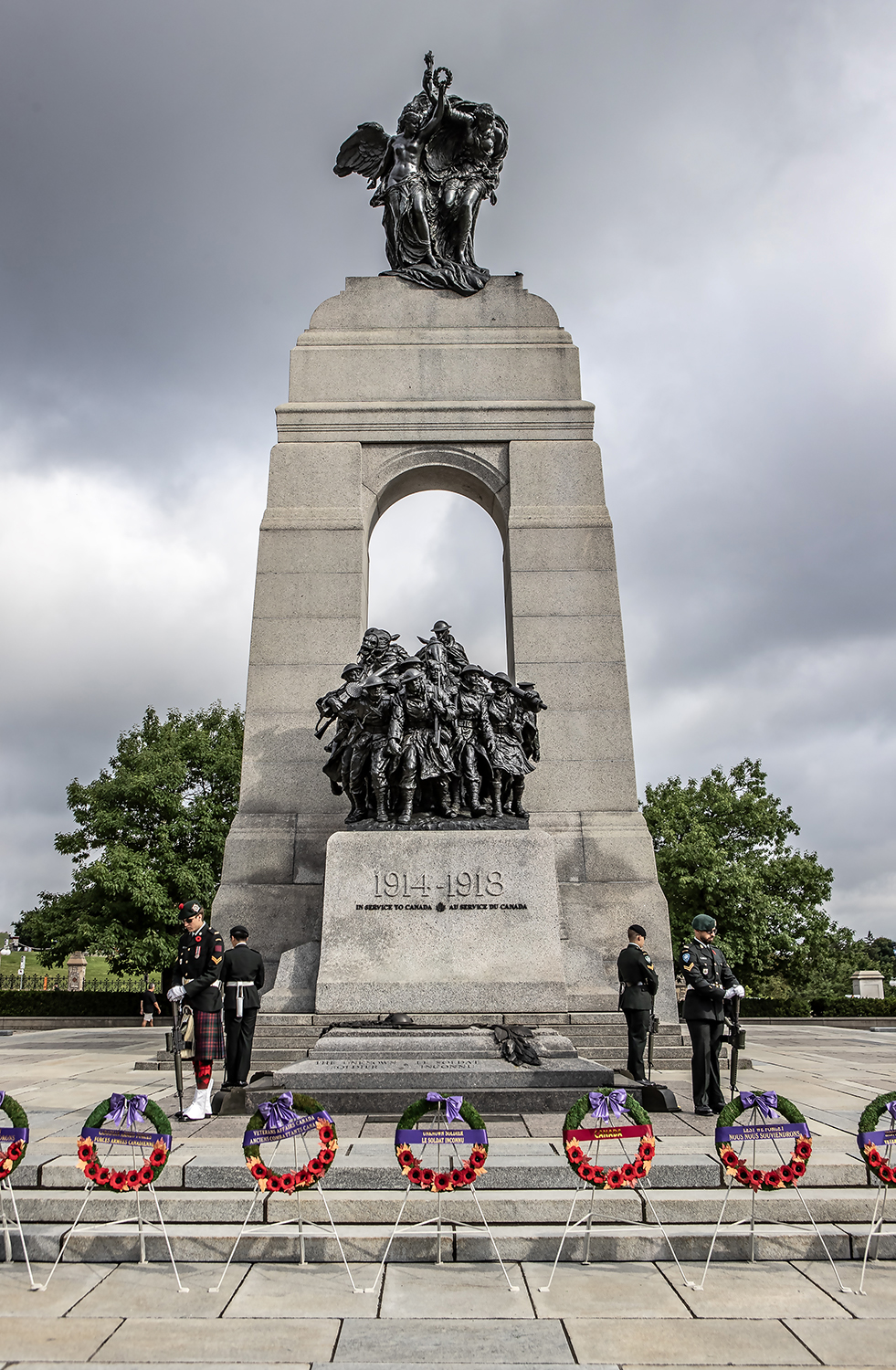
The National War Memorial on July 1, 2025, 109 years after the slaughter at Beaumont-Hamel. [Stephen J. Thorne]
It was 9:15 a.m. on the first day of the Battle of the Somme, one of the bloodiest battles of a bloody war, and two waves of Allied troops had gone before them.
The lead elements were all but wiped out. Still, the Newfoundlanders, citizens of what was then the hardscrabble Dominion of Newfoundland, were ordered on. And, so, on they went.
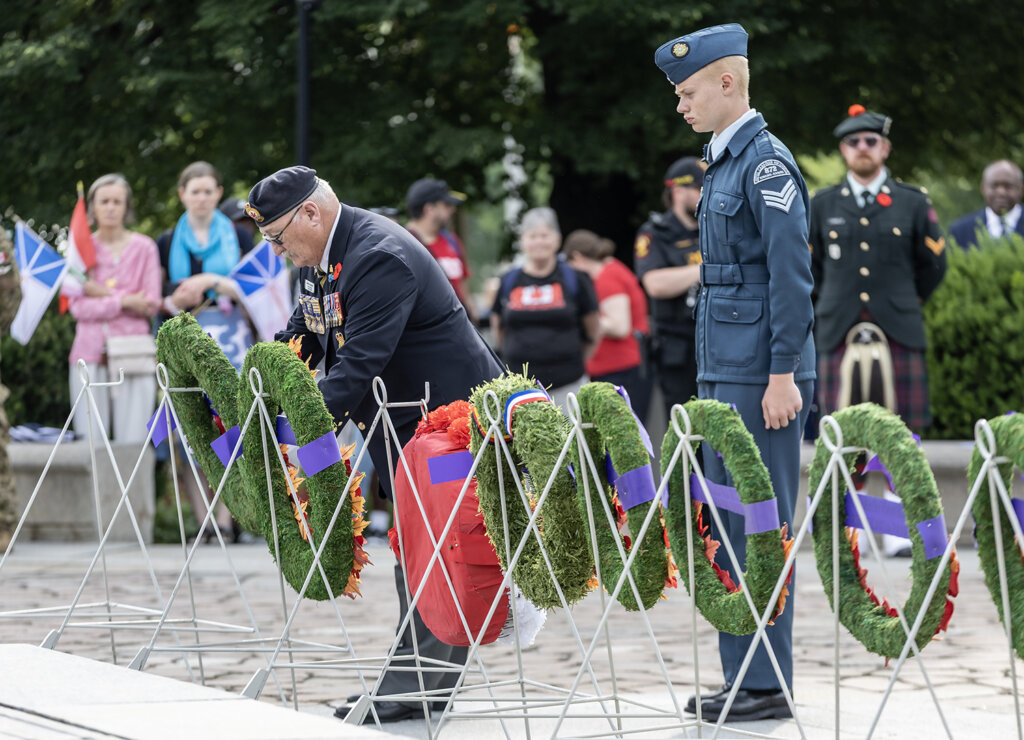
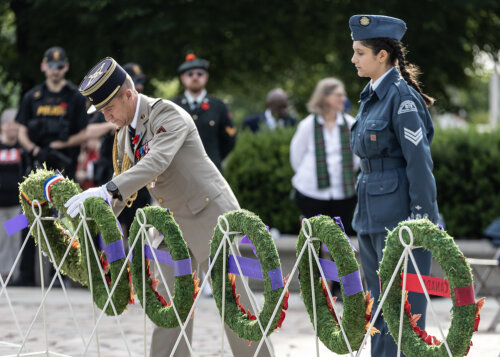
Veteran Berkley Lawrence, president of The Royal Canadian Legion and a Newfoundlander whose grandfather was wounded at Beaumont-Hamel, places a wreath on behalf of the Royal Commonwealth Ex-Services League. The RECL, which cares for veterans in the Caribbean, Africa and Australasia, was holding its 35th conference in Ottawa, hosted by the Legion. Lawrence is accompanied by Air Cadet Sergeant Simon Wright. [Stephen J. Thorne]
Two hundred and thirty-three men were killed or died of wounds; 91 were missing or presumed dead; and 386 were wounded. Every officer who went forward in the attack was either killed or wounded.
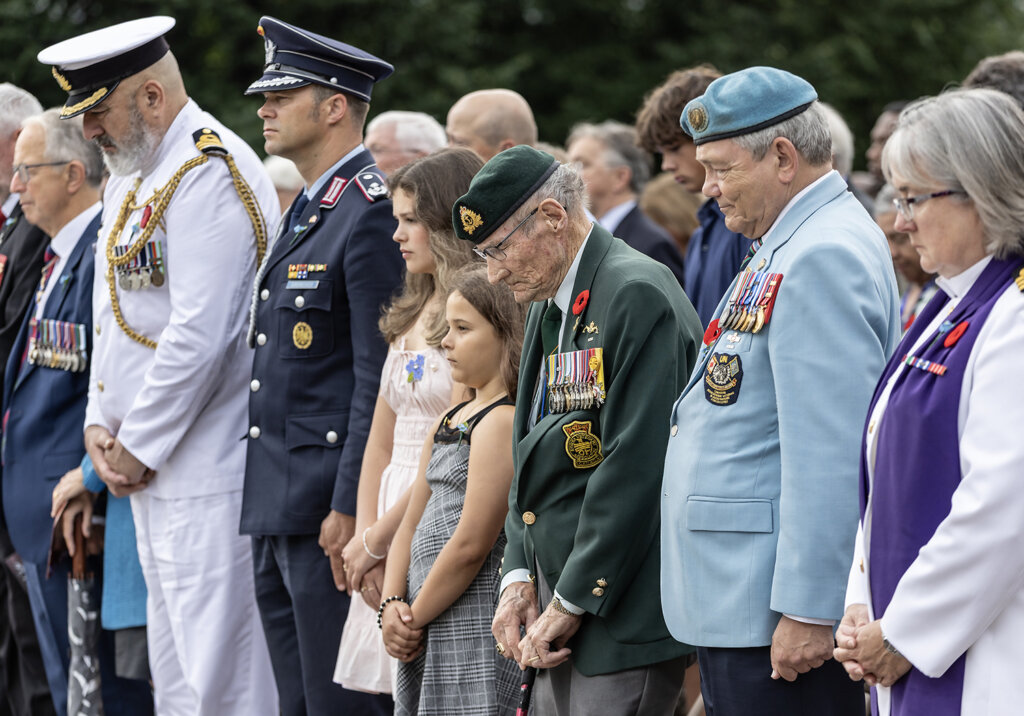
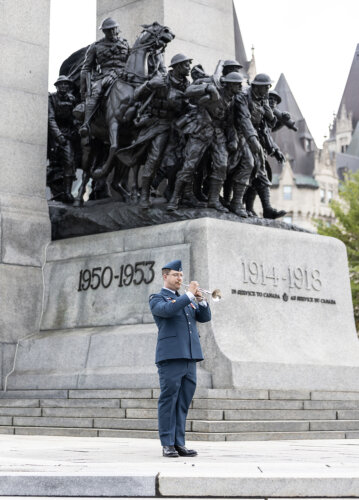
Two minutes of silence.[Stephen J. Thorne]
Before him was an audience of several hundred, including delegates to the 35th conference of The Royal Commonwealth Ex-Services League (RCEL), an organization created after the First World War to care for Empire veterans in the Caribbean, Africa and Australasia. The wars didn’t stop, and the RCEL has continued its good works ever since.
Hailing from places as diverse as Australia, Lesotho, Guyana and Malaysia, many in the crowd had likely never heard of Beaumont-Hamel or the Newfoundland Regiment, which received its Royal title from King George V in December 1917.
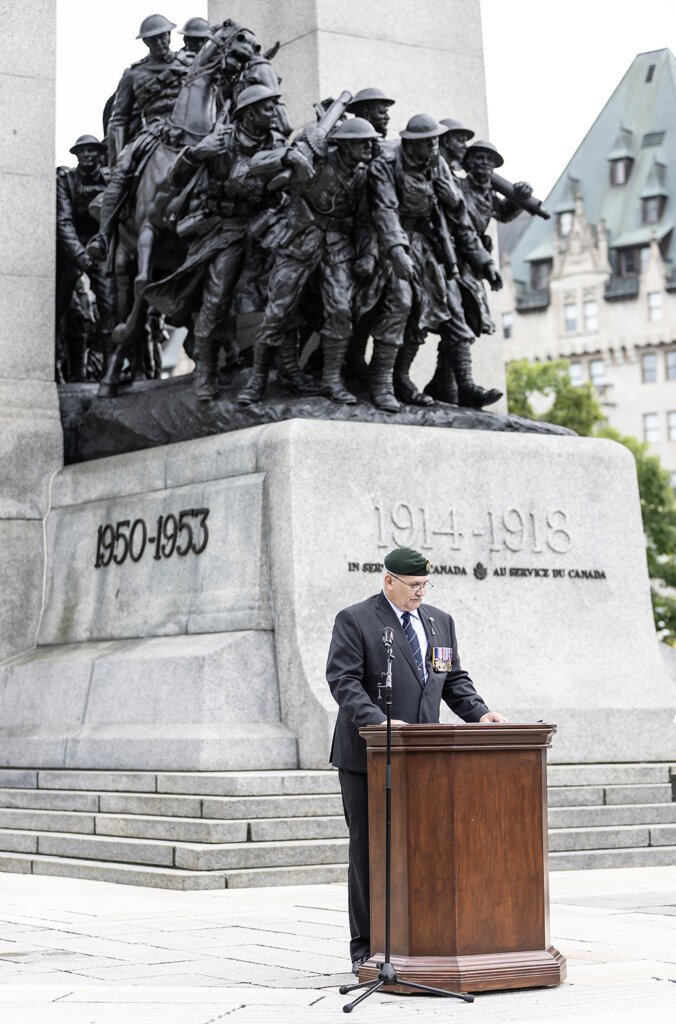
Retired colonel Gregory Burt was master of ceremonies at the Newfoundland Memorial Day ceremony in Ottawa, taking attendees on a moving journey back 109 years to the day the Newfoundland Regiment was all but wiped out during the opening action of the Battle of the Somme. [Stephen J. Thorne]
“Since the tragic losses at Beaumont-Hamel 109 years ago today,” Burt told them, “the first of July has been, for Newfoundlanders and Labradorians, a day of reflection and mourning first, and a celebration of Canada second.”
In a poignant ceremony that takes place annually before the celebrating starts a stone’s throw away on Parliament Hill, natives of the country’s youngest province performed many of the ceremonial duties.
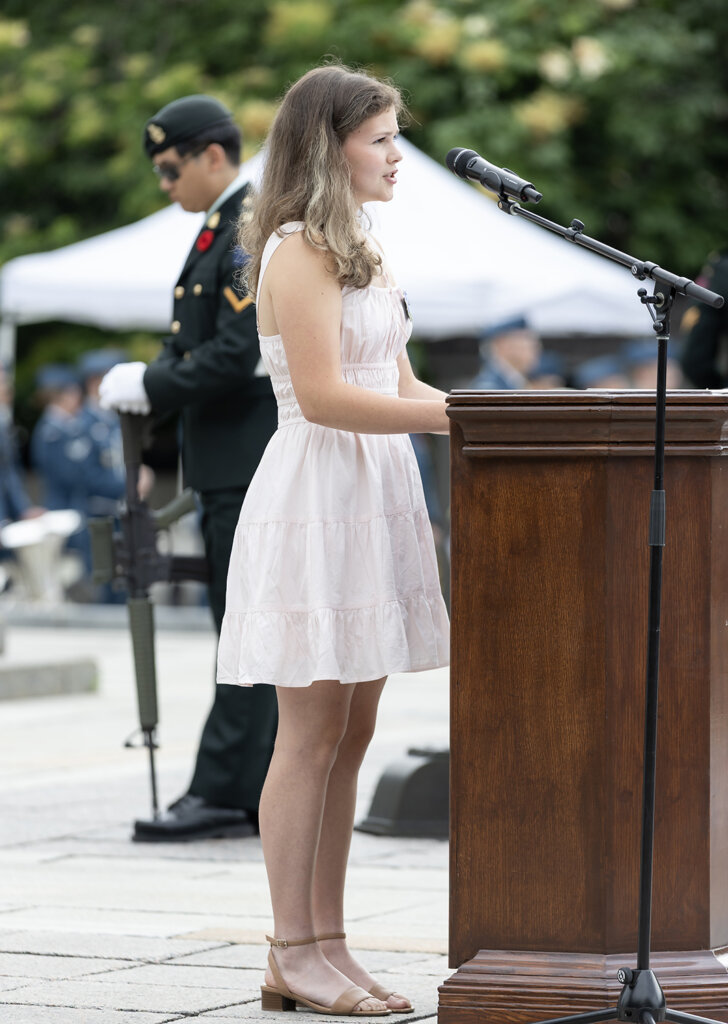
Kathleen Mercer delivered the Commitment to Remember. Her great-great grandfather, Private Bernard Murphy of Catalina, was one of the original Blue Puttees (RNR). He was wounded at Sulva Bay in Gallipoli in 1915. [Stephen J. Thorne]
“The lives they left behind in the dominion had nothing to do with the fight they were about to face,” Gosse said in a heartfelt message to the gathered.
“But their sense of duty—and, yes, probably a sense of adventure, as well—led them to sign their lives away en masse to fight strangers who were causing turmoil in the lives of other strangers.
“Many of them—so many of them—never came home.”
Newfoundlanders—many with WW I connections—placed wreaths at the National War Memorial, including Dr. Carol Gardner-Kirby, who lost three uncles in the Great War, including one at Beaumont-Hamel. She placed a wreath on behalf of the 821 Newfoundland families whose loved ones were never found.
Commodore Keith Coffen’s maternal grandfather, Henry Benjamin Vere-Holloway, a private bugler in the RNR, was wounded twice and used to show him the scars from bullet and shrapnel wounds he had suffered. Coffen placed a wreath on behalf of the Canadian Armed Forces.
Retired lieutenant-commander Richard Wayne MacWhirter’s great-uncle, Private Hugh Walter McWhirter, was the regiment’s first soldier killed in action—on Sept. 22, 1915. Hugh’s brother, George-William, was wounded while serving with the regiment in July 1916, then wounded again and captured on March 12, 1917. He remained a prisoner of war until August 1918.
MacWhirter placed a wreath on behalf of the Royal Newfoundland Regiment 110th, in Gallipoli.
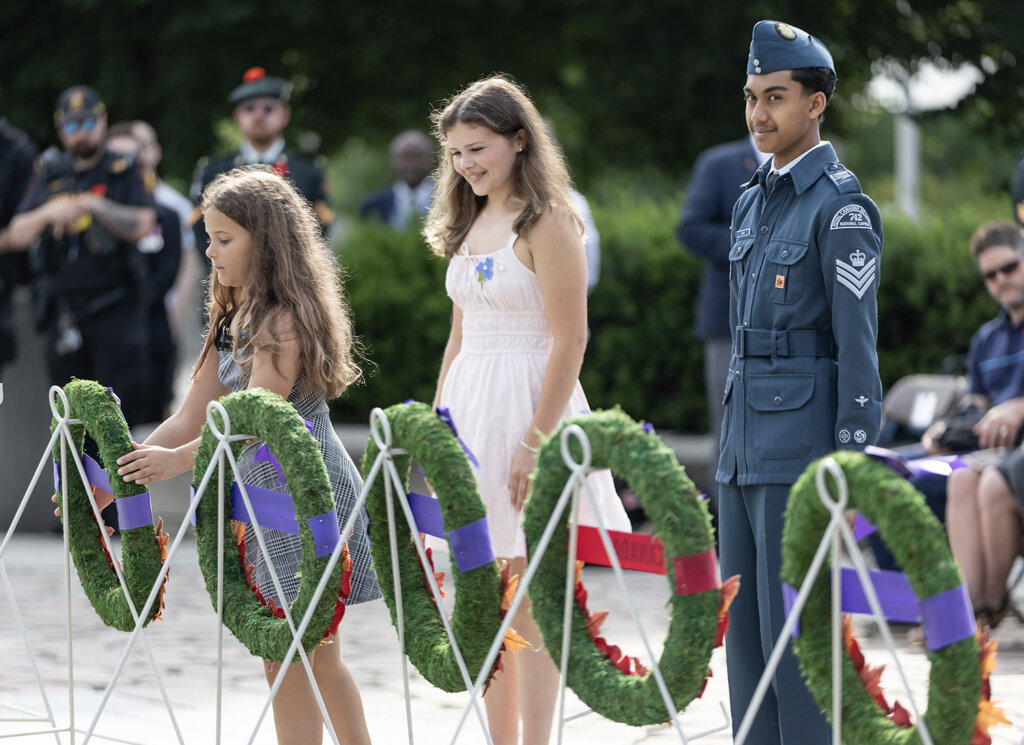
Accompanied by Kathleen Merecer and a chuffed Air Cadet Sergeant Ibrahim Alaa Ahmed Al-Kayat, Arya Burt places a wreath on behalf of the youth of Canada. [Stephen J. Thorne]
Herb Davis placed a wreath on behalf of the people of Newfoundland and Labrador. A distant cousin, Private Lester Barbour of the RNR, died of wounds in Belgium.
Kathleen Mercer and Arya Burt placed a wreath on behalf of the Youth of Canada. Burt’s distant cousins, Gidion and Steven Sweetapple, both served in the RNR.
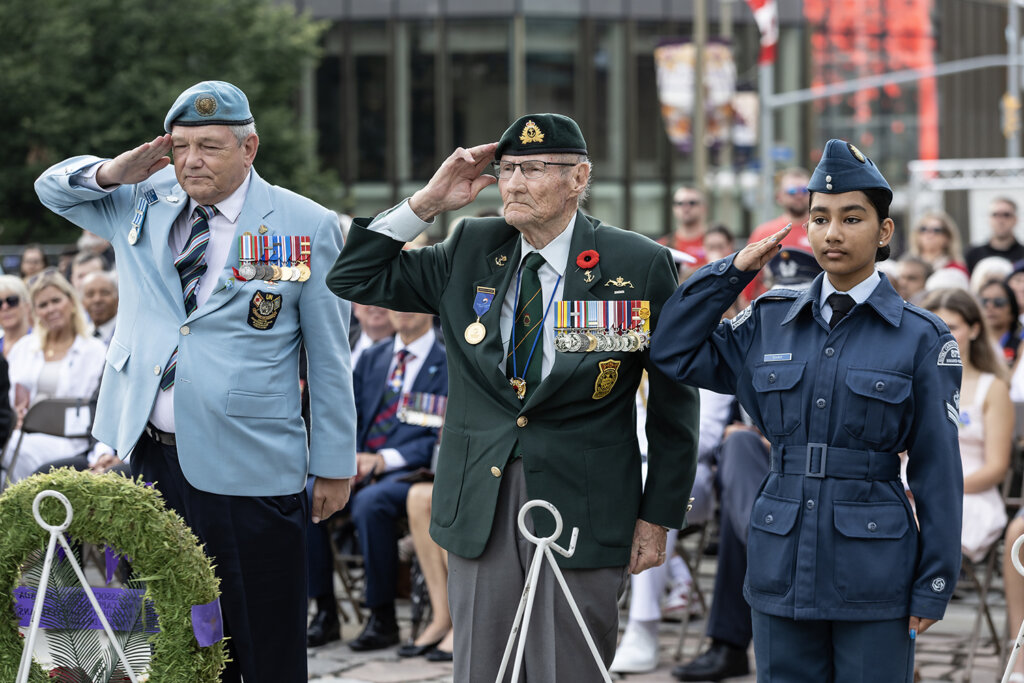
Retired forces veterans Wayne McCulloch and Bill Black, accompanied by Air Cadet Flight Corporal Haley Shah, place a wreath on behalf of the Korean War Veterans Association of Canada. Black, a Korean War veteran, is president of the organization. [Stephen J. Thorne]
There were others, including highly decorated RCMP Sergeant Curtis Barrett, a military veteran and native of Stephenville, N.L., who placed a wreath on behalf of the national police service.
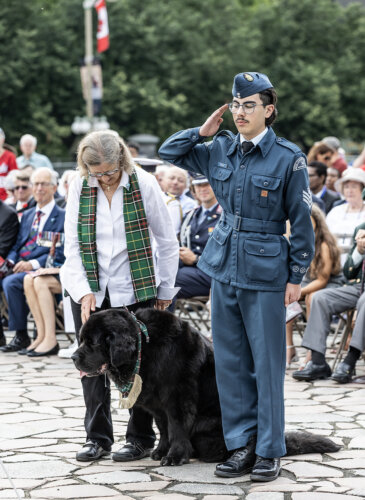
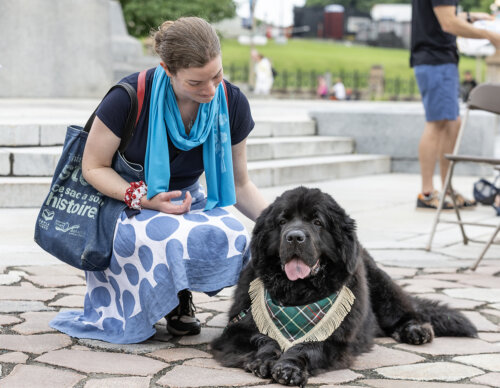
Even a Newfoundland dog, named Margaree, participated in the wreath-placing, accompanied by Joan Fisher, whose two sons continue a military family tradition. She placed the wreath on behalf of the Atlantic Voices Choir. Margaree is the choir mascot.
The choir performed “The Ode to Newfoundland,” a hymn-like anthem that is deeply engrained in the province’s history and culture.
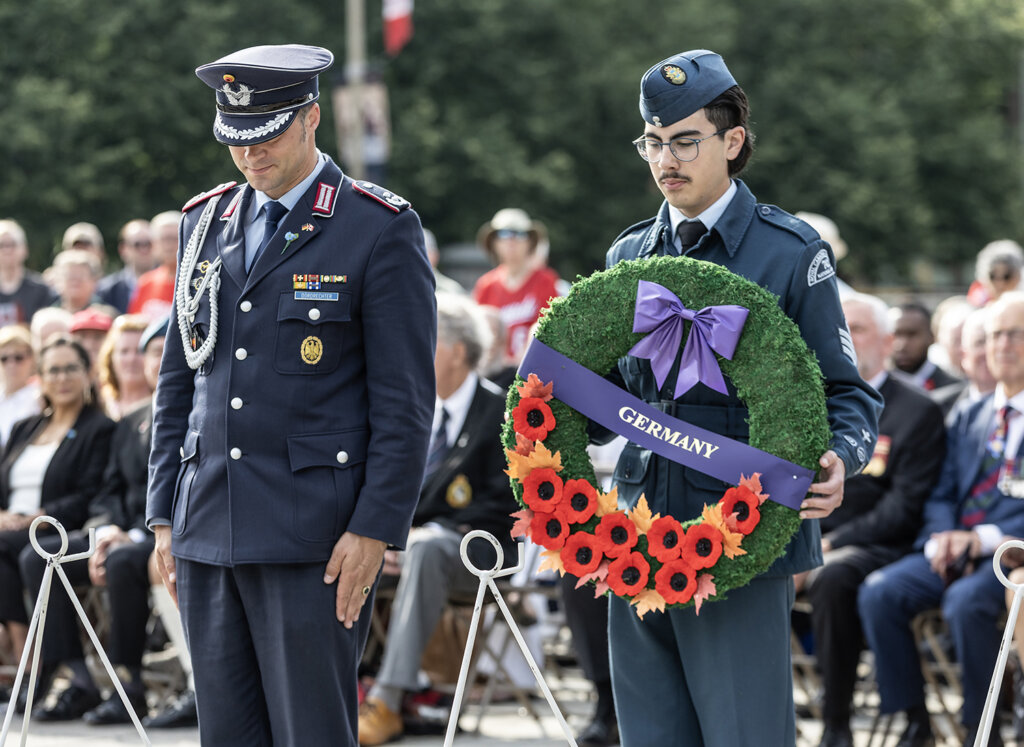
Lieutenant-Colonel Stephan Doerdrechter of Germany, accompanied by Air Cadet Flight Sergeant Kristian Sakamoto, places a wreath at the National War Memorial during ceremonies surrounding the 109th anniversary of Beaumont-Hamel, in which the Newfoundland Regiment was all but wiped out on the first day of the Battle of the Somme. Doerdrechter is wearing a forget-me-not on his left lapel, the Newfoundland and Labrador — and German — flower of remembrance. [Stephen J. Thorne]
“They advanced from this trench, which was actually behind the front line, because the sheer number of soldiers involved in earlier attacks who were dead or wounded were clogging the route to the front trenches,” Burt said.
“This meant that the regiment had to traverse more than 200 metres before they even made it to the Allies’ own front line.”
“They all instinctively tucked their chins into their chests and advanced shoulder-to-shoulder as they had so often done when fighting their way home against a blizzard.”
— an eyewitness to the action at Beaumont-Hamel
Entering no man’s land, they were met with tangles of barbed wire. The enemy trenches were more than half a kilometre away.
“As the Newfoundlanders advanced toward the enemy, there was an opening in the wire by a tree partway down the slope that marked the spot where German fire seemed to become particularly intense,” continued Burt.
“This gnarled tree was nicknamed the ‘danger tree’ by the Newfoundland troops and it marked the spot where many of them would fall that morning.”
The German machine guns were trained on the gaps.
“They all instinctively tucked their chins into their chests and advanced shoulder-to-shoulder as they had so often done when fighting their way home against a blizzard,” said one observer.
“But this time it was not snow flying all around them.”
Some 6,241 men from Newfoundland and Labrador served in the Royal Newfoundland Regiment during the First World War. Records vary at between 1,281 and 1,305 killed. Another 2,284 were wounded.
More than 2,466 Newfoundlanders and Labradorians served in other branches—the Newfoundland Royal Naval Reserve, the Newfoundland Forestry Corps—and another 3,296 joined the Canadian Expeditionary Force.
In all, over 12,000 served from a population of just 240,000, including about 175 Newfoundland women who served overseas as graduate nurses or with the Voluntary Aid Detachment.
At least 15 Inuit men, mainly from Labrador, joined the Newfoundland Regiment, many as scouts and snipers. Others served in the Canadian Expeditionary Force.
More than 22,000 Newfoundlanders and Labradorians answered the call in the Second World War. Two-thirds of the 1,089 Newfoundlanders and Labradorians killed in WW II died at sea serving with naval forces and the merchant marine.
Memorial Day in Newfoundland and Labrador—and in Ottawa—now commemorates not just the regiment at Beaumont-Hamel, but all of the province’s servicemen and women who died at war.
The chaplain, Gosse, concluded her thoughts with a poignant message.
“May we, inspired by their love, live our lives in such a way as to make them proud,” she said. “May we, faced with adversity, demonstrate the same tenacity that made them ‘tuck their chins in’ and go walking through a blizzard when the blizzard that day was bullets.
“May we be loyal to our families, our country, our homeland, so that we ensure their sacrifices were not made in vain, but respected by a people who continue to fight for justice and freedom for all.
“And may we, like them, find our final resting place, our peace, our comfort at the last, in the land we love. May it be so. And may we work to make it so.



Advertisement