







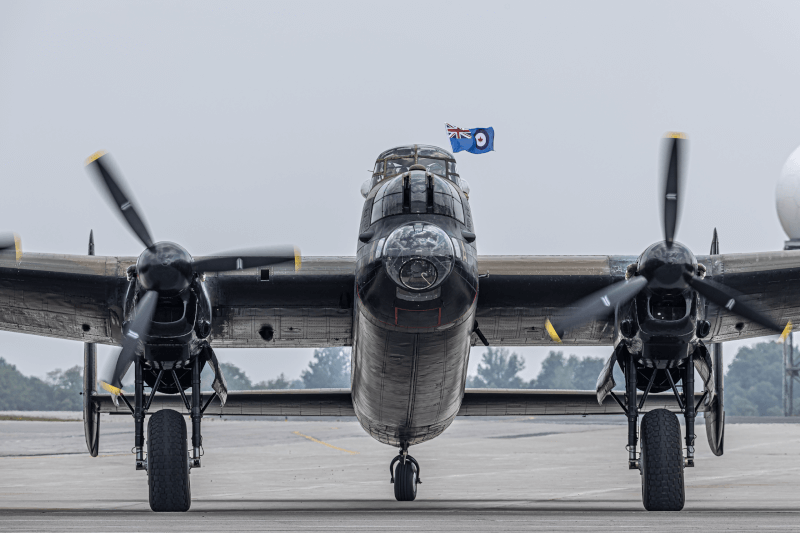
One of 430 Lancasters built at Victory Aircraft in Malton, Ont., the Canadian Warplane Heritage Museum’s 81-year-old Mk. X is one of only two of the bombers flying today. The other is in Britain. [Stephen J. Thorne/LM]
For 50 hours each year, the skies above Mount Hope near Hamilton, Ont., play host to a time capsule unlike any other. Its true uniqueness lies not in its make or model but in its spirit—in what, fundamentally, it symbolizes.
Only one other—sited an entire ocean away in Lincolnshire, England—bears any resemblance, at least as far as the clouds are concerned. Together, they’re titans, transatlantic feats of engineering and the last two airworthy Lancaster bombers in the world.
Of these, however, just one is Canadian.
Between 1943 and 1945, thousands worked at Victory Aircraft in Malton, Ont. (now Mississauga), to produce 430 Lancaster Mk. Xs during the Second World War. Among them was FM213, built in July of the conflict’s final year. In the absence of combat, it served as a Royal Canadian Air Force maritime reconnaissance patrol plane until 1963. For several years thereafter, its frame was on plinths outside The Royal Canadian Legion branch in Goderich, Ont.
In 1977, the Canadian Warplane Heritage Museum acquired the aging mechanical behemoth. Eleven years later, in September 1988, the fully restored bomber took to the skies once more.
Those who continue to maintain the 80-year-old aircraft understand the responsibility they bear as caretakers. Sean Kearney, the museum’s manager of education and public programs, shares that duty with pride. Here, in a Legion Magazine exclusive—the second of two parts—he continues an armchair tour of the bomber.
(Read Part 1 here.)
On the aircraft’s space and lighting
I have not yet had the privilege of flying in the Lancaster, but I have been inside many times. During the COVID-19 pandemic, I did a lot of virtual tours of our facility, and I was often the only one walking around the building with my cell phone and a flashlight to give myself light in the aircraft.
With its restoration, certain elements were taken out because a lot of the wartime internal components weren’t necessary, and they just add a lot of additional weight while reducing the overall space inside the plane. You look from outside the Lancaster and you’re thinking, wow, it’s huge, when really, it’s a very cramped and narrow space.
There’s also very little light, very few windows to look out of—aside from the cockpit and turrets—because it was a heavy nighttime bomber, so you wanted to reduce the amount of light that could be seen [from] outside of the aircraft.
On boarding the Lancaster
When you first get into the aircraft, you climb through the crew door, which is at the back of the plane. There’s a small ladder that allows you to enter, but you have to haul yourself into the airplane. It’s not designed for comfort. You’re often grunting and groaning while moving throughout the plane.
To the left [upon entering] is where the tail turret is located, and that’s a no-go area. No one is allowed to go into that space, and arguably, no one really wants to be in that position. It was a very cramped and uncomfortable position to be the tail-end Charlie, or tail gunner, on a Lancaster bomber, and a true credit [goes] to all who took on that role, because it was essential.
To give you an idea, there were over 10,000 rounds of ammunition that were belt-fed to the tail gunner alone, whereas a fighter aircraft carried only about 2,000 rounds of ammunition. A lot of stuff was set-up to support that gunner’s position, but all of that has been removed.
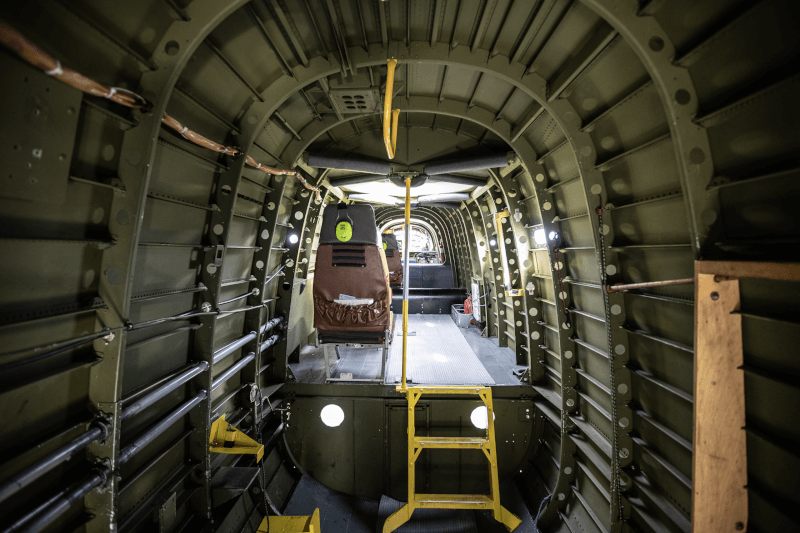
As in virtually all bombers, the Lancaster fuselage was rudimentary—functional, without luxuries of any kind. [Stephen J. Thorne/LM]
On moving through the aircraft
There’s a walkway that allows you to move easily through the back section, but then you have to bend over and start to pull yourself in as you move throughout the aircraft because it’s quite narrow. You can barely see from nose to tail as you’re moving through the plane—and wouldn’t have been able to with its wartime configuration.
Another area that has been removed is the mid-upper gunner position. That was located just as you enter through the Lancaster, toward the nose. There was what was known as an armoured skirt there, which was designed to protect the mid-upper gunner’s legs from shrapnel or enemy fire. That’s been removed because it created a huge obstacle.
We now have four seats that have been added on the port side of the aircraft for passengers. These take up space where wartime radio equipment, ammunition and other stuff was kept.
When landing and taking off, everyone needs to be in their seats, but once the aircraft reaches altitude, passengers have the option of moving around a little bit, and some can move up toward the front to see the cockpit. As you’re moving toward that area, you again have to crouch to move through. Only in the tail can most people stand up.
You pass what would have been the radio operator and navigator’s positions, the only two positions seated at a desk. The joke was that navigators flew backward for a living because the desk faced the tail. They were also the only ones privileged to have a light source because they needed to look at maps. That area is still there, if a little modified.
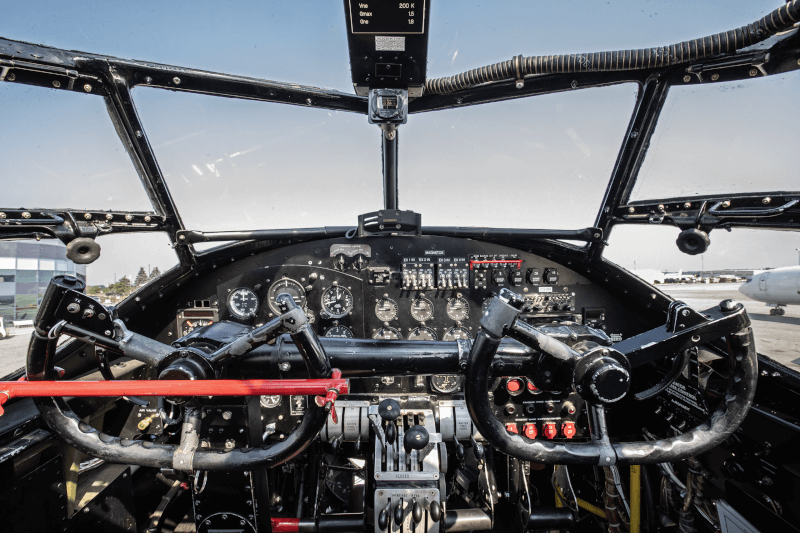
The Lancaster cockpit. There was only one pilot aboard the heavy bomber. The flight engineer, whose primary job was managing the engines, fulfilled the role of co-pilot.
[Stephen J. Thorne/LM]
On the aircraft’s front
When you move through to the cockpit, depending on your height, you might be able to stand up again. There’s a Perspex canopy that runs up and over your head and out in front of you. You’ll also see the dual-control systems where the pilot and co-pilot sit and operate the aircraft. During the war, there would have only been one pilot due to wartime necessities, but also due to the loss rate of pilots in aircraft of this type, the rationale being that if you’re going to lose a plane, it’s better to lose only one pilot than two.
There was also, however, a flight engineer who served as a co-pilot of sorts, assisting the pilot with both landing and takeoff, but otherwise focused more on ensuring that everything mechanical was operating properly on the aircraft.
As you move past these positions, you have to crouch and crawl, either scooting along on your bottom or diving headfirst and pulling yourself through to the bomb aimer’s position. The bomb aimer was the only one to be privileged with the ability to lie down on a cushion while looking through the front window and operating the bomb sight. Their job, primarily, was to line up the aircraft with its target. They did so by communicating with the pilot to move laterally, left and right. The joke was that they would also tell them to back up to make sure that the aircraft was able to deliver its payload in the correct position.
When the bombs dropped, there would be a camera that took a picture of the moment to capture its accuracy and to determine whether or not the raid was successful. The camera has since been removed, as that is where the modern radio system now exists. It’s quite a large radio, so it can’t fit in the Lancaster’s cockpit.
On Vera’s legacy
Those who built planes had a huge amount of pride. They knew they were part of something big, something that no one else thought they could do. There was a lot of doubt that Canadians could step up and build something like the Lancaster, notably in the U.K., where there was doubt that we would be able to meet the deadlines and requirements. But Canadians achieved it, they succeeded and excelled at it.
I hope that people, when they look at our Lancaster, will recognize that this pride still exists today, that not only can we be proud of our past, but still be proud of all initiatives and efforts taken in this country to build great things.
Advertisement