No boost for defence spending

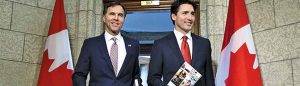
Finance Minister Bill Morneau (left) is joined by Prime Minister Justin Trudeau before delivering the 2017 budget speech. [Adam Scott / Office of the Prime Minister]

When Finance Minister Bill Morneau delivered the Liberal government’s 2017-18 budget in March, the surprise to many observers (and incurable optimists) was that there was, fundamentally, nothing new for the Department of National Defence and the Canadian Armed Forces. Despite some fuzzy hints from the defence minister and friendly meetings between Prime Minister Justin Trudeau and U.S. President Donald Trump that suggested a willingness of the government to increase defence readiness, there was nothing. In fact, there was less than nothing.

The Trudeau government removed some $8.5 billion set aside to build defence capital equipment and infrastructure and shifted it from six to about 20 years down the road. The finance minister gave hints that his document may not be the last word on the defence budget, given the defence review which was expected to be released on June 7. But clearly, any effort to raise the defence budget will await the fall budget update at the least, if not the next full budget for 2018-19.

Canada has become one of NATO’s lowest contributors to defence spending, not only with respect to its NATO obligations, but also to North American defence spending and international expeditions to prevent war, such as significant UN missions. As of May, the government had still not selected a robust UN mission to join, although it announced last year that it would do so.

Rather than complain that Canadian governments almost always disappoint the military and Canadian citizens who want an adequate military, I’m going to try to explain some hard realities about Canadian defence.

There is no solid constituency for increased defence spending. An Angus Reid Institute poll released before the budget revealed that although a slim majority of Canadians felt NATO countries should match their defence spending to two per cent of their GDP, many fewer Canadians favoured doing so within Canada.

That should not be surprising. Despite terror attacks, wars against terrorist groups and dangers of war in far-off places, Canadians feel very safe. In 1924, Canadian Senator Raoul Dandurand declared that Canadians “live in a fireproof house, far from inflammable materials” and most Canadians today would probably agree with him. The tragic reality is that within 15 years of his declaration, Canada was in a total war alongside its partners in the greatest military conflict in history. With the exception of the two world wars, Canadians feel safe because Canada is, fundamentally, safe.

Short of actual war, Canada’s defence policy is to send troops, or planes, or ships, simply to be there. Where is there? Wherever the Canadian government believes it is important to wave the Maple Leaf for whatever intangible (though sometimes tangible) result that Canada can earn. We’ve heard it all before: a seat at the table; a chance to make our voice heard when key international decisions are being made; a chance to convince our allies to “take us seriously” after wars end and we played a role, important or not, in an allied victory.

That was not true of the two world wars, but it has been true almost ever since. From where comes the physical threat to Canadian territory today? From Russia, which is building a formal military presence on its side of the Arctic Ocean? Is it going to seize islands in the Canadian Arctic Archipelago? Nonsense. Or from China, which pokes the odd Arctic research vessel into the Arctic Ocean? China has far more pressing problems in the South China Sea, East China Sea and, possibly, the Indian Ocean.

Canada takes part in military actions when Canadians get their blood up—such as after 9/11—or when we believe there is something to gain from joining our traditional allies.

We have a token military because Ottawa always has “better” things to spend its money on and doesn’t really believe Canada can make a meaningful contribution to diplomatic/military crises anywhere.

The current government’s policy of sending small packets of Canadian military resources to trouble spots allows it to answer complaints about Canadian defence spending the same way: “Don’t look at how much we spend; look at what we accomplish with the scarce dollars we do spend.”

It is possible to forecast what the defence review will actually recommend and it’s hard to expect any deviation from decades of Canadian defence policy spending. In fact, the only real threat to our national sovereignty will come when Washington washes its hands of our feeble effort and begins to take over virtually the entire role of North American defence. As Winston Churchill once said, everyone has an armed force–its own or someone else’s.


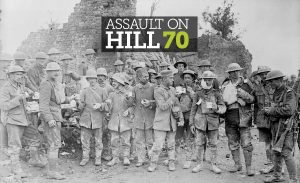
Assault on Hill 70

[Pause in the action — Canadian soldiers and German prisoners receive coffee and biscuits from a YMCA hut less than a kilo-metre from the front line in 1917. The bitter fight for Hill 70 included vicious hand-to-hand combat and German counterattacks using mustard gas and flame-throwers.]

The year is 1917 and the place is northern France. The meticulously prepared Canadians sweep up the commanding heights in the face of determined German resistance and win the day. Sound familiar?

No, it’s not Vimy Ridge, Canada’s most celebrated battle, but rather the attack on Hill 70, near the northern edge of the French coal mining town of Lens, barely 10 kilometres up the road from Vimy.

The name Hill 70 refers to the feature’s height in metres above sea level. In 1917, it was a gradually rising, chalky, treeless slope about half Vimy’s height and less than half its length. It had been in German hands since 1914 and it was well fortified.

The fight for Hill 70 in August 1917 was a large-scale and shockingly grisly battle, considered an epic Canadian victory by contemporaries. Yet, a century later, the battle has been largely forgotten. The men of the famed Canadian Corps who fought in the bloody engagement at Hill 70 deserve better.

The first major post-Vimy attack by the Canadian Corps proved a striking tactical victory in support of a broader strategic purpose. The immediate goal of the assault was to seize the dominating high ground north of German-occupied Lens, oblige the enemy to withdraw, and threaten its control of Lille, a major transportation centre. More importantly, the Canadian attack was intended to pin down German forces around Lens and draw others away from the major British offensive in Flanders, which began on July 31. The Canadian attack was also intended to cause severe German casualties, the replacements for which would be unavailable for deployment to Flanders.

In June, Lieutenant-General Sir Arthur Currie had become the first Canadian promoted to the command of the Canadian Corps. The attack on Hill 70 would be his first major operation in that position. On July 7, his immediate superior, British General Sir Henry Horne, commander of First Army, instructed Currie to prepare plans for the seizure of Lens, a shattered urban landscape of wrecked brick houses and barely recognizable streets surrounded by a labyrinth of slag heaps and destroyed mining installations, rail sidings and buildings.

It was understood that capturing Lens against the tenacious, well-concealed and dug-in defenders would prove difficult and undoubtedly very costly. Currie personally reconnoitered and studied the terrain. It made little sense to the seasoned Canadian commander to attack Lens without first seizing Hill 70, since the Germans otherwise would observe the Canadians’ advance into Lens and direct devastating artillery fire on them. The town would become a deathtrap.

Currie boldly and successfully petitioned Horne for the seizure of Hill 70 instead of Lens itself, expecting the Germans to withdraw from the town once this dominating feature was in Canadian hands. Currie planned to fortify Hill 70 right after its capture, knowing that the enemy’s doctrine of instantaneous counter-attacks would provide an opportunity to inflict massive casualties on them with concentrated artillery and machine-gun fire.

Canadian and British planning staff worked to identify objectives and readied the assault, while training and rehearsals with battlefield models familiarized officers and men with every aspect of the plan. Ammunition was moved to the gun lines and supplies of every kind were brought forward by trucks and narrow-gauge rail lines, which snaked their way as close to the front as possible. Heavy rain and Currie’s insistence on careful preparation delayed the attack until Aug. 15, probably beyond the time when it would make the most effective diversion from the Flanders offensive.

[Walking wounded — Members of a Canadian Scottish battalion near the front during the Battle of Hill 70 in August 1917. The 10 days of combat cost Canada 8,677 casualties, a quarter of them fatal.]

In the days before the attack, nearly 500 Canadian and British guns fired almost 800,000 shells, which steadily degraded German defences, cut barbed wire, hampered communications and collapsed trenches. Counter-battery fire knocked out 40 of 102 identified German artillery emplacements in positions that would disrupt the assault. Heavy guns and howitzers unleashed a deeper bombardment to disrupt German artillery and saturate rear-area enemy troop concentrations. This, combined with indirect fire from 160 Vickers machine guns, inflicted thousands of casualties on the Germans. Millions more machine-gun rounds would be fired during the battle itself. The Royal Engineers delivered 3,500 drums of burning oil and 900 gas shells into Lens, creating havoc and, just prior to the assault, causing a massive smokescreen.

Currie’s plan was to attack with two of his four divisions on a roughly 3,700-metre front to a depth of 1,400 metres, hurling the enemy back from Hill 70. Three objective lines guided the Canadian assault: first was the German front-line trenches on the forward slope, second was the crest of the hill, and third was low on the reverse side.

At 4:25 a.m., just before dawn over a hellish, shell-cratered landscape, the uphill attack began. More than 200 18-pounder field guns and 48 4.5-inch howitzers launched a dense creeping barrage of fire and steel to shield the advancing Canadians. The 1st Canadian Division, on the left, attacked Hill 70 proper; the 2nd Division on the right swept along its southern slope and through the ruins of some industrial suburbs of Lens. Each division attacked with two brigades forward, the initial assault force comprising 10 battalions—about 7,000 men—reinforced and leapfrogged by other battalions as the attack progressed. Simultaneously, the 4th Division’s 12th Brigade launched a feint attack against the southern perimeter of Lens, which successfully drew German artillery fire away from the main battle at Hill 70.

In his diary, Arthur Lapointe of the 2nd Division’s 22nd Battalion described the assault: “Zero hour! A roll as of heavy thunder sounds and the sky is split by great sheets of flame…. I scramble over the parapet and…am one of the first in no man’s land…. The noise of the barrage fills our ears; the air pulsates, and the earth rocks beneath our feet…. We reach the enemy’s front line, which has been blown to pieces. Dead bodies lie half buried under the fallen parapet and wounded are writhing in convulsions of pain.”

Even though the Germans had accurately predicted the time and location of the attack, many first-line objectives were captured in a mere 20 minutes. But the speed of the advance belies the ferocity of the fighting. Some men reached the second line about one hour after setting out, while others had already pushed to their third-line objectives. Some German positions held out stubbornly and casualties mounted as Canadian troops stormed machine-gun positions, seized stoutly defended shell craters, or picked their way through urban rubble.

As soon as the first objectives were secured, fatigue parties brought up ammunition, entrenching tools and supplies, signal linesmen laid wire to the new positions, and stretcher-bearers working in dangerously exposed positions evacuated the wounded.

One of them, Irish-born Private Michael O’Rourke from the 7th Battalion, brought out wounded men almost constantly for 72 hours, despite nearly being killed by shell bursts at least three times. O’Rourke received the Victoria Cross, one of six awarded to Canadians at Hill 70 and Lens.

The Canadians swiftly built defences by repairing captured German trenches and reversing the direction of the firing steps and parapet. They set up barbed wire and filled thousands of sandbags on the new front, and dug strongpoints in the chalky ground in carefully sited positions for 48 Vickers guns and as many as 200 Lewis light machine guns.

The Germans mounted four counter-attacks early that morning, and with the help of accurate massed Vickers and artillery fire, each was repulsed with heavy German losses. The artillery was directed by observation officers atop Hill 70, using field telephones and, a first for the Canadian artillery, wireless radio. The Germans were decimated.

“Our gunners, machine-gunners and infantry never had such targets,” Currie wrote in his diary. It was a “killing by artillery,” recounted Lieutenant-Colonel A.G.L. McNaughton, the Canadian senior counter-battery officer.

But the Germans kept coming. They threw in seven reserve battalions from two divisions, including the crack 4th Guards Division, joining the eight battered battalions already facing the Canadians. By the end of the battle’s first day, the Canadians had suffered 1,056 killed, 2,432 wounded and 39 taken prisoner.

The enemy pressure was nearly unbearable: for the next three days, the Germans counterattacked in various strengths and at different locations along the Hill 70 front. They doubted their ability to retake the hill early on, but at least their counterattacks destabilized the Canadians and prevented further advances. This bitter fighting was perhaps the most vicious hand-to-hand combat experienced by Canadians during the war, involving small arms, grenades, bayonets, clubs, fists and anything else that was handy. The Germans also deployed a terrifying new weapon: the flame-thrower.

No quarter was given by either side during these grim days. A few of the German attacks resulted in temporary gains, but all 21 of them were defeated. The Canadians suffered a further 1,800 casualties from Aug. 16 to 18, but Hill 70 remained theirs.

Adding to the misery, the battlefield was dangerously toxic, thanks to both sides’ liberal use of poison gas. Not previously used against the Canadians, the German mustard gas, so-called due to its odour, was especially gruesome. It blinded, burned lungs and hideously blistered and deformed flesh. Even those Canadians behind the lines were not immune: the Germans fired some 15,000 gas shells, mainly mustard gas, attempting to disrupt the devastating Canadian artillery fire. When the Canadian gunners donned their awkward gas respirators with foggy eye pieces, they were unable to properly lay the guns or quickly respond to appeals for support. Many in the gun lines removed their gas masks and 183 gunners became casualties. Theirs were among the most heroic actions of the 10-day struggle for Hill 70 and Lens.

[Aftermath — Canadians pass destroyed German gun pits on the western outskirts of Lens, France, in September 1917. German forces held the bombarded town until their final retreat in 1918.]

Currie should have quit while he was ahead, but he wanted the Germans out of Lens as planned. A lull of several days ended on Aug. 21, when the 4th Division, with the 2nd in support, launched a probing attack into the southern and western outskirts of Lens. The attack was a worthwhile attempt to convince the Germans to evacuate the town. But the 4th Division’s staff work was rushed and incomplete and its attacks hasty and poorly judged. This marred Currie’s enormous success at Hill 70, and the Canadian commander himself must shoulder the blame.

Weathering a heavy artillery barrage, the Germans remained alert and shelled the Canadians’ start line with devastating effect. Then they launched a spoiling attack of their own. The two sides met in no man’s land and another fierce hand-to-hand struggle erupted in the pre-dawn gloom. Without much cover, losses climbed rapidly and the Canadians were obliged to break off the attack. Few objectives were gained, and because of the urban and industrial rubble, it was difficult to dig in and consolidate even these. German machine guns decimated British Columbia’s 47th Battalion in the shattered urban landscape.

It should have ended there, but in the early hours of Aug. 23, a haphazardly planned night assault by Manitoba’s 44th Battalion against a heavily defended slag heap known as the Green Crassier proved disastrous, with German artillery and machine guns exacting a very heavy toll in Canadian lives. Against all odds, the resolute Canadians managed to scale the Green Crassier, but they could not hold it against sustained German counterattacks. The 44th suffered 257 casualties, nearly half of its strength. Minor operations on Aug. 25 ended the battle for Hill 70 and Lens. The entire fight, from Aug. 15 to 25, cost 8,677 Canadian casualties—5,400 at Hill 70 and 3,300 at Lens. There were nearly as many Canadian casualties during the 10-day battle for Hill 70 and Lens as at Vimy, although fewer men were involved. German casualties are estimated at 12,000 to 15,000.

No German forces left Lens and some reserve forces were sent there rather than be dispatched to Flanders. The Germans considered the Canadians the best assault force available to the British and admitted that at Hill 70 “the Canadians had attained their ends” and that the “plan for relieving the troops in Flanders had been upset.” Still, Lens remained in German hands.

Hill 70 had been a brilliant tactical victory and a partial strategic success. Field-Marshal Sir Douglas Haig, commander of the British Expeditionary Force, recalled Hill 70 as “one of the finest minor operations” of the entire war, while Currie recalled it as the Canadians’ “hardest” battle to that point but a “great and wonderful victory.”

Press accounts in Canada in August 1917 hailed Hill 70 as comparable to Vimy in achievement and significance. A Calgary Daily Herald headline on Aug. 17 blared: “Hill 70 Runs Red Today with Blood of German Army.”

The battle’s resonance with Canadians has been long overshadowed by Vimy. The only memorial in Canada recalling the Canadians’ deeds at Hill 70 is a modest monument and park that was laid out in the eastern Ontario hamlet of Mountain in 1925. In recent years, it was rededicated and renovated. But on Aug. 22, the Hill 70 Memorial Project, a Canadian charity, plans to unveil a dramatic, privately funded obelisk in a beautifully landscaped setting straddling the 1917 start line at Loos-en-Gohelle, France. The Battle of Hill 70 will finally get the recognition it has long deserved.


[For bravery Ukrainian-Canadian soldier Filip Konowal received the Victoria Cross after mopping up cellars, craters and machine-gun emplacements. He killed at least 16 enemy soldiers.]

Six Victoria Crosses were awarded to Canadians who fought at Hill 70 and Lens, two more than at Vimy.

A 29-year-old Ukrainian immigrant to Canada, Filip Konowal had previously served as a bayonet and hand-to-hand fighting instructor in the Imperial Russian Army. He arrived in Canada in 1913 and worked as a logger in British Columbia. He enlisted in the Canadian Expeditionary Force in 1915 and served overseas in the Canadian Corps with British Columbia’s 47th Battalion. He served at Vimy Ridge in April 1917 and distinguished himself in the fighting at Lens on Aug. 22-24.

Acting Corporal Konowal gallantly led his section of men in fighting among the shell craters and shattered houses, fiercely attacking several German machine-gun posts and killing their crews. His Victoria Cross citation reads, in part: “In one cellar, he himself bayonetted three enemy and attacked single-handed seven others in a crater, killing them all…. This non-commissioned officer alone killed at least sixteen of the enemy, and during two days’ actual fighting carried on continuously his good work until severely wounded.”

Following the war, Filip Konowal settled in Hull, Que., and died in 1959, at the age of 70.

The other five VC recipients are:

• Private Harry Brown of the 10th (Canadian) Battalion

• Company Sergeant-Major Robert Hill Hanna of the 29th (Vancouver) Battalion

• Sergeant Frederick Hobson of the 20th (Central Ontario) Battalion

• Acting Major Okill Massey Learmonth of the 2nd (Eastern Ontario) Battalion

• Private Michael James O’Rourke of the 7th (British Columbia) Battalion


“Everything works half”

“I’m trying to differentiate myself not as the injured ex-military guy,” says Christian Maranda. “I’m trying different things. It makes me feel alive.”

Story and photography by Stephen J. Thorne
A bomb had just gone off near Kandahar, Afghanistan. No one was hurt, and Captain Christian Maranda was ruminating about the paperwork all of this would spawn—when all hell broke loose.

It was Aug. 1, 2009, and Maranda’s platoon was escorting a convoy supplying a Royal 22nd Regiment team mentoring a group of Afghan National Army recruits at a strongpoint west of the city.

Coming off 18 months of intense training and three years of officer training before that, Maranda had arrived in Afghanistan on April 3. Two days later, he was in his first firefight. By mid-May, the poppies were harvested to supply the drug trade and fighting season set in.

“Lots of firefights; lots of fun—as fun as it gets, as long as no one was getting hurt,” recalls Maranda, a native of the Lac-Saint-Charles district of Quebec City. “It’s the best job in the world; the best days of my life were probably around that time.

“I like to do things to their fullest.”

It wasn’t without its difficulties, however. By August, the Van Doos’ 2nd Battalion had been in the thick of it for some time and were starting to show signs of wear.

Continued from Military Health Matters e-report No. 26

Working out of a forward operating base in the middle of Zhari District, about 15 kilometres west of Kandahar, Maranda’s platoon was wracked by illness and diarrhea; more than a dozen soldiers were out and they had already suffered losses. Mid-tour leaves were in full swing, further depleting the force.

Operations were not without frustrations, either. Prisoners would be released by local authorities almost as soon as they were locked up, it seemed, and in a kind of deadly game of whack-a-mole, operational sweeps would clear one village, only to have the enemy turn up in another.

“As soon as you looked the other way, boop, they’d reappear,” says Maranda.

Every week or two, they would go on a resupply run to the mentoring team, located between their operating base and Kandahar. Maranda had just returned from his 20-days’ leave and already a lot had changed.

“It was pretty obvious to me that we had lost control over Zhari,” he says. “Police strongpoints were getting attacked every day. At the [forward operating base], we were getting rockets; we were getting [fired on] every now and then, which didn’t happen before.”

The routes used by the Canadians had been changed. In planning for the resupply run, Maranda opted for Ring Road South there and back—a statement and a challenge to the enemy.

He was confident in the assertion that he had the best-trained troops in-theatre to deal with ambushes, improvised explosive devices and whatever else the Taliban could throw at them.

They made the run without incident and were on their way back when an IED exploded between Maranda’s vehicle and the one behind him, the second and third vehicles in the convoy.

“There were no injuries, no mechanical problems, no nothing.”

With his senior warrant officer and his platoon sergeant both on leave, Maranda exited his vehicle along with two engineers, Corporal Christian Bobbitt and Sapper Matthieu Allard, to check out the situation. He ordered everyone else to remain inside their vehicles and called in a drone to assess the overall battlefield situation.

As the three soldiers approached the crater, they could see there was still unexploded material inside, telltale signs of a second yellow jug containing the lethal mixture of home-cooked materials that made up the majority of IEDs.

Bobbitt and Allard had defused many such devices and they set to work, defusing the second IED without incident.

“I remember standing there and all I could think was: ‘The fucking paperwork I’m going to have to do because that stupid IED is in the middle of the road,’” says Maranda. “‘We’re going to have to do a blow-in-place; we’re going to have to clear the area; we’re going to have to clear the airspace.’”

Bobbitt was right there. Allard was immediately behind him. Maranda was off to one side, a couple of metres away.

“At that point, I got this feeling that tells me something’s wrong, I don’t like what I see, I’m getting very pissed right now and I don’t know why,” he recalls. “So, I tell Christian and Matthieu, ‘You know, guys, get the fuck out of here. I don’t like it. We’ll wait for reinforcements.’ And, boom, the third one—or the second one, we’re not sure—went off.”

It was a remotely detonated bomb, designed to go off horizontally rather than vertically, ensuring it would take out as many soldiers as possible.
“We got served,” says Maranda.

Bobbitt and Allard were killed instantly. “They never saw it coming. They didn’t feel anything.”

Maranda got hit from the right side and went flying, landing on a side road about 17 metres away. He woke up seconds later, the dust still hanging in the air around him. “I didn’t know what happened. A second ago, Chris and Matt were right there in front of me and now they weren’t. I couldn’t see them.”

He reached for his weapon but it wasn’t there. They never did find it. His helmet was gone too. He was seeing red—literally. He tried to get up but his legs weren’t working. He could see the blood oozing out with each heartbeat.

It took his mates a minute to find him in the dust and confusion. He was feeling more and more sluggish with every passing second. Even after they applied tourniquets, he could still see and feel the blood loss.

Both his knees were destroyed, both femoral arteries were severed and his right arm was shredded. Both arms were broken. All of his fingers were gone or broken. The lower third of his face was blown away and his body, except for his chest beneath the ceramic plates of his flak jacket, was peppered with, as the medical report stated, “innumerable” shrapnel wounds. Ballistic glasses saved his eyes.

Medevac was summoned and a Blackhawk was redirected from another mission to get Maranda, a priority life-and-death case. “I was lucky a chopper was in the air.”

Still, it was 57 minutes before he reached Kandahar, just inside the critical “golden hour” that is considered the period after a traumatic injury in which emergency treatment is most likely to succeed.

They had no sooner landed than Maranda’s heart stopped and he died. He was revived and died again, only to be brought back a second time.

“I could hear people talking to me. I could hear one of my sergeants who I was really close to telling me ‘It’s going to be all right, Chris, it’s going to be all right.’ But I could hear in his voice, ‘It’s not right, Chris. You’re fucked.’”

All he could feel was guilt at not being able to be there for his guys, even though a member of the quick-reaction force told him on the way out they had it covered.

“They didn’t need anybody; they knew what they were doing. But I felt so cheap leaving them.”

He passed out and didn’t wake up for 12 days, coming to in Germany surrounded by family. It would be a while yet before he was out of the woods. He was in hospital for four months and confined to a rehabilitation centre for nine—totalling a year in bed.

He faced more than 60 surgeries over six years and years of rehabilitation. Doctors wanted to take his right leg above the knee but Maranda insisted they try to save it. They did, only after he got his knee working again through hours and hours of effort.

“The thing is, I had little injuries everywhere. Everything was fucked up. Everything is still fucked up. Everything works half, everything’s at 50 per cent now—my knees, my hands.”

Over years, he went from a wheelchair to crutches to braces to walking on his own.

“I never quit.”

Two years after the incident, his doctor called him in. He had a copy of an e-mail in his hand and explained to Maranda that the career soldier had set some sort of survival record for blood transfusions.

Medics had to scour the Kandahar base after he’d been brought in, approaching random soldiers and asking their blood types in order to collect enough of Maranda’s type to save his life. There had been no time to test the blood for diseases, so now he had to be tested. He cleared with flying colours.

Maranda left the military in August 2016. He had fought his way through an agonizing rehab and struggled with post-traumatic stress injury and the accompanying vices. His face had been reconstructed, the wounds hidden by a full beard. He walks with a limp and uses braces on difficult terrain, but he rejects the trappings of disability.

Now 38 years old, he has endured a divorce, found a new relationship five years ago, dotes on his two daughters, ages 9 and 11, and immerses himself in sports—sprint kayak—but not the Paralympics or the Invictus Games for the war-wounded.

“I’m trying to differentiate myself not as the injured ex-military guy,” he says. “I’m trying different things. It makes me feel alive.

“If you stay at home, if you stop challenging yourself, you fall into that kind of downward spiral. The big thing for me now is not the physical thing; I’m happy to have what I have left. The issue is more mental health.

“It wouldn’t take much to fall back into depression and start taking opiates and drinking again. I always feel kind of on the edge. But I’m working on it.”

He gives talks and seminars on resiliency and courage in a business context. He works with a professional business coach in Montreal, gauging whether it’s the career for him. Projects, he says, “keep you alive, give you a sense of purpose.”

And in spite of all he endured, Maranda considers himself lucky. Lucky to be alive. Lucky to have all his limbs. He knows too many colleagues in one of those two other categories.

“I shouldn’t be alive today,” he says.


To view more images and read other instalments in Stephen J. Thorne’s Portrait of Inspiration project for Legion Magazine, please click below.


Images with impact

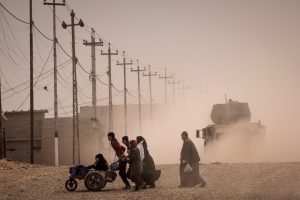
Residents of Mosul flee the city amid fighting between Iraqi forces and the Islamic State in Mosul, Iraq, on Nov. 16, 2016.[© Sergey Ponomarev / The New York Times

For 60 of the past 62 years, the World Press Photo competition has been holding a mirror to the world we live in, and it’s not, so to speak, a pretty picture.

For all but two years since 1955, when a shortage of funding shut it down, World Press Photo has been the arbiter of what is best in photojournalism, and what is best has most often been what is worst in humankind.

War, violence, starvation, poverty, cruelty, ignorance and corruption have always been an integral part of the imagery featured in the annual competition, the subsequent exhibition and the book.

Now, as World Press Photo’s annual exhibition begins its Canadian tour at the country’s national war museum, the question remains, more than ever: does it all make any difference?

Many photojournalists have declared themselves anti-war photographers, including 14-time honouree and two-time grand prize-winner James Nachtwey and, before him, Don McCullin, who has been honoured eight times including one grand prize.

Nachtwey and McCullin’s bodies of work, from strife-torn areas all over the world, are incomparable. But there is little empirical evidence they have had any significantly broad or lasting impact, except as icons of the conflicts and tragedies they depict.

They form a part of the record of man’s inhumanity to man and it will be for the historians to decide whether they helped change anything at all.

The early years at World Press Photo were heady days in the industry. Vietnam—the most visual war in history—ruled the 1960s into the 1970s. Iconic photographs, such as Eddie Adams’ Saigon Street Execution, World Press Photo of the Year in 1969, and Nick Ut’s Napalm Girl, winner in 1973, most would agree, helped usher America out of the war in Southeast Asia.

But television, digital photography, the Internet and social media now bombard us with imagery hourly. Hourly. Many people in the developed world have become desensitized by the sheer volume, immune to its impact, or ignore it altogether.

Mevlüt Mert Altıntaş shouts after shooting Russian ambassador Andrei Karlov, at an art gallery in Ankara.[© Burhan Ozbilici / The Associated Press]

Then along comes Burhan Ozbilici’s stunning photograph of an off-duty Turkish police officer, Mevlüt Mert Altıntaş, in a black suit and tie, shouting, an index finger raised in triumph, the other hand gripping a pistol as the body of Russia’s ambassador to Turkey, Andrei Karlov, lies on the floor next to him.

The picture stops the viewer in his tracks for a myriad of reasons, not the least of which is the appearance of the terrorist.

Altıntaş, who had just assassinated the ambassador in the middle of a speech, is not one’s ready-made version of a jihadist. He is clean-cut, beardless and looks more like a member of a personal security detail.

Ozbilici, an Associated Press staff photographer, was on his way home after work when he decided to drop by the gallery to check out the opening of an exhibition of Russian photographs. He had no idea what he was in for.

The photographer’s images from that day include a picture of Altıntaş lingering like a spectator behind Karlov as the ambassador addresses those attending the event. Later Ozbilici photographed those same people cowering in corners as the assassin brandishes his weapon.

Altıntaş shouted “Allahu Akbar (God is great)” and later said in Turkish: “Don’t forget Aleppo. Don’t forget Syria.” In a few minutes, he was killed by police, but not before he had brought his message to the world and the Middle East war to Ankara, just as others had to Paris, London, Zurich and Berlin.

Aside from the single picture, the series won the World Press Photo award for spot news stories.

Exhibition curator Sanne Schim van der Loeff says there is no denying the impact of photographs like those of Adams and Ut, but the very same technology that deadens some to their impact today delivers them to a far bigger audience, in every corner of the globe.


“The world has changed, especially when you compare it to the Vietnam War,” Schim van der Loeff said. “The first thing I would say is, look at how many people go to see this exhibition.

“We have, worldwide, around four million people every year, and that’s just seeing the exhibition itself irrespective of people who buy the book and who go online, etc.”

The role of the photojournalist has changed, too, she added. There is no doubt we are constantly bombarded by imagery and information, even to the point of numbness. The curator points out, however, that today’s images have reached a level of nuance, detail and artistic merit that just wasn’t possible 50 years ago.

It’s a testament to photographic skill, no doubt, but also to technical innovation that allows photojournalists to capture images at all hours of the day, in all light conditions, and transmit them from the remotest locations on Earth.

Photojournalism has evolved into an art form. Rather than simply recording what is there in front of them, as courageous as the photographers of yesteryear were, today’s photojournalists are bringing their own style and perspective to picture stories, creating new levels of visibility and understanding.

“In photojournalism today, esthetics has a role to play which I don’t think it had 40 years ago…. Creating that esthetic within an image that hurts also allows you to invite the viewer in and then kind of hit him over the head with the information you want to tell them.”

There are pitfalls. Photo manipulation is easier and more accessible, just as digital cameras have reinvigorated photography itself and invited more amateurs to do the work of professionals.

Two years ago, one in five photographs that made World Press Photo’s penultimate round of judging (22 per cent) were disqualified from competition due to “anomalies” indicative of manipulation. The competition has since required finalists to provide unretouched RAW images for inspection prior to the last round.

Libyan fishermen throw a life jacket to a boat of refugees in November 2016. [© Mathieu Willcocks / MOAS]

More than 5,000 photographers from 126 countries entered this year’s competition; 45 from 25 countries were awarded prizes in eight categories.

They include Canadians Amber Bracken for her work at the pipeline standoff in North Dakota, Giovanni Capriotti for his picture story on a gay men’s rugby club, and Darren Calabrese for his photo essay on limbless athlete Lindsay Hilton.

Combat photographs are present, but many of the conflict-related images depict the innocent victims of war. There is Swedish photographer Magnus Wennman’s photograph of Maha, age five, looking lost as she is comforted by her mother in a refugee camp in northeastern Iraq; Jamal Taraqai’s immediate aftermath of a suicide bombing outside the Civil Hospital in Quetta, Pakistan; Briton Mathieu Willcocks’ photo essay on refugees making the perilous crossing of the Mediterranean Sea, and South African Brent Stirton’s record of the fight to save the black rhino from poachers.

It’s not all dark and depressing, however, and it’s all highly worth seeing. The exhibition is on at the Canadian War Museum through Aug. 13, before travelling to Montreal, Toronto and Chicoutimi, Que.

For more information, see www.worldpressphoto.org/collection/photo/2017.

7 photos of Canada at Dunkirk

[Gunners of the 2nd Heavy Anti-Aircraft Regiment, Royal Canadian Artillery (R.C.A.), carrying a battery charge, Dunkirk, France, 1 February 1945.—Library and Archives Canada]

[Gunners of “X” Battery, Royal Canadian Artillery (R.C.A.), digging a breech pit for a captured 155mm. gun to be used to fire on Dunkirk. Adinkerke, Belgium, 15 September 1944. —Library and Archives Canada]

[Gun Crew Firing on Dunkirk. — Library and Archives Canada]

[Royal Canadian Artillery Shells Dunkirk, France. — Library and Archives Canada]

[Janine Vilain of Dunkirk and other children enjoying Canadian brown bread and sugar rations, Cassel, France, 21 September 1944. — Library and Archives Canada]

[An elderly woman with a bicycle pauses for a rest after being evacuated from Dunkirk during a 36-hour truce arranged by British and German troops. Esquelbec, France, 6 October 1944. — Library and Archives Canada]

[Private R.J. Travis of No.3 Leaflet Unit placing propaganda leaflets into a shell to be fired by Sergeant T. McCormick of the 191 Hearst and Essex Yeomanry Field Regiment, Royal Artillery (R.A.) (British Army), into German-held positions in Dunkirk, France, ca. 15-25 September 1944. — Library and Archives Canada]

Besieged

Fred Caron’s nightmares started on his first night back in camp after the siege

Story and photography by Stephen J. Thorne

The one thing about physical wounds is you know when they happen. You know the precise moment you’ve been shot in the shoulder or lost your leg to a landmine. Your life may be changed forever, and you can point to exactly when it happened and why. Furthermore, the damage is evident and treatment is prompt.

Psychological wounds aren’t usually like that. They tend to creep up on you. They gain an advantage over time, eroding or chipping away at your psyche until it can no longer hold up. You may hide it well so few can see the war you are waging inside, but the wounds still do their work and they’ll eventually get the best of you.

That wasn’t how it was for Fred Caron, however. He knows exactly the moment post-traumatic stress began to break him and why. It was sudden, it was harsh, and it took Caron, who had always been a PTSD cynic, by complete surprise.

It began at 5 p.m. on June 14, 2009, in a small village northwest of Kandahar when a Taliban rocket-propelled grenade (RPG) dropped next to the small compound in which Caron, three other members of the Royal 22nd Regiment, their Pashtun interpreter, nine Scottish soldiers and more than 60 members of the Afghan National Army (ANA) had taken shelter for the night.

Fifteen minutes later, a mortar fell just outside the walls. During the 75 minutes that followed, multiple RPGs and no less than eight mortars fell inside the compound, seriously wounding two Afghans and a British soldier. It’s a miracle that more weren’t seriously wounded.

Continued from Military Health Matters e-report No. 25

That short but hellish ordeal proved to be Caron’s psychological Waterloo, the moment his psyche broke. He would continue fighting—himself and the Taliban—for four more months, until his tour ended on Halloween and he went home.

Caron was a non-commissioned officer from Rimouski, Que. He joined the military at 17 and worked his way up through the ranks from private to lieutenant over 21 years.

He had spent virtually his entire career as a paratrooper and reconnaissance soldier. Now, on his second tour in Afghanistan, he was leading a small team mentoring a company of Afghan soldiers of whose loyalty he wasn’t exactly sure.

Caron’s squad and the trainees had been assigned to 3rd Battalion of the Black Watch, which formed the Aviation Assault Battle Group. The Scots, coming off a stint in Iraq, had been dubbed The Flight Crew by British media.

They were an autonomous unit of some 300 soldiers, tasked with extended search-and-destroy missions every week or so. They had eight Chinook helicopters at their disposal, along with drones and mobile artillery and mortar support.

“I’d never worked with such a trained and ready unit,” says Caron. “They were amazing. The guys always said, ‘same shit; different place.’”

Firefights were an everyday occurrence as they disrupted Taliban areas, cleared villages and searched for insurgents, improvised explosives labs and caches of weapons and ammunition.

And, in spite of what the Scots said, each operation was unique, with its own set of goals and challenges.

Caron kept a constant eye on the Afghan captain he was mentoring and who was leading their company. His cellphone seemed just a little too present; his helmet was rarely on when the phone was in use, and rarely off when it wasn’t.

And then there was the advice that same Afghan captain had rendered when he and Caron first met: “Don’t trust anybody, not even me.”

Communications were problematic, to say the least.

Caron has an excellent command of the English language, learned on his first deployment—to Germany from 1989 to 1993—but his French-Canadian accent sometimes confounded his interpreter. Not to mention the Scots, whose own accents sometimes confounded him, particularly over the radio.

“That was funny,” he recalls, “until we got into real trouble.”

Indeed, the complexities of the arrangement were numerous.

The Afghans were on another radio system from the allied NATO forces. They did not eat allied rations. And their equipment was inferior to anything the Brits or the Canadians had, making it difficult for them to keep up on, say, operations after dark, during which the Afghans were the only good guys without night-vision equipment. Even their lack of adequate footwear complicated matters.

June 14 was Day 5 of a six-day operation and, even before that first RPG round came in, it was not going well.

The Afghan captain was ignoring orders from the British commander, moving too fast and not conducting thorough searches.

Their company eventually found itself outside of its operations box, the predetermined sector in which they were supposed to be working. The garden they were in wasn’t even inside the village where they were supposed to be.

Two Afghans had already been killed by landmines in the previous days. Gripped by apparent fear, their ANA captain was refusing to follow the plan. “They were not ready to do the job,” Caron says, but then-Afghan president Hamid Karzai had made ANA participation a condition of allied operations in his country.

Eventually, Caron had enough. He assumed control of the company and, with the help of British reconnaissance soldiers, they made their way to the appointed compound inside the village, where they were to wait to be extracted.

“The sun was going down. Just 10 minutes before we got hit by RPGs, I took off my flak vest to dry off. I remember seeing guys without flak vests everywhere, changing shirts before it cooled off. And then we got hit—pow.”

As the barrage ramped up, Caron had his soldiers pressed against the mud wall nearest the source of fire. Others, however, were at the opposite wall, exposed, and they caught the brunt of the attack.

“After that first round, I had my flak jacket back on, let me tell you that.”

At one point, a mortar landed directly in front of Caron and exploded. He looked down, ran his hands over his body searching for wounds, and there were none. The momentum of the shell’s flight had carried the bulk of its shrapnel away from him.

“I don’t know who that guy was [on the mortar] but he was not just any Taliban,” says Caron. “He was very well trained. I can say that I’ve shot a lot of mortars in my career and I was not as good as he was. He was really good; right on us.”

The enemy was 1,887 metres away—out of small-arms range. The village had been abandoned that morning. A British reconnaissance soldier caught shrapnel in the leg as he climbed a ladder to a rooftop in the compound, yet he still managed to pinpoint the exact position of the mortar team that was shelling them.

Caron called the battle group commander personally, relayed this information, and requested a mortar strike on the enemy position. One of the British companies was at that moment engaged in a firefight of its own. His request was denied.

Caron was at a loss. He didn’t know what to do. His support had been denied him. Nothing in his training had prepared him for this.

“I was left there by myself and I was seeing people shot in the leg, shot in the back. We didn’t receive support. I’ve never felt more abandoned in my life.”

He sent his warrant officer, whom he’d known since they were corporals together, out to a landing zone with the most seriously wounded and a smoke grenade, then called Kandahar Airfield for medevac. Again, he was denied. He was told a sandstorm had grounded the choppers. A fundamental rule of operations had been broken—if helicopter support was unavailable, the mission should have been aborted.

Caron was so angry, he made his way out to the landing zone to tell his warrant personally that no evac was coming.

As they were making their way back to the compound, they heard a Blackhawk helicopter approaching. It was a U.S. special forces team returning to Kandahar from their own operation. They diverted, took the wounded and landed at the airfield without incident, further confusing and frustrating Caron.

Holed up in that compound, they were sitting ducks. Caron knew they had to get out and advance on the enemy. And so, they did. They took up a position and waited for their scheduled 3 a.m. exfiltration.

Everybody was wet and shaking. Many were in shock. Caron covered his warrant, François (Frank) Ranger, in a blanket and reiterated a promise he’d made to his friend’s wife, that he’d get him home safe and sound.

“I’ll make another promise today,” he added. “If I am getting out of here [alive], I’m getting out of the army too.”

They made it back to Kandahar, but it would be four years before Caron, then promoted to captain, would leave the military on a medical discharge.

“Everything I trained for didn’t work,” he recalls today. “I’d been in the combat school teaching a lot of this; everything I taught didn’t work. I was pretty pissed.”

He says his after-action report detailing what happened that day was rejected by senior command. He refused to rewrite it, telling his superiors to write what they wanted.

The nightmares had started his first night back in camp after the siege.

“I should’ve stopped right there and said that’s enough. But I continued to do it and do it and do it.”

He returned to Canada at the end of the rotation and, with the birth of his son, he took parental leave. The day he returned to duty, he snapped. And he knew exactly why it happened. June 14, 2009, was still raw.

“From that day, from that moment, the lieutenant I was before, the warrant I was before, I knew from that date it was finished. I haven’t been the same guy since.”

He wept for no reason. He had no patience. He had anxiety. He’d have nightmares and wake up with cold sweats.

“All of my career, I was one of the guys who didn’t believe in PTSD,” he says. “I always treated PTSD [sufferers] as the bad guy. When I realized that I was one of them, that hurt me bad.”

Eventually, his wife told him to get help or she would take the kids and leave. So, he did, resigning himself to the assumption that admitting to his problem would likely spell the end of his career. It did.

A veteran of 25 years and seven deployments, he says he was well taken care of after he left the military but that couldn’t make up for what he’d lost.

“I felt like somebody who was left alone again. I’d been by myself on the 14th of June and, once again, I was on my own. You cannot keep in the army an officer who cannot be deployed again. I understand that.

“But it wasn’t easy, getting out of something that I always wanted since I was 13 years old. Wearing a beret, that’s all I wanted to do in my life. But I knew from the time I made that promise [to Frank] that my time was up.

“I really believe that I died on the 14th of June, 2009, and everything that I do today is like being in overtime.”

He cherishes every moment with his family, tries to be the best father he can, and lives with the fact that his new whole is a fraction of what he once was. He still relies on sleep medication.

Caron was awarded the Medal of Military Valour, Canada’s third highest medal for conspicuous acts of valour in the face of enemy hostility. He says the action described in his citation never happened.

He tried to refuse his Sacrifice Medal—Canada’s equivalent to the U.S. Purple Heart—on grounds he had no physical injuries. Then he was called into his commander’s office and told: “Take your medal and shut the fuck up. You earned it.”

He still looks out for his guys.

“I always have time for a guy who fought, even if it’s hurting me again.”


To view more images and read other instalments in Stephen J. Thorne’s Portrait of Inspiration project for Legion Magazine, please click below.