The Quebec Colossus

He just couldn’t turn down such a brazen dare. All his life Louis Cyr had been called upon to prove the immense strength bestowed upon him by nature. He was not about to allow some upstart to arbitrarily strip him of the title of World’s Strongest Man, earned and bolstered at countless public demonstrations and weight-lifting show-downs throughout North America and England.

So, on Feb. 26, 1906–when he was 44–Cyr took on Hector Décarie, a young buck at the peak of his rigorous and scientific physical conditioning. The setting was a cavernous pavilion in Parc Sohmer, an exhibition ground that had sprung up in 1889 to lure customers to east-end Montreal aboard the city’s new tramway system. Parc Sohmer, built by a promoter who had tried to bilk Cyr early in his career, had been the scene of many Cyr triumphs over the years. One of these was his laughingly lopsided wrestling match in 1901 against Édouard Beaupré, an eight-foot-two-inch, 400-pound giant from Willow Bunch, Sask. During the match, Cyr tossed the Willow Bunch Giant to the mat four times in three minutes.

The weight-lifting match against Décarie wouldn’t be so easy. Word of the match spread quickly in Quebec as people sensed a historic occasion, either an astonishing comeback or the tragic end to an unprecedented career. Four thousand people packed the pavilion, hundreds more were turned away. When the spotlights were turned on they revealed to a shocked crowd the disparity between the two men. Cyr was slow moving and short of breath. His colossal girth had clearly fallen to seed. Décarie’s young body was hard and taut, like marble in motion.

For the first of eight lifts, the weight-lifters had to keep their legs straight and their feet together, a position that Décarie knew would be terribly awkward for a man of Cyr’s inverted-pyramid physique. Décarie lifted first, 135 pounds, little exertion apparent. Cyr’s turn. The crowd was hushed as the champion shuffled forward to take his turn with the barbell now weighing 151 pounds.

With the agony of strain contorting his face, Cyr managed to force the weight above his shoulders. Décarie added another 20 pounds to the bar and, with some struggle, raised it high. It was back to Cyr. He hesitated, looking to the crowd for a sign of hope, then, his eyes wet with tears of shame, he shook his head and conceded the lift to Décarie. Although the show-down with Décarie eventually finished a 4-4 draw, Cyr could not claim victory. After the match he called for silence and made this announcement: “I have decided to retire forever. I pass on my crown as world’s strongest man to Hector Décarie.”

The next day the papers began to feed on the carcass of the fallen champion from St-Jean-de-Matha, Que. In Montreal, a sports reporter for La Presse wrote: “There was a time when Louis Cyr was the hero of French-Canadians, the Samson of strongmen, the prototype of human strength. Alas, those times are over. Louis Cyr, beaten by age, is no more than a shadow of himself, a remnant of his past glory, a relic of his former power.”

One wonders whether the reporter would have been so harsh had he known the truth about Louis Cyr, that the man who showed up to win that night was in fact dying of a combination of debilitating ailments brought on by excessive eating that left him nearly crippled, subsisting exclusively on a diet of milk. That Louis Cyr was alive, let alone lifting enormous weights, was a miracle.

Cyr himself apparently didn’t make too much out of the rendezvous with Décarie. Indeed, he saw himself as the winner. In his memoirs–recorded two years after the event–Cyr merely notes that, unlike all his other competitions, the one with Décarie was based on points, not total weight lifted, in which case he had won hands down.

In his day, Cyr was probably the best known Canadian in the world, with the possible exception of Sir Wilfrid Laurier. His legend persists 100 years after he lifted himself into prominence simply because his feats of strength are so overwhelming and so well-documented they have resisted, like a mountain of granite, the erosion of time. It also helps to keep the name in play that there are weight-lifting championships bearing his handle, a dandy bronze statue in the St-Henri district of Montreal to keep kids asking “who is Louis Cyr?” and a play based on that fateful night in February 1906. The play, which was staged last summer near Shawinigan, is subtitled The Story Of A Life, The Story Of A Man, The Story Of A People. This was not just a weight-lifter because Cyr was the pride of a Quebec badly in need of inspiration.

That is not to say that every town in Quebec has a street named for their celebrated compatriot. There is a Chemin Louis Cyr in St-Jean-de-Matha, but, as Stuart McLean recounts in his 1992 book Welcome Home: Travels In Smalltown Canada, townspeople refused to rally a few years ago when most of the Cyr memorabilia kept by his surviving grandson was put up for auction. Only a few items were salvaged by a couple of determined Mathalois when the town could have had an entire museum’s worth for $8,000.

The hopeful news is that since that tale was told, St-Jean-de-Matha has realized what a treasure it has in Louis Cyr, who is buried there. One of the above determined individuals, Pierre-Michel Gadoury, himself the grandson of senior strongman Donat Gadoury, has been the driving force behind the museum devoted to Louis Cyr which is housed for now in the town hall. The museum contains a growing collection of Cyr artifacts, photos and other memorabilia; a life story that is at once stirring and disturbing.

It is probably best to begin that story in 1755 when the two brothers Cyr, exiled from their Acadian homes by British troops, fled to Quebec. Pierre Cyr, Louis’ great-great-grandfather, settled in St-Cyprien-de-Napierville, south of Montreal. Somewhere along the genetic trail, the Cyr family picked up a tendency to be very strong and live very long. In his memoirs, Louis recounts that his great-grandpa Pierre was known to battle bears with a stick and lived to be 102. But it is his grandfather Pierre who, as the young Louis’ constant companion, drilled into the boy the importance of physical strength, not just as an asset to hard farmwork, but as a noble goal in itself. He also sowed the seeds of his grandson’s eventual destruction by convincing him that the more you eat, the stronger you’ll be, a credo that Louis followed with mortal gusto.

With a reputed birth weight of 18 pounds–”my first record”, he would joke–Louis Cyr began life in October 1863, as Noé-Cyprien, the eldest of 17 children born to his mother Philomène and his farmer father. His mother was a story in herself. She could fling 200-pound sacks of grain around like pillows and later, when she and her husband opened a tavern in Montreal, it was she who was the bouncer. It was also mom who, after having a vision in which she saw her budding Samson vanquish the English in a reprise of the Plains of Abraham, compelled Louis to let his hair grow long and curly, which, until baldness prevailed, was his strongman trademark.

From an early age Louis showed exceptional strength. As a toddler he would tip over a chair, pile it high with logs and drag it across the farmhouse floor. At eight years, told by papa to go round up a calf, he happily did so, returning with the 100-pound animal wrapped around his shoulders. At school, teased for his size, he quickly turned the taunts to respect through feats of strength; a little bullying was involved, but by all accounts Louis was a nice, God-fearing boy who obeyed his parents and didn’t unduly throw his precocious weight around.

The Cyrs were like thousands of Quebecers in the late 19th century. Times were tough on the farm and jobs were scarce. In 1879–when Louis was 15–the family packed its belongings and headed for the greener pastures of the United States. About 900,000 Quebecers made this same trek over a period of 80 years in what’s called the Great Hemorrhage, an exodus that historians say set francophone Quebec’s development back by decades.

It was in Lowell, Mass., where the on-again, off-again farm and factory worker shed the Noé-Cyprien name at the U.S. border and got his first taste of the business potential of his muscles. Cyr was prodded by his work buddies to try his strength against a Professor Donovan, part strongman, part con-man, who ran a local gym. Cyr easily out-lifted the Professor and suddenly realized his destiny might not be confined to menial work. Word spread of Cyr’s feats of strength and soon enough he found himself at his first public competition in Boston where he scored a triumph as the baby-faced, curly-haired “Frenchman” who lifted a massive Percheron workhorse off the ground.

Shortly afterwards the Cyrs decided to return to Quebec and Louis happily agreed, his heart then set on wooing a young woman from St-Jean-de-Matha he had met in Lowell. Petite Melina Comptois also happened to be the heart’s desire of the reigning Canadian strongman David Michaud. This love triangle eventually came crashing down when Louis married Melina and took on Michaud for the Canadian championship in an arena near Quebec City. Michaud lost both his title and his true love and Cyr was handed his ticket to fame.

Cyr, a devoted young husband of 18, was torn between a steady job and going on tour as the latest sensation in a world insatiable for new feats of physical power. He and his father had already taken a little caravan around rural Quebec showing off his incredible strength and Louis liked the life. After a hurly-burly stint as a cop in Montreal, Cyr surrendered to show biz and signed on with a series of promoters and circuses and later formed his own travelling circus.

From 1885 to 1896 Cyr travelled widely in Canada and the U.S. racking up one amazing stunt after another. The feat that perhaps stands above all took place in Boston in May 1895, when he raised a platform holding 18 hefty men off the ground with his back, a hoist of 4,327 pounds, an achievement that has never been even remotely approached. In Montreal, in 1891, his arms strapped in a special harness, he held firm while four enormous workhorses did their best to pull him apart. Later in London, England, he did the same trick with two horses for the amusement of the Marquis of Queensberry, who made him a gift of one of his prize stallions. The marquis and Prince Edward–the future king of England, were among many aristocratic types who befriended the colonial colossus on his 11-month British tour.

Among Cyr’s other remarkable feats: 273 pounds lifted over the shoulder with one arm, the barbell never touching the body; 1,897 pounds lifted off the ground with two hands; 987 pounds off the ground with one hand; 553 pounds with one finger. By way of comparison, in the modern world of power-lifting, the record for a dead-lift is 406 kilograms or 893 pounds, less than half of what Cyr did.

Cyr used a barbell lifting style typical of the era whereby at no time during the lift from floor to full-arm extension over the shoulder does the weight actually rest on the body. As body-building guru Ben Weider notes in his 1976 biography of Cyr, the military press, the style Cyr employed, is immeasurably more difficult than the contemporary clean and jerk method. Weider wonders “what a modern trainer could have done with the muscular force” of Louis Cyr.

While Cyr was wracking up record after record, defeating all who dared meet his challenge, he was putting on similar tours de force at the dinner table. In one noted instance, he and fellow strongman Horace Barré were each presented with a suckling pig and with little apparent effort consumed the entire meal in one sitting. Barré would eventually die of his excesses, and so would Cyr. When he was 37, tipping the scales at 355 pounds, Cyr suffered a severe attack of Bright’s Disease, a kidney ailment that left his legs paralyzed. On top of that he suffered heart problems and asthma that forced him to sleep upright in a rocking chair. His doctors had all but written him off when along came a medical miracle in the form of Dr. Donald Hingston who prescribed Cyr a diet consisting only of milk.

Cyr rallied and decided to lead a less punishing life, running the farm he had bought in St-Jean-de-Matha, managing his circus, playing with his grandchildren, playing his fiddle and serving as the benevolent godfather of St-Jean-de-Matha. He felt well enough to return to the stage in 1901 to fell the Willow Bunch Giant, but the recovery was superficial. One doesn’t really know what possessed him to risk his life in such a way, for he was not a foolhardy or hot-headed man, but Hector Décarie’s challenge was apparently just too boastful for Cyr to ignore. And so Louis Cyr gave the last public demonstration of his titanic force that fateful February day in 1906.

Drained by the effort, Cyr’s health slid downward and he died six years later on Nov. 10, 1912. He was 49. The news of his passing shared the front pages with the escalating brutality of the Balkan War that soon would lead to WW I, and the preparations being made in Canada for the next sitting of Parliament, Robert Borden’s first after defeating Wilfrid Laurier a year earlier.

The Balkan struggle comes and goes, same too the revolving doors of Canadian politics, but one thing has not changed in over a 100 years. Canada’s Louis Cyr is still the strongest man who ever lived.

Dulse-Sea-Dulse

Jay Willar straightens stiffly, knuckles kneading his backbone, and surveys the hard-won efforts of a morning’s labor: a 10-foot-wide swath of ground-laid netting festooned with tangled ribbons of pink-brown dulse. The noonday sun is already working its magic, baking it to a deep reddish-purple. Jay’s easy smile invites small talk. He’s putting in a third summer on Grand Manan Island, off the south coast of New Brunswick, harvesting dulse. While he admits that ‘dulsing’ isn’t easy, I’m flabbergasted when he tells me that four months’ picking is worth a whopping $7,000. Hard work notwithstanding, he’s put himself through three years of university harvesting seaweed.

Owner of the drying ground and ‘King of the Dulse to other Grand Mananers’, Leroy Flagg strolls over to look at Jay’s work. Now 75 years old and more or less retired, Leroy says he’s probably picked more dulse than anybody else on the island. “Started when I was 10,” he recollects. “Back then, dulse was worth about five cents a pound. Picked 325 pounds in one tide some years back–nobody else ever came near it!”

Leroy appraises Jay’s purple blanket of dulse. “Spread too thick in some spots,” he notes. “But it’ll probably dry out to about 600 pounds.” “Which is worth what?” I ask. “Oh,” drawls Leroy, “somewhere’s around $3.50 to $4 a pound.” I whistle appreciatively. “Gee, that’s not too shabby for a few hours’ work. Maybe I should give this a try myself.” Leroy looks me up and down a couple of times and guffaws. “You got any muscle in them skinny arms?” “No sweat,” I boast, flexing my biceps and flashing him my best drop-dead classic smile. He throws back his head and roars. “OK girlie, you fetch yerself back here at 8 o’clock tomorrow morning and I’ll send you out with them two fellers over there.”

“Them two fellers” turn out to be Bruce Linton and his brother, Fulton. We pile into a black half-ton truck and bounce down a dirt road towards Dark Harbour, on the west side of the island.

Die-hard dulse enthusiasts and dedicated pickers will tell you that the best dulse in the world comes from here. Massive, deeply shadowed cliffs buttress the western shore. Sunlight is rare, only a few hours a day and none before late morning. Great lumpy beach rocks, topped with curls of dulse exposed at early morning low tide, stay cool, shaded and moist–ideal conditions for this tender plant. Historical records indicate Grand Mananers have been harvesting dulse commercially since 1868. More than 150,000 pounds of it are marketed yearly across North America. Small quantities are occasionally shipped to Ireland, Africa, Hawaii and Australia. Referred to as “salad of the sea,” dulse is a variety of red algae common to cooler coastal waters from New Jersey to Greenland. Powdered dulse flavors stews, soups and salads. Dried fronds are eaten as a snack–an acquired taste. Dulse is rich in potassium, sodium, chlorine and vitamins.

We top the rise overlooking the harbor. The view below is spectacular–a 120-metre-wide seawall cradling a near-perfect circle of placid blue water. Salmon cages and a painter’s palette of fishing boats dot the harbor.

Fulton brakes the truck to a jolting halt on the beach, and we hop out and start unloading our gear. Dulsing requires rubber aprons, plastic garbage buckets, waterproof pants and burlap sacks–all of which we pile into a mustard-colored dory. Bruce pushes off, Fulton yanks the motor into a roar accompanied by a few puffs of oily blue smoke, and we zip across the bay. The tide is out and the bottle-necked gut isn’t navigable. We’ll have to haul the boat over the seawall.

“Everybody out!” Fulton hollers, as the dory grinds to a sloshing halt. Bruce hooks the boat to 15 metres of steel cable attached to a rusty winch perched atop the seawall, and waves an okay to his brother. I leap smartly out of range as the winch coughs, sputters and wheezes into action and hauls the dory at breakneck speed to the top. “Isn’t all of this kind of hard on the bottom of your boat?” I pant, as we drag the dory down the other side. “Nah,” says Fulton, “it’s coated with (non-stick material).” “What did they use in the old days?” Fulton grins. “French fry grease from the local restaurants.”

We shove off again. It’s a flawless morning. The dory trails a sparkling wake through the calm water of the Bay of Fundy. A mauve smudge along the horizon is all we can see of the State of Maine.

We travel about two kilometres south before Fulton slows the boat and begins scanning the shoreline. “Today we’re looking for a rock with a hole in it,” he explains. “We got some good picking near it yesterday.” Although most of the rocks look pretty much the same to me, Fulton spots his marker and guides us into shore. The dory shoulders aside huge, chestnut-brown fronds of kelp floating up from the murky gloom below. Getting out of the boat is tricky. The large, tide-rounded rocks are slick with green algae. I can’t do anything except hang onto the side of the dory. “Here,” encourages Bruce, handing me a lime-green garbage pail. “Use this to prop yourself up with while you pick.” Easier said than done. I inch along cautiously–it’s like walking uphill on a greasy cheese grater.

There is dulse everywhere. Clutching the bucket with one hand I bend, comb my fingers through a purple-red mass, and pull. Surprisingly, the dulse isn’t slimy. Cool, velvety, moist and slightly rubbery, it pulls away from the rock with a crisp popping sound–like ripped lettuce. A good picker can take 200-300 pounds of wet dulse on one low tide. There are two low tides daily. It takes me the better part of an hour to fill my bucket–by which time Bruce and Fulton are two pails ahead of me. I realize, somewhat belatedly, that I have moved a fair distance down the beach and that getting a full load of dulse back to the boat is going to involve a great deal of heaving and straining, and possibly some serious bodily injury. But being a guest has its advantages: I am rescued.

We motor back to Dark Harbour and renegotiate the sea wall. The boys agree to drop me off at one of the large cages used for the rearing of salmon. I’m in luck; some of the salmon are about to be sorted for size. The man in charge is Earl Carpenter, who explains that farm salmon are ready for market when they reach an average of nine pounds. Getting them up to size requires a diet of fish meal, feather and bone meal, wheat, canola, and corn meal. Earl says fish at this particular farm swallow a ton or more of food per day, and that salmon at larger sites will consume two to three tons daily.

A huge fabric scoop affixed to a crane is lowered into one of the cages and lifted out, thudding and pulsating with fish. Amid much manoeuvring and splashing, the scoop is positioned over a Y-shaped wooden trough. Each arm of the ‘Y’ is fitted to a length of plastic pipe, the ends of which hover over the water inside two nearby cages. The drawstring at the bottom of the scoop is loosened to release a torrent of molten silver. Two men, dressed head to toe in fluorescent slickers, sort wriggling salmon as they flip-flop down the trough and through the pipes into their new pens.

A launch from the salmon farm takes me back to shore, and I set off in search of Roland Flagg and his ‘winkling’ operation. ‘Winkling’ is island talk for harvesting the tiny edible snails called “periwinkles.” I’m not surprised to discover that Roland and Leroy Flagg are brothers, and that Roland also buys and markets dulse. But he’s more than happy to talk about winkling. “I used to pick ‘winkles m’self,” he says, “but I’ve been buying ‘em from people for 26 years now. I can have more than 65 people come on one day!” Winkling, it seems, is as lucrative as dulsing. At 80 cents per pound, a largebucket of periwinkles can fetch $120. Two buckets a day is considered a good haul–about two hours’ work for an experienced winkler. Roland opens up a small, refrigerated building next to the dulsing shed. It’s packed, floor to ceiling, with wet sacks of periwinkles–pungent with the tangy odors of salt and seaweed. “They’re real good cooked and dipped in vinegar or butter,” he explains. “People love ‘em. Some of these’ll be in New York by Sunday. I usually ship out 6,000 to 7,000 pounds a week, mostly to Montreal, Toronto and New York.”

All this talk about food, not to mention my early-morning adventure, has my stomach growling. The North Head Bakery looks promising. I push open a newly painted screen door that nudges a tinkling bell. Nothing beats the smell of freshly baked bread! Shop owner Richard Rice, who greets me wearing spotless, starched white linens, says he makes 200 different kinds of bread. It’s almost impossible to choose. There’s a miche campagnarde–a round bread also known as the countryman’s cob, and couronne–a traditional and festive French bread shaped like a crown. This is a bakery with panache. Richard apprenticed at Au Bon Croissant in Montreal before opening this shop in 1990. He takes justifiable pride in his handiwork, and in the historic origins of some of his more esoteric creations. Confidently tearing open a crusty loaf, he offers me a sample. The aroma, texture and flavor are perfect.

A wedge of Danish blue cheese and two pears from the local grocery store are popped into my hamper, along with a still-warm baguette. This feast is wolfed down atop Swallowtail cliffs, a stone’s throw from North Head lighthouse. Below me, a thread of squealing gulls stitches through the salt breeze in the wake of the Grand Manan ferry as she rounds the point bearing mail, tourists, tradesmen and transport trucks. Trim and sleekly white, she’s a far cry from her steam-driven predecessors.

Records indicate that a packet service once operated weekly between St. Andrews, N.B., and Grand Manan. It was authorized in 1839. Today there are two crossings daily between North Head and Blacks Harbour. The 35-kilometre trip, one of surpassing beauty along rocky shores and wooded islands, takes 1 1/2 hours.

Perched like a footnote below New Brunswick in the Bay of Fundy, Grand Manan lies 12.5 kilometres due east of Quoddy Head, the easternmost point of the United States. Twenty-four kilometres long and 10 wide, it is the largest of an archipelago of 20 islands. The Passamaquoddy Indians called the island “Mun-A-Nook,” meaning “Island Place.” Inscribed as “Menan” on circa-1600 charts, Grand Manan has known both French and English ownership. A small group of Loyalists who stepped ashore May 6, 1784, were the island’s first settlers. The moderating effects of the waters of the Bay of Fundy blessed them with warm summers and short, bearable winters.

Descendants of those hardy folk established an economy that is still nourished today by the bay’s abundant waters. Nearly everybody, it seems, is a jack of all trades–and the trades change with seasonal and tidal offerings. Dulse pickers dot the shorelines from spring through mid-autumn. Lobster traps are set out after the second Tuesday in November, and must be out of the water by June 30. Heart-shaped herring weirs–traps–with fanciful names like Gale, Gamble, Struggler and Dream are tended from summer to early winter. Haddock, cod and pollock are fished between May and October. Gill-nets and trawl strings snare halibut in summer and early fall. Sea urchins are processed for their roe, November through April. Clams are harvested from September to April.

Fish dragging during summer months nets cod, redfish, haddock, hake and pollock. Scallop dragging takes place year-round. But new federal quota and monitoring regulations are putting intense pressure on small boat owners–people like Ivan Green, who started fishing with his father in 1949. “You were a free man back then,” he says wistfully. “Now it’s like being a slave on the end of a string. Fishing was the best possible life that a man could have until the government got into it.” With more than a little resentment creeping into his voice, Ivan explains that “two years ago a scallop license cost $30. Last year the price went up to $6,800. The big company boats can afford it, but the little guys can’t. I stopped ground-fishing too. My quota went down to 14,000 pounds–what I got for that wouldn’t buy grease for the motor. I cut my net up today. I agree that we have to have quotas; with today’s technology there’s no way fish can escape you. But the way it’s being done now is ousting the little guy. I figure this interference will last till they break us.”

Despite ever-increasing troubles in their fishing industry, Grand Mananers don’t count themselves as hard done by. They are a gritty lot, hard-working, steadfast and dedicated to lifestyles governed by Fundy’s tides. One of the island’s truisms runs something along these lines: “When all else fails, you can always go clamming.” This surely is rooted in their partnership with the sea, and their unshakeable belief in the benevolence of the Almighty. Their faith is reflected in 14 churches of various denominations, serving some 2,500 souls. Between 1977 and 1984, the teetotalling Ministerial Association staged a seven-year protest against the island’s first drinking establishment, the Marathon Inn. The local Legion–Grand Manan Branch, established by charter on Dec. 7, 1945–has never served up anything other than tea, coffee and soda pop.

Island legend says the Almighty Himself lent islanders a righteous hand against the evils of drink. In 1864 a young man from a local settlement of the time called Sinclairville, one John Green, went to a liquor store in Grand Harbour and then drank himself silly. So silly, in fact, that his friends expressed grave concerns: “John, you’ll die before you get home.” He blithely replied, “I defy God Almighty to kill me!”

God, it seems, took young John up on his dare. His body was found the next day, a Sunday, by the road. Not surprisingly, this unnerving event precipitated the immediate baptism of some 27 souls and the establishment of a branch of the North Head church. As if determined to keep imprudent souls from straying, Green’s ghost is said to make occasional appearances at the Cedar Street Bridge.

I have my own appointments to keep–notably, the next ferry to the mainland. I watch from the upper deck as Grand Manan fades into the morning mist. The ferry is late getting in. I have fewer than 50 minutes to make the one-hour trip to Saint John to catch another ferry to Digby, N.S. Other passengers hope to make the same connection, so our captain calls ahead. Four cars race from Blacks Harbour to the Saint John ferry terminal. Although we arrive 15 minutes late, the ferry is still at dockside, engines thrumming. We are greeted with a warm smile. “From Grand Manan?” “Yes!” “Drive right on.”

“Only in the Maritimes,” I laugh. “Only in the Maritimes.”

Jack Nichols


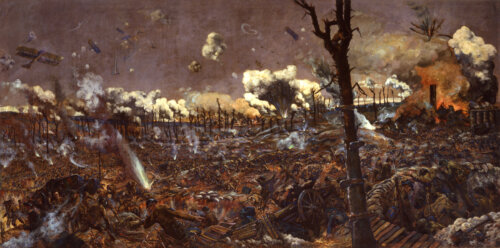
The war art of Jack Nichols includes from top to bottom: Normandy Scene, Beach in ‘Gold’ Area; Drowning Sailor; Troops in Hospital.

Jack Nichols paints people. He has no formal education, but his strong canvases have placed him among the top Canadian artists of his time. He is a classic example of raw talent.

Born in Montreal in 1921, Nichols was orphaned as a child. Consequently, he wasn’t able to afford an education. By the time he was 14, he had worked at a variety of jobs that kept him painting until the money ran out at which point he would find other work and save again for more painting time. He was influenced and encouraged by artists Louis Muhlstock and F.H. Varley.

Nichols, who now resides in Toronto, joined the merchant navy as an ordinary seaman in 1940. Four years later he was appointed an official war artist with the Royal Canadian Navy. He arrived overseas in time to cross the English Channel on D-Day. He remained in Normandy until the fall of Caen and then returned to London to develop his drawing. The impact that the war had on him is clear in his war art.

There is a heaviness to his work. Swirling fabric and dense composition leaves little room for lightness of spirit. The emotion of war is perfectly depicted. Despair drenches his canvases, overwhelming the viewer. Even in the painting Troops in Hospital there is only temporary relief from the threat of death.

Following the war, Nichols won a Guggenheim fellowship for creative painting. This allowed him to travel and paint in the United States for a year. He spent most of the time in the studios of printmakers where he proved his talents as an artist and printmaker.

During the early 1960s, the artist’s health interfered with the time he could devote to painting and drawing; he has only worked intermittently since, but his work serves to remind us of the emotional toll of war.

The Canadian War Museum in Ottawa has 43 Nichols works. Twenty nine of his black and white drawings will be displayed at the museum from April 10 until early September.

Email the writer at: writer@legionmagazine.com

Email a letter to the editor at: letters@legionmagazine.com

Many of the Canadian War Museum’s ­holdings are ­available in reproduction at affordable prices. For more information, contact Image Reproduction Services, Canadian War Museum, 1 Vimy Place, Ottawa, ON K1R 0C2; tel: 1-819-776-8686; fax: 1-819-776-8623; e-mail: Imageservices@warmuseum.ca

Military And Legion Respond To “Bosnia Without The Bullets”


by Ray Dick

It started with a whimper, a dark omen on a weather radar screen that was tracking steadily from the southern U.S. towards the Canadian Great Lakes region, and ended with a crippling bang that caused half a billion dollars damage, at least 20 deaths and left more that a million people without heat, light and transportation in southeastern Ontario,Quebec and New Brunswick.

This is Bosnia without the bullets,” said one soldier, who recently returned from the former Yugoslavia, about the devastation he found in the Montreal area from the worst ice storm in recent history.

The soldier was quoted by Chief of Defence Staff Maurice Baril, on one of several trips he made to areas devastated by the storm that struck in early January.

More than 15,500 troops, including 3,700 reservists, were employed in Operation Recovery, the biggest ever Canadian deployment in peacetime. As they moved into the affected areas they found dark and silent streets in two of the country’s major cities, Ottawa and Montreal, makeshift rescue centres and soup kitchens and rural and urban landscapes strewn with fallen trees and branches and thousands of downed power poles. Shorted-out power lines and collapsing transformers brightened the sky with lightning-like fireworks at the height of the storm.

In Ontario the Forces provided personnel and equipment to support clean-up operations and transportation assistance to shelters in the areas of Ottawa-Carleton, Brockville, Lanark County, Hawkesbury, Perth, Smiths Falls and Kingston.

In Quebec the Forces provided housing and hospital support, assisted Hydro-Quebec in reconstructing high-tension towers, conducted road maintenance and provided logistic support to the affected population and a 100-man military police contingent to patrol against looting in blacked-out Montreal. About 400 personnel from the Atlantic area helped in New Brunswick, mostly around the Saint John area with the main task of brush removal.

A civilian army of hydro workers in Ontario and Quebec toiled long hours, sometimes round the clock, along with the military troops from across the country to restore power as ice storm victims huddled in shelters or strived to survive in unlit and unheated communities with the aid of temperamental generators and donated food, cots and blankets. Hard hit were the maple syrup producers in both provinces who lost most of their maple trees to the relentless buildup of ice and the dairy and beef farmers who were unable to milk and water their livestock.

Three weeks later, as donations of money, food and equipment continued to flood in from across the country and military troops and emergency hydro crews from as far away as the southern United States started a gradual withdrawal to their home bases, there were still pockets of darkness in heavily hit areas south of Ottawa along the St. Lawrence and on the South Shore in Montreal. It was these people, among many others who then had their hydro power returned, whose spirits were lifted by the mere sight of the yellow-helmeted hydro crews in their neighborhoods, of military troops delivering help and comfort to their front doors and the welcoming sight of Royal Canadian Legion members who delivered hot food and opened their branch doors to provide shelter.

Grateful storm victims expressed their appreciation in the letters to the editor page in their local newspapers. Jack MacKinnon of Ottawa writes in the Ottawa Citizen: “After the unfortunate problems of the Somalia operation, the Canadian military has come through magnificently in two recent natural disasters; the Manitoba floods and now the Eastern Canada ice storm…. All this should be realized by those who object to the maintenance of our Armed Forces now that the other Cold War is over, and who have been successfully pressing to have expenditures on the military diverted to other fashionable causes.”

Liz Rohonczy of Kars, a community near Ottawa, writes in The Citizen, that “one can only have the highest praise for the (hydro) workers on the front line. When I see the miles of twisted lines and row upon row of shattered poles around my village, I consider it nothing short of a herculean task to have the power up in the estimated time frame. The flashing lights of the hydro trucks can be seen all across the countryside from dawn to dusk and deep into the night. The crews are working inch by inch, mile by mile, day by day.”

Brenda Otten of Aylmer, Que., writes in the Ottawa Sun: “My ice storm heroes are all the friendly, helpful people at Aylmer Branch. From the first day of the storm they opened their doors to everyone who was without power and needed hot meals, hot coffee and a place to warm up. They even provided take-out meals and coffee for the crews and residents who were not able to come to the Legion.”

In a letter to the editor of The Prescott Journal in Prescott, Ont., senior citizen Louise Mays adds her praise of Fort Wellington Branch: “What a marvelous job they have done providing shelter for all and sundry during the recent ice storm.” Hot food was served and cots were set up, and volunteers went from door to door encouraging the people to come to the Legion for shelter, warmth, hot food and drink. “There was a staff of voluntary drivers to take people wherever it was necessary. A movie was provided for children…and euchre tournaments were held to occupy adults who had taken refuge there.”

“This was a rewarding experience, for Canadian soldiers to help out a Canadian population in need,” commented Major Marc Rouleau, a Bosnia and Croatia veteran who was in charge of some 9,500 emergency military troops in Quebec. “Yes, in many ways it was like Bosnia, the collapsed power pylons and the thousands of people in emergency shelters.”

In Ontario, Maj. Rita LePage was also in the process almost three weeks after the crisis of sending some 5,000 troops back to their home bases in Petawawa and Borden and the hundreds of army reservists “from Windsor to Cornwall, and from Thunder Bay to Ottawa.” She had seen signs of major improvement in the Ontario region, “but there will be troops here to help the storm victims as long as they are required.”

The Legion, along with civic authorities and such organizations as the Salvation Army, was quick to react to the plight of the storm victims. Many branches in the areas affected in both Ontario and Quebec, many of them also without light and power, hooked up generators, provided hot meals and shelter space, and paying for it all from their own resources. As the crisis progressed, Dominion Command offered $25,000 contingency funds for use as called for by Ontario and Quebec commands to assist in relief efforts in the two provinces.

Quebec Command President Ray Thorne acknowledged in a letter the “generous” contribution from Dominion Command and said the money would go to The Royal Canadian Legion Quebec Disaster Relief Fund, “primarily to aid our veterans and members who are in distress (and) also to financially aid those branches that operated shelters, provided meals and generally depleted their own funds in doing so. Many of our branches were successful in doing this and…the Legions in these communities will long be remembered for their generosity and community spirit.”

In Ontario Command an early decision was made to donate $20,000 from the provincial poppy fund to provide relief for victims of the ice storm. The donation was made to the disaster response fund of the Canadian Red Cross, which was working with the federal and provincial governments to co-ordinate the relief effort. Ontario Command Secretary Marlene Lambros told branches in a letter: “For this occasion, Ontario Command branches are authorized to donate up to $1,000 from poppy funds for ice storm disaster relief without the prior approval of provincial command. Sufficient funds should be retained to meet future requests for assistance from veterans and their dependants.”

But it was the swiftness of the branches in both Ontario and Quebec to react to the needs of their communities that will long be remembered by the ice storm victims: branches such as Mallorytown that used a generator to provide about 200 hot meals a day and sleeping accommodation for 100, and the Legionnaires in Prescott and other hard-hit towns and cities between Ottawa and the St. Lawrence and in the villages and towns across the river in Quebec. Even the branches that did not lose their hydro during the crisis, such as the Ottawa suburban branch of Strathcona with about 310 members, contributed to the relief effort. The cook at Strathcona cooked up several roasts and Second Vice Gord Helmer delivered the hot meals to a shelter in Russell.

As usual in a disaster situation, some businesses and individuals made a lasting impression on the long-suffering ice storm victims. At St-Jean-Sur-Richelieu in Quebec a big yellow chicken sign in front of Le Coq Rapide restaurant became a beacon of hope to residents in the otherwise blacked-out town. Using a gas-powered generator, the restaurant sold about 3,000 roast chicken dinners daily to victims tired of the cafeteria-like food in the shelter.

But there is one business, Amber’s Cafe in Hallville south of Ottawa, that will never be forgotten by residents of this farming community. Sue Armstrong, who purchased Amber’s about five years ago and operates the business with her young son, was without power for 12 days but continued to operate the cafe and gave out hundreds of meals free to the storm victims in the community.

“We all needed each other,” said Armstrong. “I had just got in a shipment of bread before the storm. People in the community gave me food that would have spoiled in their refrigerators and freezers. These people in their cold and dark homes needed somewhere to come for a hot meal and companionship. I had a propane stove, grill and pizza oven, and lots of candles for light.” She even sent out food in care packages, delivered by the military troops, to storm-bound residents who couldn’t make it into her cafe.

“The military men deserve the biggest pat on the shoulder ever,” said Armstrong. “They really came through for us, and once they got here they didn’t leave until the power was restored and the crisis was over.”

D-Day At Sea And In The Air: Army, Part 20

The long frustrating debate over the timing and location of a Second Front in Northwest Europe came to an end at the Quebec Conference of August 1943. Winston Churchill, Franklin Roosevelt and their senior military advisers were briefed on the progress of Operation Neptune, the planned assault phase of Operation Overlord. They agreed the invasion of France would take place in May 1944. The planners outlined four conditions that had to be met if the landings were to be successful. First, the enemy must remain ignorant of the actual landing area. Second, the Allies must achieve complete air and naval superiority in and over the English Channel. Third, the local defences must be largely destroyed by air and sea bombardment. Finally, the Allied air forces must prevent the enemy from bringing up reinforcements quickly, especially during the first few days after the landings.Accomplishing these four tasks would not be easy. Fortunately, the Germans were convinced the invasion would take place at the mouth of the Somme River or in the Pas de Calais region opposite Dover. The Allied deception plan to draw attention away from Normandy worked well because the Germans wanted to believe the intelligence they had received about possible landings north of the Seine River. Allied planners used intelligence from Ultra to help track the location of all enemy divisions in France. The same planners were certain the enemy had not identified Normandy as the landing area.

The Allied air forces promoted the deception plan while isolating Normandy from the rest of France. On the eve of the June 6, 1944, invasion, the German army reported that “constant air attacks” had destroyed bridges over the Seine and crippled rail transportation with raids on marshalling yards as far north as Brussels, Belgium. The report concluded that the “concentration of air attacks on coastal defences between Dunkirk and Dieppe…confirmed the focal point of a large-scale landing” in that area.

This deception was an extraordinary achievement, but more remarkable was the enemy’s belief that Normandy was a feint and a second landing would soon take place. As late as July 23, on the eve of the destruction of the German forces in Normandy, German army commanders still believed that the “sector from north of the Somme to the Seine is in great danger.” They refused to transfer infantry divisions to the Normandy battlefront.

The greatest challenge for the Allies seemed to be achieving air superiority. On D-Day the English Channel would be full of slow, vulnerable targets. The 4,126 landing ships and landing craft would be accompanied by 864 merchant ships and 736 ancillary vessels. Most of these would sail at the same time to be marshalled through the narrow shipping channels cleared of mines. The 1,213 Allied warships–the largest modern fleet ever assembled–could fight back against air or naval attack, but in the congested waters in front of the invasion beaches they too would be easy targets for the German air force.

By June 1944 the Allied air forces had more than 13,000 operational aircraft–plus 3,500 gliders–in Britain. Close to 11,590 planes were assigned to protecting the invasion. Long-range-fighter patrols covered much of France while continuous screens of low- and high-altitude fighter-bombers shielded the beaches, the Channel and the assembly areas as far back as the Isle of Wight. All told, 3,700 fighters were committed, including the Royal Canadian Air Force wings of 2nd Tactical Air Force.

The air effort on D-Day was more than sufficient. During the winter of 1943-44 and the following spring, the bomber offensive had reduced the Luftwaffe to a shadow of its former self. The American B-17 and B-24 bombers–escorted by Mustang fighters–had destroyed much of Germany’s day-fighter force. British and Canadian crews of Bomber Command had forced the enemy to divert aircraft and other resources to the defence of Germany. In June 1944, the Luftwaffe had fewer than 200 available aircraft in all of France. “If it’s white, it’s American. If it’s black, it’s British. If you can’t see it, it’s the Luftwaffe” is how German soldiers described the situation. The German air force was completely overwhelmed and air superiority was achieved beyond the Allied planners wildest dreams.

Naval superiority was never really in doubt and historians have taken the navy’s role in the invasion more or less for granted. Canadians have just begun to hear about the exploits of the minesweeping flotilla at Omaha beach or the battle fought by the RCN’s tribal-class destroyers Haida and Huron.

Admiral Bertram Ramsay, the overall naval commander, believed that the underwater mine was the “greatest obstacle to success” in the assault. The RCN agreed to contribute 16 bangor minesweepers to Neptune, but their crews had to be trained to use the serrated line or “sweep” to cut mooring cables and bring the mines to the surface for destruction. On D-Day, 10 RCN bangor minesweepers, which formed the 31st Canadian Minesweeping Flotilla under Commander A.H.G. Storrs, led the United States 1st and 29th divisions towards Omaha beach. Our other minesweepers served with the 4th, 14th and 16th flotillas. The ones that were part of the 14th helped open the path to Gold beach.

Haida and Huron were part of the 10th Destroyer Flotilla that was based in Plymouth. They helped form part of a strike force capable of dealing with the landings. Allied air superiority meant the German navy could operate only at night. However, the German destroyer flotilla, which was based in the Bay of Biscay, was a serious threat. It included two destroyers armed with 5.9-inch guns and eight torpedo tubes. They were larger, faster and packed a heavier punch than even the tribals.

The German flotilla was ordered into action on D-Day, but thanks to Ultra the flotilla’s moments were known and Beaufighter aircraft, including those of 404 Squadron RCAF, kept the destroyers bottled up in the harbor at Brest until June 8. Naval historian Michael Whitby says the bold tactics and persistence of Haida and Huron played a key role in destroying the German flotilla.

British planners, still haunted by their memories of Dieppe, insisted on an enormous air and naval bombardment designed to destroy fortified defensive positions on the coast. On the eve of June 6, Bomber Command employed more than 1,000 aircraft in attacks on 10 coastal batteries in the invasion zone. More than 5,000 tons of bombs, the most yet dropped in a single night, failed to destroy any of the batteries, but some neutralization was achieved. Just three aircraft were lost but one was a Lancaster from 6 Bomber Group RCAF.

The U.S. 8th Air Force arrived over the coast at first light with orders to destroy enemy positions along the beach. Poor visibility meant that pathfinder bomb aimers followed instructions to avoid short bombing and the risk of hitting Allied landing craft. They delayed for up to 30 seconds after the target was identified on radar. The main American concentrations fell well inland leaving the beach defences intact.

The navy took over the counter-battery task and naval guns–assisted by spotter aircraft–were able to complete the neutralization or destruction of all large gun batteries. Unfortunately, the beach defence positions were largely untouched and when the first landing craft arrived the enemy position had to be overcome by infantry supported by tanks.

The elaborate preparations had given the army confidence that the landings could succeed; however, the war diarist of the Royal Winnipeg Rifles only exaggerated a little when he wrote that “the bombardment…failed to kill a single German or silence one weapon.”

The final key to the success of Overlord was to prevent the enemy from counter-attacking the landings or sealing off the beach-head before it could be established in depth. The Germans had stationed just three of their 23 static coastal divisions in the invasion area. However, the powerful 352nd Division had been added to thicken the defence positions near Omaha beach. The 21st Panzer Div., meanwhile, provided a local reserve in the British-Canadian sector. Two other armored divisions, 12th SS and Panzer Lehr, were eight to 12 hours away and other units north of the Seine and Brittany could arrive in the crucial first few days unless Allied air power intervened.

This task of preventing that was the responsibility of 2nd Tactical Air Force and the U.S. 9th Tactical Air Force. 2nd TAF was organized in late 1943 with two composite groups of fighter-bombers, a night-fighter group and one of medium bombers. There were Canadian pilots in many RAF units, but all RCAF fighter squadrons were assigned to 83 Group that was to work closely with the Anglo-Canadian invasion forces.

Apart from 400 Sqdn., which was part of the Photo Reconnaissance Wing, RCAF squadrons in 83 Group were assigned to one of four Canadian fighter wings, 126, 127, 143 and 144. A day- fighter wing consisted of three squadrons of 18 aircraft with a strength of 39 officers and 743 other ranks. 144 Wing was equipped with Typhoon IB fighter-bombers while the other three flew the Spitfire IXB. “Bombphoons” normally carried two 500-pound bombs and were tasked to “provide direct support to the army.”

Spitfires could also carry bombs and frequently did so, but as pilot Hugh Godefroy noted “dive bombing was extremely inaccurate” because “without dive breaks, Spitfires dived so fast that the altimeter went round in a blur.” The pilots could not pull out at exactly 3,000 feet if your instrument could not keep up.

Typhoons were thought to be considerably more accurate in ground attack roles but even here there were serious problems. 2nd TAF created its own operational research section in late 1943 when it became evident that no one knew very much about how to hit relatively small targets.

A study of operations against a viaduct in France that was 500 yards long and eight yards wide revealed that “Bombphoons” scored hits one in 82 times while Typhoons with rockets secured one hit for every 15 fired. Even rocket projectile attacks on gun positions produced discouraging results, varying from 110 strikes at a casement in Courseulles-sur-Mer with zero hits to two hits out of 127 in Fontenay.

Training courses for Spitfire and Typhoon pilots helped improve accuracy against identified targets, but average pilots still had great difficulty in navigating and locating targets. As one tactical memorandum put it: “Fighters, given a six-figure map reference, were unable to spot well camouflaged guns even when the guns were firing.” All of this meant that the tactical air forces were being called upon to perform tasks for which they were not properly equipped. On D-Day the weather further hampered ground-attack operations and those German divisions ordered to the beach-head were able to take advantage of the low cloud cover.

The 12th SS Hitler Youth Div., which had been delayed by confusion and uncertainty, began its advance in the early afternoon of June 6. To minimize losses, vehicles were camouflaged and ordered to maintain 100-metre intervals, but in the late afternoon air attacks disrupted the cohesion of the columns and slowed their advance to a crawl. By the end of that day, 12th SS had suffered 83 casualties, including 22 dead. No tanks had been hit, but none reached the battlefield.

Panzer Lehr, which had much further to travel, did not start its march until the evening. Darkness saved it from continuous attack but by the next morning the two approaching columns were repeatedly strafed, bombed and rocketed. Losses included a large number of soft-skinned vehicles and four tanks, but the tactical air force’s most important contribution was to delay the panzers.

When the division reached the front on the morning of June 8, the 7th Cdn. Infantry Brigade had secured control of the Caen-Bayeux highway and railway line, while British 50th Div. had captured Bayeux. The Allies had secured their beach-heads and were moving quickly to link them together.

Canadian and British squadrons had also demonstrated the meaning of air superiority to the soldiers fighting through the Atlantic Wall. No German aircraft attacked the landings on D-Day and on June 7 when more than a dozen Ju 88s tried to break through to bomb the beaches, pilots of 401 Ram Sqdn. destroyed six and forced the remainder to flee.

The limits of air power were evident, however, when Germany’s 346 Div.–the only unit transferred to the battlefield from north of the Seine–crossed the river and bicycled towards the airborne bridgehead east of the Orne River without interference.

The divisions sent from Brittany to the American sector also reported only minor delays and losses due to Allied air power. The tactical air forces had helped to prevent any serious counter-attacks on D-Day, but they could not stop the enemy from sending enough additional troops to seal off the beach-head. By June 10 the Germans had established a new defensive perimeter that forced the Allies to fight a battle of attrition within sight of the Normandy coast.

The battle would continue to be influenced by Allied air and naval power. On June 7, the North Nova Scotia Regt. and the Sherbrooke Fusiliers ran into the 12th SS near l’Abbaye d’Ardennes. The German counter-attack was broken up by the guns of HMS Belfast which saturated the enemy with tons of high explosive.

On June 12 General Erwin Rommel reported that naval gunfire was so strong that “operations with infantry or panzer formations in the area commanded by this quick-firing artillery is not possible.” Rommel urged Hitler to permit a withdrawal out of range of the warships but the Fuhrer would not allow ground to be given up.

Rommel was equally concerned about the long-term effect of Allied air power. “The enemy,” he wrote “has complete control of the air over the battlefield and up to 100 kilometres behind the front…movements of our troops in the battle area by day are almost completely prevented, while the enemy can operate freely. Neither our flak nor the Luftwaffe seems to be in a position to check this crippling and destructive operation of the enemy air force…”

The Battle of Normandy could not be won by air or naval power, but the air force and navy helped establish the pre-conditions for victory.